
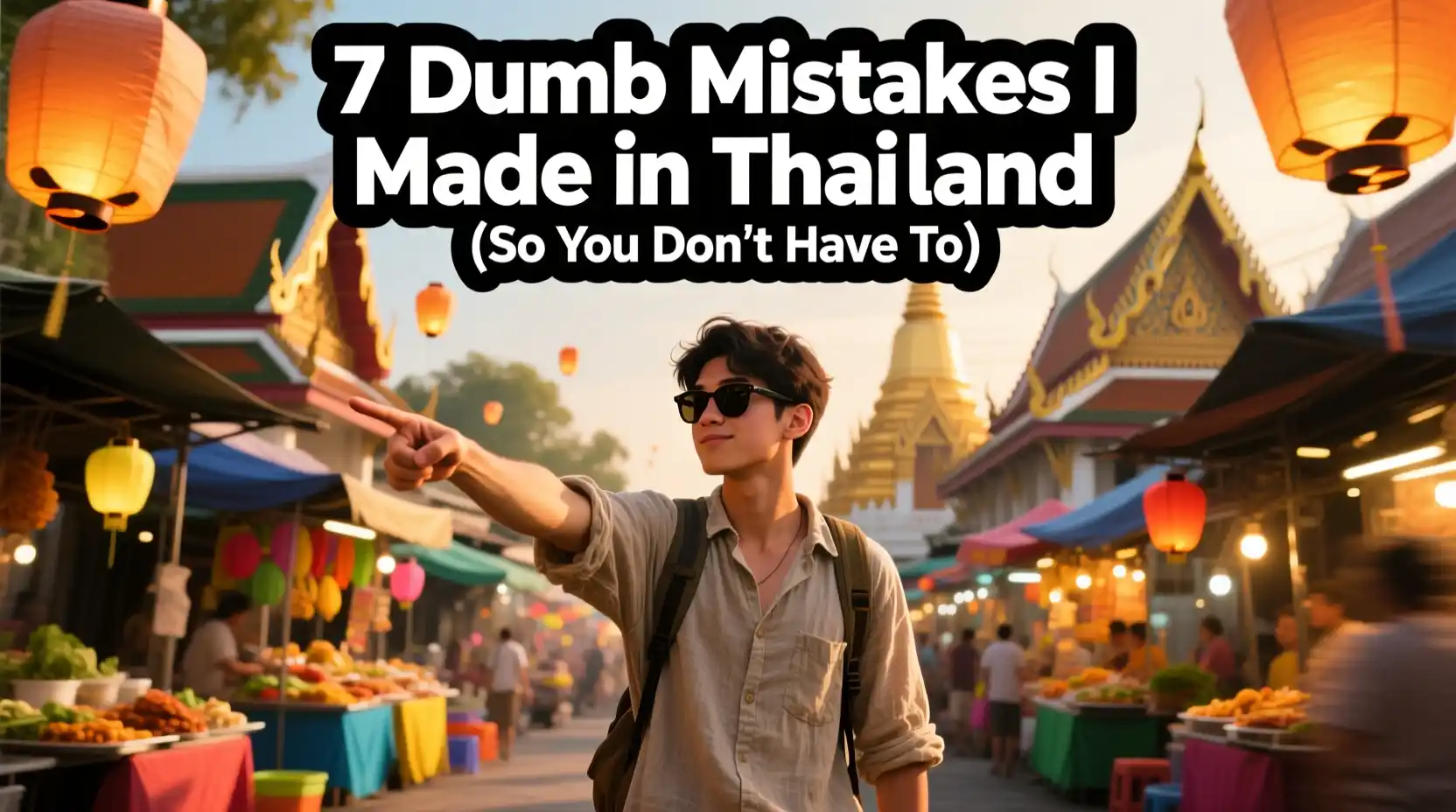
7 Dumb Mistakes I Made in Thailand (So You Don’t Have To)
7 Dumb Mistakes I Made in Thailand (So You Don’t Have To): A Guide to Not Being a ‘Farang’ Fool
The first time I set foot in Thailand, I was a textbook cliché. I was armed with a Lonely Planet guide that was already two years old, a backpack stuffed with clothes I’d never wear, and a head full of romanticized visions from movies like The Beach and Eat Pray Love. I pictured myself drifting on a longtail boat towards a limestone karst, a gentle breeze rustling my hair as a golden sunset painted the sky. I saw myself sitting cross-legged in a serene temple, achieving enlightenment with the help of a wise, smiling monk. I imagined myself a savvy, worldly traveler, effortlessly navigating the vibrant chaos of Bangkok’s streets.
The reality, as it often is, was a bit different. It was more sweat, more confusion, and a significantly larger dent in my wallet than I had anticipated. It involved getting spectacularly lost, eating a dish that felt like a volcano erupting in my mouth, and being scammed not once, but twice, by the same charming tuk-tuk driver.
Don’t get me wrong. Thailand was, and remains, one of the most incredible, life-affirming places I have ever visited. It is the Land of Smiles for a reason. But beneath that veneer of tropical paradise and easy-going hospitality lies a complex, deep, and nuanced culture. And it’s a culture that will happily hand you your own foolishness on a platter if you come unprepared.
This isn’t a guide to the “best” temples or the “hidden” beaches. You can find those anywhere. This is a confession. It’s a deep, embarrassing, and painfully honest dive into the seven dumbest mistakes I made during my first few months in Thailand. My hope is that by laying my own naivety bare, I can save you the money, the embarrassment, and the stomach cramps. This is the guide I wish I’d had. It’s the ultimate field manual for navigating Thailand not just as a tourist, but as a respectful, prepared, and genuinely happy traveler.
So, grab a Chang (or a Leo, if you’re feeling classy), settle in, and let’s begin. Here are the seven dumb mistakes I made in Thailand, so you don’t have to.
Mistake #1: I Was a Financial Idiot – The Cash, Card, and Exchange Catastrophe
The Dumb Move
I landed at Suvarnabhumi Airport (BKK) in a haze of jet lag and excitement. My first order of business, after fighting my way through immigration, was money. I remembered reading something about ATMs being the best option. So, I strolled up to the first gleaming machine I saw, stuck my debit card in, and requested the maximum withdrawal. A few moments later, a wad of crisp thousand-baht notes spat out. Success! I felt like a financial genius. I then proceeded to use my credit card for almost everything else – hotels, big meals, train tickets. I was modern, I was cashless, I was… completely wrong.
Why I Made It
It was a combination of laziness and a false sense of security. Back home, I use my card for everything. It’s convenient, I get points, and I can track my spending. I assumed Thailand would be the same, just with better weather. I saw the airport ATM as a one-stop-shop and didn’t give it a second thought. The idea of hunting down a specific currency exchange counter felt like a relic from a bygone era of travel. I was a 21st-century traveler, dammit.
The Painful Consequences
The consequences were slow, insidious, and hit my wallet from three different angles:
- The ATM Assault: When I checked my bank statement a week later, I wanted to cry. Not only had my home bank charged me a $5 foreign transaction fee, but the Thai ATM bank had slapped me with their own 220 baht (around $6) fee. On top of that, the exchange rate used by the ATM was the standard, interbank rate, which is almost never the best. I was losing nearly $12 on every single withdrawal, and I was making a lot of them.
- The Credit Card Con: Many places in Thailand, especially smaller guesthouses, local restaurants, and market stalls, add a 3% surcharge for using a credit card. I blissfully signed receipts, not realizing that my 500-baht meal was actually costing me 515 baht. Over a month, that adds up. More importantly, by relying on my card, I was missing out on the entire cash-based economy and the cultural experience of haggling and paying with colorful local currency.
- The “Dynamic Currency Conversion” Trap: A few times, my card machine would prompt me with a question: “Pay in your home currency (USD) or Thai Baht (THB)?” Thinking I was being smart by seeing the price in dollars, I always chose USD. This is a sneaky trick called Dynamic Currency Conversion (DCC). The merchant sets their own, abysmal exchange rate, which is always far worse than the rate your own bank would provide. I was voluntarily paying a premium for the “convenience” of seeing a familiar currency symbol. I was getting fleeced, and I was thanking them for it.
The Deep Dive: How to Master Money in Thailand
Let’s get this right, because it’s the foundation of your entire trip. Getting your money sorted in Thailand isn’t just about saving a few bucks; it’s about freedom, flexibility, and not having a minor panic attack every time you check your bank balance.
Part A: The Golden Rule – Cash is King, But Not All Cash is Equal
While major hotels, high-end restaurants, and malls in Bangkok and Chiang Mai readily accept cards, the heart and soul of Thailand runs on cash. That street food stall making the world’s best Pad Thai? Cash only. That charming beach bungalow on Koh Lanta? Cash only. That tuk-tuk driver who just quoted you a ridiculously high price? He’ll only laugh if you try to tap a card.
You need cash. But where you get it is the most important financial decision you’ll make.
- AVOID: Exchanging money at your home airport before you leave. The rates are universally terrible. Also, avoid the airport exchange counters in Thailand. While convenient, their rates are significantly lower than what you can get in the city. They are a last resort.
- GOOD: Using an ATM. This is a solid, reliable option, but we need to optimize it. Look for ATMs linked to major banks like Kasikornbank (K-Bank), Bangkok Bank, or Siam Commercial Bank (SCB). They are less likely to have skimming devices. The 220 baht fee is now standard for almost all foreign cards, so factor that into your budget. To minimize fees, withdraw the maximum amount allowed per transaction (usually 20,000-25,000 baht). It’s better to pay one 220-baht fee for 20,000 baht than two fees for 10,000 baht each.
- THE BEST (The “Super Rich” Method): This is the pro-level move. There is a chain of currency exchange booths in Thailand called “Super Rich” (and its competitor, “Super Rich Thailand”). These are not your typical dodgy exchange counters. They are large, professional, and consistently offer the absolute best exchange rates in the country, often even better than the interbank rate you see on Google. They are the gold standard.
- Where to find them: The most famous branches are in Bangkok. There’s a huge one near the CentralWorld shopping mall, another on the walkway between the Chit Lom BTS station and Siam Paragon, and several others in high-traffic tourist areas. There are also some at the airport, but the ones in the city are known to have slightly better rates.
- How to use them: Bring your home currency in clean, undamaged bills. They can be picky about torn or marked notes. The process is simple: you go to the counter, state how much you want to exchange, they show you the rate and the final amount you’ll receive, and you hand over the cash. It’s fast, secure, and you’ll walk out feeling like a financial wizard.
Part B: The Plastic Strategy – Using Cards Wisely
Cards are still useful, but you need a strategy.
- Get the Right Cards: Before you leave, talk to your bank. Look for a credit card and a debit card that have:
- No Foreign Transaction Fees: This is crucial. Many premium travel cards waive the standard 3% fee. This alone will save you a fortune.
- Low or No ATM Withdrawal Fees: Some banks, particularly online ones or credit unions, have partnerships with international banks or will reimburse your ATM fees. Charles Schwab Investor Checking is a famous example in the US for this. If you have one of these, the Thai bank’s 220-baht fee is the only one you’ll pay.
- Embrace Digital Banks: Consider getting an account with a digital bank like Revolut, Wise (formerly TransferWise), or N26. These services are designed for international travel. You can hold multiple currencies in the app, and they use the real mid-market exchange rate when you spend or withdraw. They often have low or no fees for ATM withdrawals up to a certain limit each month. This is a game-changer.
- ALWAYS Choose to Pay in Thai Baht (THB): When the card machine asks if you want to pay in your home currency or Thai Baht, ALWAYS, ALWAYS, ALWAYS CHOOSE THAI BAHT. This is the DCC trap. By choosing the local currency, you ensure that the transaction is processed through the Visa/Mastercard network, and your own bank applies its (hopefully good) exchange rate. Choosing your home currency lets the merchant set the rate, and it will never be in your favor.
Mistake #2: I Treated Transportation Like a Free-for-All – The Tuk-Tuk, Taxi, and Train Tangle
The Dumb Move
My vision of Bangkok transportation was, of course, the iconic tuk-tuk. I imagined zipping through traffic, the wind in my hair, a symphony of honking horns creating a vibrant soundtrack. So, on my first day, I flagged one down. “Grand Palace?” I asked. The driver, a man with a gleaming smile, nodded enthusiastically. “For you, special price! 500 baht!” I, having no frame of reference, thought, “Sounds reasonable!” and hopped in. He didn’t take me directly to the Grand Palace. Instead, he took me to a “government-approved” gem shop. Then a tailor shop. Then another gem shop. The “special price” included a commission-based tour of Bangkok’s least interesting tourist traps.
Why I Made It
Pure, unadulterated naivety. I was a walking, talking dollar sign with a backpack. I saw the tuk-tuk as a fun, quintessential experience, not as a business transaction. I didn’t understand the concept of a fixed meter price versus a negotiated price. I assumed that because he was a driver, his job was to drive me where I wanted to go. I failed to realize that for many tuk-tuk drivers, their real job is to be a commission-based salesperson, and driving is just the method.
The Painful Consequences
I lost half a day of my precious vacation time being shuttled between shops I had no interest in. I felt pressured and uncomfortable. I paid five times the going rate for a journey that took three times as long as it should have. Worst of all, it created a cynical and distrustful mindset in me for the first few days. I started viewing every local who approached me as a potential scammer, which is a terrible way to experience a new country.
The Deep Dive: A Transport Masterclass for Thailand
Getting around Thailand can be cheap, efficient, and even fun, but you need to know the rules of the road for each mode of transport.
Part A: The Tuk-Tuk – Understanding the Scam
Let’s be clear: you can have a good tuk-tuk experience. But you must go into it with your eyes wide open.
- The “Scam” Explained: The most common scam is the “20-baht tuk-tuk tour.” A driver will offer you an unbelievably cheap ride (e.g., 20-40 baht) to see a major attraction. The catch? He must stop at one or more “sponsor” shops along the way—a gem store, a tailor, a travel agency. He gets a petrol voucher or commission for every tourist he delivers, regardless of whether you buy anything. You waste your time, and he gets his reward.
- How to Avoid It:
- NEVER agree to a “cheap” ride from a tuk-tuk driver who approaches you, especially near major tourist sites like the Grand Palace or Wat Pho.
- Always negotiate the price before you get in. And be firm. A short tuk-tuk ride (e.g., 1-2 km) should cost around 60-100 baht, depending on traffic and your haggling skills. Anything more is a tourist price.
- State your destination clearly and ask, “No other stops, yes?” or “Direct to [destination], meter price?” (They don’t have meters, but it shows you know the deal).
- The Golden Rule: The best use for a tuk-tuk is for a short, fun ride where you’ve already agreed on a fair price and you’re not in a hurry. For serious, point-to-point travel, there are better options.
Part B: The Taxi – The Meter is Your Best Friend
Taxis in Bangkok are abundant and, when used correctly, excellent.
- The “Taxi Scam”: A taxi driver will refuse to use the meter and instead quote you a fixed, inflated price. This is most common at airports, outside tourist hotels, and during rush hour or when it’s raining.
- How to Avoid It:
- ALWAYS insist on the meter. When you get in, just say your destination and the word “meter.” If they shake their head or quote a price, just say “no, thank you” and get out. There will be another taxi along in 30 seconds. Do not feel bad about this. It’s not rude; it’s standard procedure.
- Hail moving taxis. A taxi that is already driving is more likely to use the meter than one parked at a stand.
- Have your destination written in Thai. This helps overcome language barriers and ensures you’re going to the right place.
- Pay what’s on the meter, plus a small tip. Rounding up to the nearest 10 or 20 baht is standard and appreciated.
Part C: The Modern Saviors – Grab & Bolt
If you want to avoid all the hassle and negotiation, ride-sharing apps are your godsend.
- Grab: This is the “Uber of Southeast Asia.” It’s everywhere in Thailand. You can use the app to book a car (GrabCar), a bike (GrabBike), or even a taxi (GrabTaxi). The price is fixed upfront, there’s no haggling, and the payment is cashless or cash-based, depending on your preference. It removes 99% of the potential for being scammed.
- Bolt: A European competitor to Grab, often slightly cheaper. It’s worth having both apps to compare prices.
- Why They Are Great: They are perfect for longer journeys, airport transfers (you can select a larger vehicle), and for anyone who just wants a stress-free experience. The only downside is that in some very central areas of Bangkok, they can’t pick up right on the main street due to regulations, so you’ll have to walk to a nearby alley (a ‘soi’).
Part D: The Public Transport Champions – BTS & MRT
For navigating Bangkok’s gridlock, the Skytrain (BTS) and Metro (MRT) are unbeatable.
- BTS (Bangkok Mass Transit System): This is the elevated Skytrain. It’s clean, air-conditioned, fast, and easy to navigate. It covers most of the major shopping districts (Siam, Sukhumvit) and tourist areas. It’s the best way to travel long distances across the city.
- MRT (Mass Rapid Transit): This is the underground subway. It’s equally clean and efficient and intersects with the BTS at key stations like Asok and Siam. It’s great for reaching areas like Chatuchak Market and Hua Lamphong Railway Station.
- How to Use Them: Buy a stored-value card (Rabbit Card for BTS, MRT Plus Card for MRT) at any station. It saves you from queueing for single-journey tickets every time. Just tap in and tap out. The maps are in English, and the announcements are in both Thai and English. They are a tourist’s best friend for beating the traffic.
Mistake #3: I Was a Cultural Clod – Insulting Monks, Royalty, and Everyone In Between
The Dumb Move
I was at Wat Pho, marveling at the giant Reclining Buddha. It was hot, I was tired, and I wanted a good photo. I saw a beautiful, ornate statue of a Buddha and, without thinking, I plopped myself down on the base of it, pointing my feet directly towards the Buddha’s face to get a comfortable position. I then leaned back, propping my foot up on the ledge for a casual, artsy shot. A monk walking by gave me a look that wasn’t a smile. It was a look of profound disappointment. I was confused. What did I do?
Why I Made It
Pure, blissful ignorance. I was so wrapped up in my own experience as a tourist that I completely forgot I was a guest in a sacred space. My cultural reference point was Western: a statue is a piece of art, a bench is for sitting, a foot is just a foot. I had done zero research on Thai etiquette, especially religious etiquette. I assumed that as long as I wasn’t loud or destructive, I was being respectful. I was wrong.
The Painful Consequences
In that moment, I didn’t cause an international incident, but I was deeply disrespectful. I contributed to the stereotype of the entitled, clueless farang (the Thai word for Westerner). I probably offended that monk and any other Thais who saw me. The real consequence was internal: a deep sense of shame and embarrassment that lingered. It was a wake-up call that travel isn’t just about seeing things; it’s about understanding and respecting the culture that created them.
The Deep Dive: A Crash Course in Thai Culture and Etiquette
Thailand is a Buddhist country with a deep reverence for the monarchy and a social structure based on respect. Understanding a few key principles will not only stop you from making a fool of yourself but will also endear you to the local people.
Part A: The Sacred Trinity – Monks, Buddha, and the King
- The Monarchy: The King and the Royal Family are deeply revered in Thailand. They are seen as the moral and spiritual heart of the nation.
- NEVER say anything disrespectful about the King or the Royal Family. This is not just a social taboo; it’s a criminal offense (lèse-majesté) and is taken extremely seriously. Jokes are a very bad idea.
- ALWAYS stand for the Royal Anthem, which is played in cinemas before a film and in some public places at 8 am and 6 pm. Just follow what the locals are doing.
- NEVER step on a coin or a banknote. The King’s image is on all Thai currency. Stepping on it is the ultimate sign of disrespect. If you drop money, pick it up carefully.
- Buddhism and Monks: Religion is woven into the fabric of daily life.
- Monks: Monks are highly respected. Women should never touch a monk or hand anything directly to them. If a woman wants to give something to a monk, she must either place it down for him to pick up or pass it to a man to give to him.
- Temples (Wats): Temples are sacred places, not museums.
- Dress Code: This is non-negotiable. Both men and women must cover their shoulders and knees. No tank tops, no short shorts, no revealing clothing. Many major temples (like the Grand Palace and Wat Phra Kaew) are extremely strict and will refuse entry if you are not dressed appropriately. It’s a good idea to carry a sarong or scarf with you to cover up.
- Shoes: You must remove your shoes before entering any temple building (the main prayer hall, smaller shrines, etc.). Look for where other people have left their shoes.
- The Buddha: Treat all images of the Buddha, big or small, with the utmost respect. Never climb on a Buddha statue. Don’t turn your back directly on a major Buddha image to take a selfie; it’s considered more polite to crouch down.
Part B: The Unspoken Rules – Head, Feet, and the “Wai”
- The Head is Sacred: In Thai Buddhist culture, the head is the most sacred part of the body.
- NEVER touch a Thai person on their head, not even a child’s hair. Ruffling a kid’s hair, a common sign of affection in the West, is highly inappropriate in Thailand.
- The Feet are Lowly: The feet are considered the lowliest part of the body, both physically and spiritually.
- NEVER point your feet at anyone, especially at a Buddha statue or a monk.
- NEVER rest your feet on a table or chair.
- When sitting on the floor, try to tuck your feet underneath you or to the side, away from people.
- Be mindful of how you step over people or food.
- The “Wai” (ไหว้): This is the traditional Thai greeting, a prayer-like gesture with a slight bow. You will see it everywhere. As a foreigner, you are not expected to initiate a wai, but you should absolutely return one.
- How to Return a Wai: When someone offers you a wai (a shopkeeper, a hotel receptionist, a new acquaintance), simply press your palms together in front of your chest and give a slight bow. You don’t need to be as elaborate as they are.
- The Rule of Thumb: The higher the hands and the deeper the bow, the more respect is being shown. You’ll see Thais give a very high wai to monks and elders. Don’t try to match this. A simple, chest-level wai is the perfect respectful response from a visitor.
Part C: The Social Graces – Smiling, Saving Face, and Shouting
- The Land of Smiles (But Not All Smiles are Equal): Thais smile a lot, but it doesn’t always mean they are happy. A smile can be an apology, a way to defuse a tense situation, a sign of embarrassment, or a polite way of saying “no.” Don’t misinterpret a smile during a negotiation or a problem as a sign that they aren’t taking you seriously.
- Saving Face: This is a cornerstone of Thai culture. It means avoiding confrontation, embarrassment, and causing others to lose dignity. Getting angry, raising your voice, or being overly direct is deeply counterproductive. It makes everyone involved lose face.
- The Golden Rule: Stay calm, be polite, and keep a smile on your face, even when you’re frustrated. A quiet, polite, “mai pen rai” (never mind, it’s okay) can solve more problems than an angry shout. If you have a serious complaint, ask to speak to a manager quietly and privately.
- Public Displays of Affection: While common in the West, overt public displays of affection are frowned upon in traditional Thai society. Holding hands is generally fine, but passionate kissing should be saved for private spaces.
Mistake #4: I Was a Food Fool – Fearing the Street and Ignoring the Spice
The Dumb Move
My first few days in Thailand were a culinary disaster. I was terrified of street food. My Western-bred brain saw a cart on the sidewalk, a wok over a flaming gas tank, and a tub of mysterious meat sauce, and all I could think was “salmonella,” “E. coli,” and a very unpleasant toilet-bound future. So, I ate exclusively in “safe” Western-looking cafes and hotel restaurants. My meals were bland, expensive, and utterly forgettable. Then, on day four, feeling brave, I ordered a Pad Thai from a street vendor. To prove I was a seasoned traveler, I confidently told the vendor, “Pet pet!” (Thai for “very spicy”). The vendor raised an eyebrow but nodded. What arrived was a nuclear-red, searingly hot plate of noodles that felt like a chemical weapon in my mouth. I spent the next ten minutes sweating, crying, and chugging water, which only made it worse.
Why I Made It
It was a paradox of fear and ego. The fear was irrational, based on stereotypes rather than reality. The ego was the classic “I can handle it” bravado of a tourist trying to prove something. I didn’t understand that Thai spice is not just about heat; it’s about a complex balance of flavors. And I certainly didn’t know how to properly order food to suit my own (then-nonexistent) tolerance.
The Painful Consequences
I missed out on some of the best food of my life during those first few days. I denied myself the true heart of Thai culture, which is inextricably linked to its street food. The “pet pet” incident left me physically miserable and humbled. I learned the hard way that “spicy” in Thailand is on a completely different level than “spicy” at a Thai restaurant back home.
The Deep Dive: How to Eat Like a King (or Queen) in Thailand
Thai food is a religion. To truly experience Thailand, you must embrace its culinary landscape. This means conquering your fear of street food and learning to speak the language of spice.
Part A: Conquering the Street Food Fear
Street food in Thailand is not just cheap; it’s often fresher, safer, and more delicious than restaurant food. Here’s why and how to do it safely.
- Why It’s Safer Than You Think:
- High Turnover: The best stalls are busy. A high volume of customers means the food is cooked fresh and doesn’t sit around for long. Look for stalls with lots of locals lined up.
- Open-Air Cooking: You can see everything. You can see the cook’s hands, the ingredients, and the wok. It’s a transparent process. A dirty-looking stall or a cook with poor hygiene is an easy red flag to spot.
- High Heat: That flaming wok is a sterilizing machine. The food is cooked at incredibly high temperatures, killing off most bacteria.
- How to Choose a Safe Stall:
-
- Follow the Locals: This is the number one rule. If a stall is packed with Thais, especially office workers at lunchtime, you can be 99% sure it’s good and safe.
- Look for Fresh Ingredients: Can you see the fresh vegetables, raw meat, and live seafood? Are they on ice or in a cool box? Is the vendor’s workspace relatively clean?
- Check the Cookware: Does the wok look clean? Are the plates and utensils being washed (or at least rinsed) regularly?
- Trust Your Gut: If a stall looks or feels “off” for any reason, just walk away. There are a million other options.
Part B: Mastering the Art of Spice
Thai cuisine is a delicate balance of four fundamental flavors: sweet, sour, salty, and spicy. “Spicy” doesn’t just mean “hot.” It comes from fresh chilies and chili paste, which add flavor, not just pain.
- The Spice Scale: Don’t just say “spicy.” You need to be specific.
- Mai Pet (ไม่เผ็ด): Not spicy. This is your safe starting point.
- Pet Nit Noi (เผ็ดนิดหน่อย): A little bit spicy. This is the perfect level for most beginners. It adds a gentle warmth without overwhelming the other flavors.
- Pet (เผ็ด): Spicy. This is a moderate, respectable level of heat that most Thais would consider normal.
- Pet Pet (เผ็ดเผ็ด): Very spicy. You’re entering the danger zone here. This is for people who know what they’re doing.
- Pet Mak Mak (เผ็ดมากมาก): The hottest of the hot. Only order this if you want to challenge a local or hate your own taste buds.
- How to Order: When you order, just add your preferred spice level. “Pad Thai, mai pet, khrap/ka” (Pad Thai, not spicy, thank you – khrap for men, ka for women). Vendors are used to this and will happily adjust the heat for you.
Part C: Beyond Pad Thai – A “Must-Try” Starter Kit
Pad Thai is great, but it’s just the beginning. Dive into these incredible dishes:
- Som Tum (ส้มตำ): A spicy and sour green papaya salad. It’s a flavor explosion. Ask for “mai pet” if you’re not a chili-head.
- Tom Yum Goong (ต้มยำกุ้ง): The famous hot and sour soup with shrimp. It’s fragrant with lemongrass, galangal, and kaffir lime leaves.
- Gaeng Ped (แกงเผ็ด): Red curry. A rich, coconut milk-based curry with your choice of meat (chicken – gai, pork – moo, beef – neua). Order it with a side of jasmine rice (khao suay).
- Khao Soi (ข้าวซอย): A specialty of Northern Thailand (Chiang Mai). It’s a creamy, coconut-based curry soup with egg noodles, chicken or beef, and topped with crispy noodles. It’s pure comfort food.
- Moo Ping (หมูปิ้ง): Grilled pork skewers. You’ll find these on every street corner in the morning and evening. They’re sweet, savory, and the perfect cheap snack.
- Mango Sticky Rice (ข้าวเหนียวมะม่วง): The ultimate dessert. Sweet, sticky glutinous rice soaked in coconut milk, served with fresh, ripe mango. It’s heaven on a plate.
Part D: The “What If” – Dealing with “Bangkok Belly”
Sometimes, despite all precautions, your stomach might protest. It’s often just a reaction to different bacteria and spices, not necessarily food poisoning.
- Prevention: Drink only bottled water. Be cautious with ice (in reputable places it’s usually made from filtered water, but in very rural stalls it can be iffy). Consider taking probiotics before and during your trip.
- The Cure: If you do get an upset stomach, rehydration is key. Oral rehydration salts (available at any pharmacy) are your best friend. Stick to a bland diet of rice and bananas for a day. Imodium can help with symptoms, but if it’s severe or lasts more than a day or two, don’t hesitate to go to a pharmacy or clinic. Thai healthcare is excellent and affordable.
Mistake #5: I Tried to Cram a Continent into a Two-Week Itinerary – The “If It’s Tuesday, This Must Be Phuket” Fiasco
The Dumb Move
I had two weeks. My plan was ambitious, to say the least. I was going to “do” Thailand. My itinerary looked something like this: Fly into Bangkok (3 days), overnight train to Chiang Mai (2 days), flight to Phuket (3 days), ferry to Koh Phi Phi (2 days), ferry to Krabi (2 days), fly back to Bangkok for one last night before flying home. I was going to see temples, trek in the jungle, party on the beach, and go island hopping. I was going to do it all.
Why I Made It
The classic “fear of missing out” (FOMO). Thailand has so much to offer, and I wanted to see all of it. I looked at a map and thought, “Oh, it’s not that far.” I completely underestimated the sheer exhaustion of constant travel. I was treating the country like a checklist, not a place to be experienced.
The Painful Consequences
I was exhausted. I spent more time in transit—in airports, on planes, on buses, on ferries—than I did actually enjoying any single place. I was constantly packing and unpacking. I never felt settled or relaxed. I saw a lot, but I experienced very little. I remember sitting on a beautiful beach in Koh Phi Phi, but instead of enjoying it, I was stressing about catching the next ferry to Krabi. I had a whirlwind tour of bus stations and hotel lobbies, but I barely scratched the surface of Thai culture. It was a frantic, stressful, and ultimately superficial trip.
The Deep Dive: The Art of the Slow and Meaningful Itinerary
The single most important piece of advice I can give you for traveling in Thailand is this: SLOW DOWN. Less is more. The quality of your experience is inversely proportional to the number of places you visit.
Part A: The Reality of Travel Times
Thailand is a big country. What looks like a short hop on a map can be a full-day ordeal.
- Air Travel: Flying is fast, but you have to factor in getting to the airport (often an hour or more from the city center), checking in 2 hours early, the flight itself, deplaning, getting a taxi from the destination airport, and checking into your new hotel. A one-hour flight can easily consume 5-6 hours of your day.
- Train Travel: Trains are a great way to see the countryside, but they are slow. The overnight train from Bangkok to Chiang Mai is a 12-14 hour journey.
- Bus Travel: Buses can be efficient for long distances, but they can also be slow and subject to traffic.
- Ferries: Island hopping is not as seamless as it seems. Ferries can be delayed, canceled due to weather, or incredibly crowded. A journey from one island to another can take 3-4 hours, plus waiting time at the dock.
Part B: Building a Better Itinerary – The “Hub and Spoke” Model
Instead of zigzagging across the country, pick one or two “base” locations and explore the surrounding areas from there. This is the “hub and spoke” model.
- Example 1: The Classic 2-Week Trip
- Days 1-6: Bangkok Hub. Stay in Bangkok. Use it as a base to take day trips. You can do a day trip to Ayutthaya (the ancient capital), a day trip to the Damnoen Saduak floating market, or a day trip to Kanchanaburi (Bridge on the River Kwai). This way, you only unpack once.
- Days 7-13: Chiang Mai Hub. Fly from Bangkok to Chiang Mai. Stay in Chiang Mai. Use it as a base to explore Northern Thailand. You can do a multi-day trek into the hills, visit an elephant sanctuary (an ethical one!), take a cooking class, and explore the city’s incredible temples.
- Day 14: Fly from Chiang Mai back to Bangkok for your flight home.
- Example 2: The Beach-Focused 2-Week Trip
- Days 1-3: Bangkok. Arrive, get over your jet lag, see the main sights (Grand Palace, Wat Pho).
- Days 4-13: Krabi/Phuket Hub. Fly from Bangkok to Krabi. Pick a base in either Ao Nang (Krabi) or a quieter beach on Phuket (like Kata or Karon, avoiding Patong if you’re not into the party scene). From this hub, you can take day trips to Railay Beach, the Phi Phi Islands, James Bond Island, and go kayaking in mangrove forests. You get to see the islands but sleep in the same comfortable bed every night.
- Day 14: Fly back to Bangkok.
Part C: The Power of Downtime
Don’t schedule every minute of every day. The best travel moments often happen when you have no plans at all.
- Schedule “Nothing” Days: Build in days where you have absolutely nothing planned. Sleep in. Read a book by the pool. Wander aimlessly through a neighborhood you’ve never explored. Find a cafe and just people-watch. This is when you recharge and when you have those serendipitous, authentic travel experiences.
- Embrace Spontaneity: If you fall in love with a place, stay longer. If you’re not feeling a city, leave early. Your itinerary is a suggestion, not a prison sentence. Having a slower pace gives you the flexibility to follow your instincts.
Mistake #6: I Was a Scam Magnet – Falling for the Gem, the Tailor, and the “Closed Temple” Trick
The Dumb Move
This is a collection of hits, not just one. I was walking towards the Grand Palace when a friendly, well-dressed Thai man approached me. “Ah, hello! Where are you going?” he asked in perfect English. “The Grand Palace,” I said. “Oh, I am so sorry,” he said with a pained expression. “It is closed. Special Buddhist ceremony today. Only for Thai people.” My heart sank. But then, his face brightened. “But! Today is a special day for the government. The Thai Gem and Jewelry Export Promotion is having a one-day-only tax-free sale for foreigners. I can take you there in a tuk-tuk for a very cheap price! It is a great opportunity.” Believing every word, I hopped in his recommended tuk-tuk and was taken to an air-conditioned “government” gem shop, where a smooth-talking salesman tried to sell me a “priceless” sapphire for a “bargain” $3,000. A week later, a different “helpful” local told me the main post office was closed for a holiday, but a “special” tailor shop nearby was open and offering custom-made suits for an incredible price. I went. The suits were cheap polyester.
Why I Made It
I was a victim of my own politeness and desire to be a “good guest.” These scammers prey on that. They are friendly, plausible, and seem to be going out of their way to help a lost tourist. They create a sense of urgency and exclusivity (“one-day-only sale,” “special holiday”). I wanted to believe them because they were being so nice. I was also completely unaware of the classic, well-worn scams that operate in Bangkok.
The Painful Consequences
I wasted time and energy. I was put in high-pressure sales situations that were uncomfortable and difficult to extract myself from. While I didn’t buy the sapphire (a small miracle), I did buy a terrible suit that fell apart after one wearing. The biggest consequence was a deep-seated paranoia. For the rest of my trip, I was suspicious of any Thai person who tried to talk to me, which robbed me of countless potential genuine interactions.
The Deep Dive: A Field Guide to Common Thai Scams (And How to Shut Them Down)
Knowledge is your best defense. If you know the playbook, you can’t be tricked.
Scam #1: The “It’s Closed” Scam
This is the most common scam in Bangkok, usually operating around major tourist attractions like the Grand Palace, Wat Pho, and Wat Arun.
- The Play: A friendly local (sometimes a tuk-tuk driver) approaches you and tells you the place you’re going to is closed for a “special Buddhist holiday,” “cleaning,” or a “ceremony for monks only.” They will then offer to take you to another “lucky” temple or, more likely, a gem shop or a tailor shop instead.
- The Reality: The Grand Palace is open every single day of the year. Major temples are almost never closed during peak tourist hours.
- How to Shut It Down: The moment someone tells you a major attraction is closed, your scam alarm should go off. Do not believe them. Simply smile, say “No, thank you, I will go and check for myself,” and walk away. If you’re really unsure, ask a guard at the entrance or check the official website.
Scam #2: The Tuk-Tuk Gem Scam
This is the big one, and it can be very convincing.
- The Play: As described above, you’re offered a cheap tuk-tuk ride that includes stops at “government-approved” gem shops. You’ll be told that you can buy gems cheaply in Thailand and sell them for a huge profit back home. The shop will look very professional, with certificates of authenticity and polished salespeople.
- The Reality: The gems are almost always worthless low-quality stones or colored glass. The “certificates” are fake. There is no such thing as a “government-approved” gem shop for tourists. You will not be able to sell them for a profit.
- How to Shut It Down: NEVER BUY GEMS FROM A SHOP A TUK-TUK DRIVER TAKES YOU TO. If you want to buy gems, go to a reputable, established jewelry store in a major mall like Siam Paragon or CentralWorld. The golden rule is: if it sounds too good to be true (a 10x profit on gems), it absolutely is.
Scam #3: The Tailor Shop Scam
Similar to the gem scam, you’ll be steered towards a tailor shop offering “custom-made” suits or dresses at an unbelievably low price.
- The Play: You’ll be measured, shown beautiful fabrics, and promised a high-quality, custom-fitted garment in 24 hours.
- The Reality: The “cashmere” or “silk” is usually a cheap polyester blend. The workmanship is shoddy, and the garments will often fall apart after a few wears. The “24-hour” promise is a tactic to get your money before you have a chance to think about it.
- How to Shut It Down: Avoid any tailor shop recommended by a random stranger or tuk-tuk driver. If you want a custom suit, ask your hotel or an expat for a recommendation. A good quality, custom-made suit takes days, not hours, to make and will cost a significant amount (though still less than in the West).
Scam #4: Other Scams to Be Aware Of
- The “Wrong Change” Scam: Simple but effective, especially with large notes (like 1,000 baht). You hand over a big bill, they give you change for a smaller one (e.g., change for 500 baht). Always count your change carefully before you walk away.
- The “Photo with Animals” Scam: Be wary of people on the street offering you a chance to take a photo with a “pet” monkey, slow loris, or other exotic animal. The animals are often drugged and treated cruelly. It’s best to refuse.
- The Jet Ski Damage Scam: Common in beach destinations like Phuket and Pattaya. You rent a jet ski, and when you return it, the owner points out pre-existing “damage” and demands an exorbitant amount of money for repairs, sometimes keeping your passport as collateral.
- How to Avoid: Only rent from reputable, established operators. Take detailed, time-stamped photos and videos of the jet ski from every angle before you take it out. Point out any existing scratches to the owner and have them acknowledge it.
Mistake #7: I Underestimated the “Land of Smiles” – Thinking It Was Just a Cheap Party
The Dumb Move
My initial perception of Thailand was shallow, to say the least. I saw it through the lens of a gap-year student brochure: cheap beer, full moon parties, beautiful people, and exotic beaches. I thought the “Land of Smiles” was just a marketing slogan for a country that was fun, easy, and geared towards giving Westerners a good time. I was focused on what I could get from Thailand—a tan, a good story, a cheap holiday—rather than what I could learn from it.
Why I Made It
It was the dominant narrative I’d been exposed to. Movies, travel shows, and stories from friends all painted a similar picture. I was young, and I was looking for adventure and fun, not a profound cultural immersion. I was treating Thailand like a theme park, not a sovereign nation with a deep, complex, and sometimes painful history.
The Painful Consequences
This mindset almost ruined my trip. It made me impatient with things that didn’t fit my “fun” agenda. It made me view interactions with locals as transactional. I missed out on the real Thailand: the warmth of a family inviting me for a meal, the profound peace of a morning alms-giving ceremony, the intricate beauty of Lanna architecture, the resilience and humor of a people who have weathered immense political and social change. I almost left with a collection of photos and hangovers, instead of a life-changing experience.
The Deep Dive: Seeing Beyond the Smile – The Real Thailand
The “Land of Smiles” is not about service with a grin. It’s a cultural philosophy rooted in Buddhism, a concept known as sanuk (fun, joy, pleasure in what one is doing), and a national commitment to maintaining harmony and “saving face.” To truly appreciate Thailand, you need to look deeper.
Part A: Understanding Sanuk and Sabai Sabai
- Sanuk (สนุก): This is more than just “fun.” It’s the idea that life should be enjoyed, and that work and play should be intertwined. You see it in the way street vendors laugh with their customers, in the playful banter of a market, and in the joyous chaos of a Songkran water fight. It’s a national ethos.
- Sabai Sabai (สบาย ๆ): This translates to “comfortable” or “relaxed,” but it’s a state of mind. It’s about not getting stressed, going with the flow, and taking things easy. This can be frustrating for a tourist in a hurry (“Why is this happening so slowly?!”), but it’s a core part of the Thai identity. Embracing a little sabai sabai is the key to relaxing in Thailand.
Part B: Look for the Real Interactions
Move beyond the tourist-facing transactions.
- Learn a Few Words: Going beyond “sawasdee khrap/ka” and “khob khun khrap/ka” will open doors. Learn “ao naam krap/ka” (can I have water, please?), “tao rai khrap/ka?” (how much?), and “aroi maak maak khrap/ka!” (very delicious!). Thais are incredibly appreciative of any effort to speak their language.
- Get Off the Beaten Path: Spend an afternoon just wandering through a residential neighborhood (soi). Visit a local market, not the one in the guidebook. Eat at a food court in a mall where locals eat. Go to a public park on a weekend and watch families play.
- Show Genuine Interest: Ask people questions (politely). Ask a food vendor what’s in their dish. Ask a tuk-tuk driver about his family. People are proud of their culture and are often happy to share if they sense you are genuinely curious, not just another tourist ticking a box.
Part C: Acknowledge the Complexity
Thailand is not a paradise. It has problems like any other country: political instability, social inequality, environmental challenges, and the human cost of mass tourism. Acknowledging this doesn’t diminish its beauty; it deepens it.
- The “Dark Side” of Tourism: Be aware that the idyllic beach you’re enjoying might have been built on land with a contested history. The cheap alcohol you’re drinking might be part of a system that encourages binge drinking and has social consequences. The elephant you’re riding might have been cruelly broken.
- Be a Responsible Traveler: Choose ethical elephant sanctuaries (like Elephant Nature Park). Refuse single-use plastics. Spend your money at local, family-owned businesses instead of international chains. Travel in the off-season to lessen the burden on popular destinations. By making conscious choices, you contribute to a more sustainable and equitable form of tourism.
By moving beyond the superficial “party paradise” mindset, you open yourself up to the true magic of Thailand. You discover that the smile isn’t just a welcome; it’s an invitation. An invitation to slow down, to look closer, to listen, and to understand. And that is a far more valuable souvenir than anything you can buy in a shop.
Conclusion: From Fool to Farang
Looking back at my blundering first trip, I cringe, but I also smile. Those mistakes, as dumb as they were, were my greatest teachers. Each overpriced tuk-tuk ride, each cultural faux pas, each frantic ferry crossing was a lesson learned the hard way. They forced me to shed my tourist skin and start engaging with Thailand on a deeper level.
Thailand is not a country to be simply “done.” It’s a country to be felt, tasted, and understood. It’s a place of breathtaking beauty and profound spirituality, of chaotic energy and serene stillness. It will challenge you, frustrate you, and ultimately, change you.
So go. Book that ticket. But go with your eyes wide open
Disclaimer
This blog post is a personal account of my travels and experiences in Thailand. The information provided is based on my own opinions, mistakes, and research at the time of writing. Travel information, including prices, laws, customs, and operating hours, can and does change frequently. This post is intended for entertainment and informational purposes only and should not be considered professional travel advice. I am not a travel agent, financial advisor, or legal expert. Before you travel, you should conduct your own thorough research, consult with relevant professionals (such as a doctor for travel vaccinations or a financial institution for currency advice), and check official government websites for the latest travel advisories and entry requirements. The author and publisher of this blog are not responsible for any losses, injuries, damages, or inconveniences that may arise from following the information contained herein. Travel at your own risk and always exercise common sense and caution.
Have any thoughts?
Share your reaction or leave a quick response — we’d love to hear what you think!
-
 0
-
 0
-
 0
-
 0
-
 0
-
 0
