
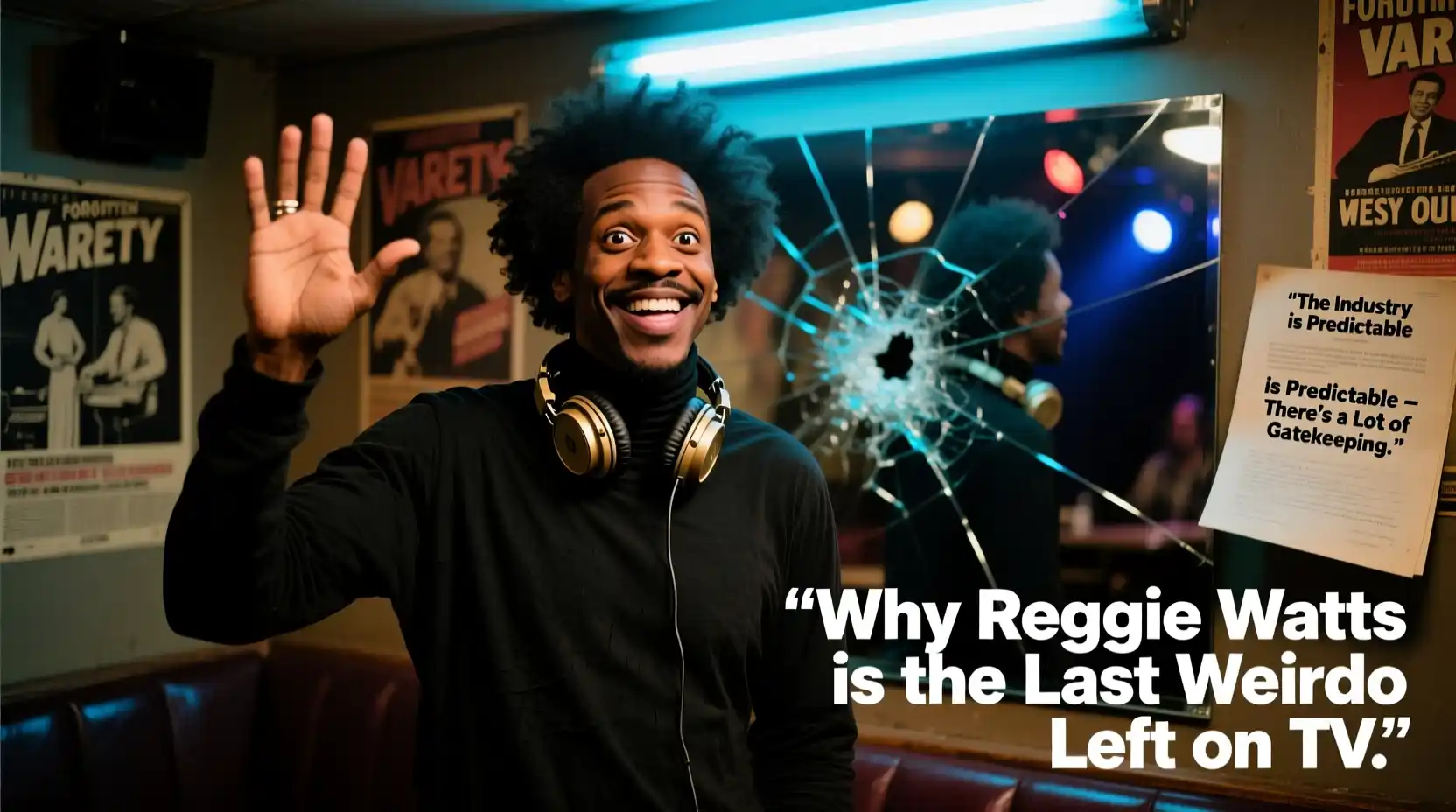
The Industry is Predictable – There’s a Lot of Gatekeeping”: Why Reggie Watts is the Last Weirdo Left on TV
By [krishnan], Professional Blog Writer and Cultural Critic
In an era where algorithms dictate what’s “viral,” content is hyper-optimized for engagement, and network executives demand “safe” programming, one man has consistently defied categorization, subverted expectations, and remained blissfully, beautifully weird: Reggie Watts.
With his signature dreadlocks, velvet blazers, layered vocal loops, and surreal sense of humor, Watts has carved a niche that doesn’t just challenge the status quo — it warps it like a warped vinyl played at the wrong speed. He’s a comedian, a musician, an improviser, and a performance artist who floats between genres with the ease of someone who never bought into the genre to begin with.
But according to Watts himself, the creative landscape is growing increasingly inhospitable to true oddballs. In a recent interview, he dropped a truth bomb: “The industry is predictable – there’s a lot of gatekeeping.” Those words aren’t just a critique; they’re a quiet elegy for the death of true creative freedom in mainstream television.
Watts, who served as the bandleader on CBS’s The Late Late Show with James Corden from 2015 to 2023, was often the one wild card in an otherwise formulaic late-night landscape. His spontaneous jazz-rap-scat routines, existential monologues in made-up languages, and uncanny ability to turn a mundane prompt into a cosmic fever dream made him a cult favorite — but also a rare anomaly.
So, where did all the weirdos go?
The Golden Age of the Weird: A Brief Retrospective
To understand the significance of Reggie Watts’ current position in entertainment, we need to revisit a time when oddballs weren’t just tolerated — they were celebrated.
In the 1970s and 1980s, figures like David Bowie, Warren Zevon, Andy Kaufman, and The Residents thrived by being deliberately bizarre. Television, too, had space for surrealism: The Muppet Show, Saturday Night Live in its early years, and Pee-Wee’s Playhouse all embraced the absurd.
But the 1990s and early 2000s delivered the golden age of the television weirdo. Think:
- David Lynch with Twin Peaks
- Tim and Eric with their low-fi, grotesque comedy
- Seth Green and Dan Milano with Robot Chicken
- Robert Smigel’s Triumph the Insult Comic Dog
- The Mighty Boosh in the UK
These creators weren’t trying to fit in. They were pushing boundaries, testing taste, and creating content that felt dangerous — not in a violent sense, but in the way it destabilized our understanding of what “entertainment” should be.
That era cultivated a culture where experimentation was not just allowed but encouraged. Networks had enough margin for failure that they could afford to take risks on artists who didn’t follow a formula.
But things changed.
The Algorithmic Takeover: Why Predictability Reigns
Today’s entertainment industry is shaped more by data than daring. Streaming platforms, social media, and digital advertising have created a feedback loop where content is judged not by its originality, but by its shareability, watch time, and conversion metrics.
As a result, the “weird” gets filtered out. Why?
- Risk Aversion: Networks and platforms fear losing subscribers. Weird content doesn’t always go viral — and when it does, it’s often misunderstood or polarizing.
- Homogenization of Humor: Jokes are now focus-grouped. Satire is sanitized. Edge is sanded down. The “safe” comedian — someone who delivers relatable, non-offensive, easily digestible material — gets the gig.
- Corporate Synergy: With media conglomerates owning everything from music labels to streaming platforms, originality often takes a backseat to brand alignment and cross-promotional potential.
This is where Reggie Watts stands out — or rather, stands apart.
Reggie Watts: A Portrait of the Artist as a Weirdo
Born in Germany to an American military father and a Swiss mother, Watts grew up in Montana before relocating to Seattle and then New York. From early on, his artistic voice was shaped by a love for jazz, hip-hop, and improvisation — but filtered through a distinctly absurdist lens.
His breakout moment came on YouTube in the early 2010s with viral videos of him performing improvisational musical monologues — streams of consciousness layered with beatboxing, synth loops, and faux-academic gibberish. He’d launch into rants about existential dread and gluten-free yogurt, all while building intricate sonic landscapes in real time.
But Watts wasn’t just making noise. He was deconstructing language, culture, and performance itself.
“I like to think of myself as a jazz poet. Or maybe a poet pretending to be a jazz musician. Or a jazz musician pretending to be a comedian.”
— Reggie Watts, 2013 TED Talk
That TED Talk, which garnered millions of views, cemented his reputation as a genre-defying innovator. But even as he gained mainstream exposure — touring with bands, appearing on Conan, The Colbert Report, and eventually landing the Corden gig — Watts never compromised his weirdness.
On The Late Late Show, he was the yin to Corden’s yang: where Corden was polished, Watts was raw; where Corden relied on celebrity interviews and carpool karaoke, Watts offered existential lullabies and surreal musical collages. He was the id of the show — a subconscious erupting in polyrhythms and philosophical tangents.
And yet, despite being a key part of the show’s identity, many viewers never quite “got” him. They didn’t know how to categorize him. Was he the bandleader? The warm-up act? A running joke? A performance art piece?
Exactly.
The Cost of Being Unclassifiable
The industry doesn’t know what to do with unclassifiable talent.
In a world that thrives on branding, tagging, and merchandising, someone like Reggie Watts is both an asset and a liability. He’s original — which is celebrated in theory — but originality doesn’t lend itself to easy monetization.
Consider this: Watts has no Netflix stand-up special. No weekly podcast with millions of downloads. No branded merchandise line. His biggest platform was a supporting role on a late-night show — one that ended not because of failure, but because of shifting priorities at the network.
Compare that to contemporaries like Hannah Gadsby, John Mulaney, or Bo Burnham — all talented and unique in their own right, but whose work fits into recognizable containers: stand-up special, world tour, documentary.
Watts? He’s harder to market. He doesn’t tour “jokes” — he improvises entire realities.
“I don’t write material. I create environments. The joke isn’t the punchline — it’s the world I’ve built for three minutes.”
— Reggie Watts, The Believer Magazine, 2020
This resistance to convention is precisely why the industry sidelines artists like him.
Gatekeeping in Entertainment: Who Decides What’s “ Marketable”?
When Watts says there’s “a lot of gatekeeping,” he’s not just complaining — he’s diagnosing a systemic issue.
Gatekeeping occurs at every level:
- Talent agencies who prefer clients with “clear brand personas”
- Network executives who want hosts and performers that appeal to the broadest possible demographic
- Streaming platforms that prioritize data over vision
- Award shows that reward familiarity over innovation
Let’s look at late-night TV — perhaps the most gatekept space in entertainment.
Currently, the late-night lineup includes:
- Stephen Colbert (former satirist turned corporate-friendly host)
- Seth Meyers (smart, progressive, but formulaic)
- Jimmy Fallon (game-show host masquerading as a comedian)
- Jimmy Kimmel (a safe, legacy figure)
No one in that lineup is doing what Watts did — which is to fundamentally challenge the idea of what a musical performer even is on television.
And after Corden left, Watts wasn’t just replaced — he was erased. The new bandleader, Felicia Collins, while talented, operates in a more traditional funk/R&B format. There’s no improvisational jazz nonsense. No mock-serious lectures on “the quantum sandwich.” No linguistic anarchy.
The weirdness quota has been cut to zero.
The Last Weirdo Standing? A Comparative Table
To better understand Reggie Watts’ unique position, let’s compare him to other prominent “weird” entertainers — past and present — and examine why he might be the last of his kind on mainstream TV.
| Artist | Era | Medium | Known For | Mainstream Longevity | Why They’re Not “The Last Weirdo” |
| Reggie Watts | 2010s–2020s | TV, YouTube, Live | Improvisational music-comedy, surreal monologues | Moderate (Corden show) | Currently the most visible oddball in mainstream media. No successor in sight. |
| Andy Kaufman | 1970s–80s | TV (Taxi), Live | Anti-comedy, performance art, wrestling | Short (died young) | Revolutionary, but predated digital era. No platform to sustain. |
| Tim & Eric | 2000s–2010s | TV (Adult Swim), Web | Absurdist, low-fi, disturbing humor | Niche (cult following) | Too niche for broadcast TV. Never hosted a network show. |
| Bo Burnham | 2000s–2020s | YouTube, Stand-up, Film | Musical satire, meta-commentary | High (Netflix specials) | Brilliant, but his work is tightly scripted and performative — not improvisational or unclassifiable. |
| Sacha Baron Cohen | 2000s–2020s | TV/Film | Satirical characters (Borat) | Moderate | Pushed boundaries, but characters are pre-written. Less spontaneous. |
| Maria Bamford | 2000s–2020s | Stand-up, TV | Mental health humor, character work | Moderate (Netflix, podcast) | Embraces weirdness, but within the framework of stand-up comedy. |
| Flying Lotus | 2000s–2020s | Music, Film | Experimental jazz/electronic, surreal visuals | Underground/indie | Too experimental for mainstream TV. |
| The Onion | 1990s–2020s | Print, Web | Satirical news | Declined (print) | Digital presence, but no TV platform. |
Conclusion: Reggie Watts is unique in that he occupied a mainstream television platform while maintaining an avant-garde artistic identity. No current figure on network TV combines musical innovation, linguistic abstraction, and performative absurdity at the level Watts did — and did consistently.
The Death of Creative Anarchy in a Streamlined World
The gatekeeping Watts speaks of isn’t just about access — it’s about the narrowing of what is considered legitimate art.
In the past, television could be a sandbox for experimentation. PBS aired The Electric Company. HBO launched Mr. Show. Adult Swim gave birth to Aqua Teen Hunger Force. Public access channels once hosted outsider art that felt like transmissions from another dimension.
Today? Most of that has migrated online — but even there, the pressure to conform is intense.
YouTube rewards consistency. TikTok glorifies trends. Instagram favors aesthetics over substance. Podcasts need “hooks.” Even Patreon artists build their brands around deliverable content.
The artist who resists labeling — who thrives in ambiguity — gets lost in the noise.
And that’s the tragedy. Not that weirdos don’t exist (they do — more than ever), but that the mechanisms for amplifying them have been dismantled or repurposed.
Watts wasn’t trying to be “accessible.” He was trying to be honest — to express the chaotic, nonlinear way our minds actually work. His performances feel like overhearing someone’s dreams while they’re still asleep.
Now, he’s off the nightly airwaves.
What’s Next for the Weird?
Is there hope?
In some corners, yes. Niche platforms like Patreon, Bandcamp, and independent film festivals still support experimental work. Artists like Julia Jacklin, Yves Tumor, and Sophie (RIP) pushed sonic boundaries in ways that resonate with Watts’ spirit. In comedy, performers like Nate Bargatze (who is weird in his deadpan way) or Taylor Ortega (a new wave of surreal digital clowns) are finding audiences.
But none of them occupy a daily, network television slot — the kind of visibility that once allowed figures like Weird Al Yankovic or Penn & Teller to become household names.
Watts recently launched a new podcast, The Reggie Watts Podcast, and continues to tour, but these are smaller platforms. He’s no longer a nightly presence in America’s living rooms.
And in his absence, late-night feels… quieter. Safer. Duller.
Final Thought: Celebrate the Weird Before It’s Gone
Reggie Watts isn’t just a performer. He’s a reminder that creativity doesn’t have to be efficient, marketable, or even understandable to be valuable.
When he says the industry is predictable and full of gatekeeping, he’s not just talking about his own experience — he’s speaking for every artist who’s been told they’re “too out there,” “hard to book,” or “not quite the right fit.”
In a world obsessed with metrics, the immeasurable — humor, wonder, strangeness — gets lost.
So let’s honor Reggie Watts not just as a talent, but as a symbol. A last bastion of improvisational chaos in an age of algorithmic order.
Because if we lose the weirdos, we don’t just lose entertainment — we lose our capacity to imagine anything different.
And in a culture increasingly defined by repetition, imitation, and nostalgia, imagination might be the most radical act of all.
What do you think? Is Reggie Watts the last true weirdo on TV? Who else deserves that title? Share your thoughts in the comments below.
Follow this blog for more deep dives into culture, creativity, and the artists who refuse to play by the rules.
Have any thoughts?
Share your reaction or leave a quick response — we’d love to hear what you think!
-
 0
-
 0
-
 0
-
 0
-
 0
-
 0
