
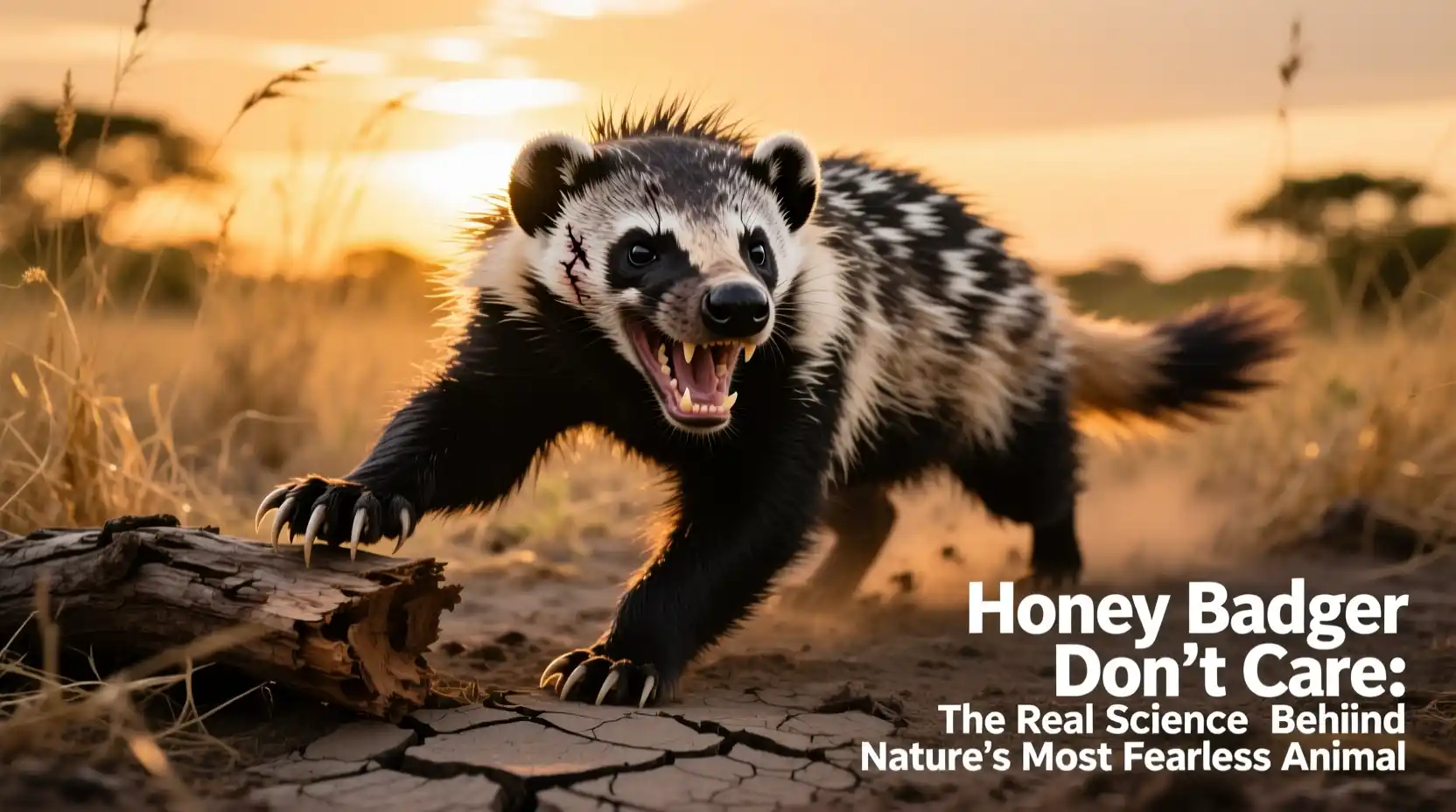
Honey Badger Don’t Care: The Real Science Behind Nature’s Most Fearless Animal
Introduction: From Meme to Marvel
If you spent any time on the internet in the early 2010s, you know the video. A gravelly, cigarette-deepened voiceover by “Randall” narrates the antics of a small, striped mammal as it eats a cobra, gets bitten, passes out, wakes up, and finishes the meal. The tagline became a pop-culture anthem: “Honey badger don’t give a sht.”*
The meme painted the Honey Badger (Mellivora capensis) as a psychopathic nihilist of the animal kingdom—a reckless berserker with a death wish. But while the internet laughed, biologists were taking notes. The truth is, the Honey Badger’s reputation is not an exaggeration; if anything, the meme undersold it.
The Honey Badger does not act out of madness or a lack of care. It acts out of evolutionary perfection. It is a masterpiece of biological engineering, a living tank wrapped in a loose-fitting suit of armor. To understand why the Honey Badger “doesn’t care,” we have to look past the viral video and into the paleontology, physiology, and neurology of one of the most unique carnivores on Earth.
This is the real science behind nature’s most fearless animal.
Chapter 1: Taxonomy and Evolution—The Black Sheep of the Mustelids
To understand the Honey Badger, you must first understand its family. It belongs to the order Carnivora and the family Mustelidae. This makes it a cousin to the weasel, the otter, the ferret, and the wolverine. However, taxonomically, it is the sole member of the subfamily Mellivorinae.
For a long time, scientists debated exactly where the Honey Badger fit into the mustelid family tree. Genetic analysis has revealed that the Honey Badger represents a very ancient lineage that split from the rest of the weasels roughly 13 to 16 million years ago. This evolutionary distance explains why it looks so different from its slender, slinky cousins. While a weasel is built for speed and pursuit through narrow tunnels, the Honey Badger is built for power and endurance.
Fossil Record and Ancestry
The genus Mellivora first appeared in Asia during the late Miocene epoch. In fact, a much larger ancestor of the modern Honey Badger, known as Mellivora sivalensis, lived in the Siwalik Hills of India and Pakistan. This prehistoric badger was significantly larger than the modern version, resembling a small bear in stature. As the climate changed and forests gave way to grasslands, the Honey Badger evolved into a smaller, more agile form, retaining the immense power but gaining the adaptability needed to survive across two continents.
This deep evolutionary history has resulted in an animal that is a “generalist” in the truest sense. While other animals specialized to the point of extinction when their environments shifted, the Honey Badger’s ancestors survived because they could eat almost anything and live almost anywhere.
Chapter 2: Anatomy of a Tank—The Skin and the Skull
The Honey Badger’s fearlessness is rooted in its physical invulnerability. You cannot be brave if you are fragile. The Honey Badger is built like a biological armored vehicle, possessing two primary anatomical superpowers: its skin and its jaws.
The Inverse Suit of Armor
Most animals have skin that is tight against their bodies to prevent tears. The Honey Badger has the opposite. Its skin is incredibly thick—loose and rubbery, measuring about 6mm (0.25 inches) deep around the neck area. This skin is too tough for most predators to penetrate.
The looseness is a tactical advantage. If a lion or a leopard grabs a Honey Badger by the scruff of the neck, the badger can simply turn around inside its own skin and bite the attacker. It is incredibly difficult to get a grip on the animal; there is no muscle or bone underneath the initial layer of skin to latch onto.
Furthermore, the skin is impervious to traditionally harsh defenses. It is resistant to bee stings (allowing them to raid hives) and porcupine quills. While porcupine quills can eventually penetrate, they rarely cause fatal damage because the loose skin prevents the quill from digging deep into vital organs immediately. Researchers have observed Honey Badgers pulling quills out of their own skin with their teeth, treating the injuries like minor splinters.
The Cranial Structure
The skull of the Honey Badger is a study in structural engineering. It is short, flat, and incredibly robust. Unlike dogs or cats that have long snouts designed for speed and breathing, the Honey Badger’s skull is designed to withstand massive crushing forces.
The sagittal crest (the ridge of bone on top of the skull where jaw muscles attach) is enormous. This gives the animal a bite force that is disproportionate to its size. While exact measurements are hard to come by, anecdotal evidence suggests they can crunch through tortoise shells with ease—a feat that requires incredible pressure.
Chapter 3: The Secret Weapon—Molecular Venom Resistance
The most famous “Honey Badger Don’t Care” moment is the consumption of venomous snakes. The Honey Badger is known to hunt and eat puff adders, cobras, and black mambas. But how does it survive the bite?
For years, scientists believed the resistance was purely physical—thick skin preventing fang penetration. While that helps, it’s not the full story. Sometimes, they do get bitten. In the viral video, the badger is bitten on the face by a puff adder. It passes out. An hour later, it wakes up, shakes it off, and keeps eating. This is not magic; it is molecular biology.
The Nervous System vs. Neurotoxins
Snake venom, particularly from elapids like cobras and mambas, is often neurotoxic. It works by binding to the acetylcholine receptors in the victim’s nervous system. This blocks the transmission of signals from the nerves to the muscles, causing paralysis and eventually respiratory failure.
In 2013, researchers led by Dr. Danielle Drabeck published a landmark study in the journal Toxicon identifying the genetic mutation responsible for the Honey Badger’s immunity. They found that the Honey Badger’s molecular “lock”—the shape of the receptor that the venom key fits into—has slightly changed shape.
It’s like changing the locks on your house. The snake’s venom “key” still fits into the lock, but it doesn’t turn. It binds weakly or not at all, meaning the nervous system continues to function even when saturated with venom.
Interestingly, this mutation is not unique to Honey Badgers. The study found that similar mutations evolved independently in mongooses, hedgehogs, and pigs. This is an example of convergent evolution—unrelated animals developing the same solution to the same problem (snakes) because they share the same environment.
Hemotoxins and the “Nap”
However, they are not immune to everything. Vipers (like the puff adder) possess cytotoxic and hemotoxic venom which destroys tissue and blood cells. The Honey Badger is not immune to this. The “nap” we see in the video is actually a coma induced by the sheer shock and damage of the venom. Their resistance buys them time; the venom works slower, allowing their incredibly fast metabolism to process the toxins and their robust healing abilities to repair the tissue damage. They survive the bite not because they feel nothing, but because they are hard to kill.
Chapter 4: Physiology and Intelligence—The Problem Solver
Being tough isn’t just about armor and poison resistance. It’s about having the brainpower to use those tools effectively. The Honey Badger possesses a high level of encephalization (brain-to-body mass ratio), indicating significant intelligence.
Tool Use and Escape
In captivity, Honey Badgers are notorious escape artists. They have been observed using tools to unlock cages. In one famous instance from the Colobus Conservation in Kenya, a badger named “Stinky” figured out how to open a latched gate. He stacked rocks to climb over a wall, unlatched the gate, and let his friends out. When zookeepers installed a more complex lock, Stinky figured it out within hours. They then installed a steel pole, thinking he couldn’t climb it. He rubbed his body against it to get friction and shimmied up anyway.
This intelligence translates to the wild. They are not just dumb brutes charging into danger; they calculate risks. When raiding a beehive, they use their long claws to tear apart the structure, utilizing smoke or dust to mask their scent or confuse the bees.
Sensory Adaptations
Honey Badgers have poor eyesight. Their eyes are small and adapted for nocturnal activity, but they don’t rely on vision for hunting. Instead, they rely on a highly developed sense of smell and acute hearing. Their nasal cavities are large and complex, allowing them to locate prey—such as a tortoise or a nest of larvae—buried deep underground.
Chapter 5: The Diet—The Ultimate Generalist
The scientific name Mellivora capensis translates to “Honey Eater of the Cape.” While they do love honey, it is actually a misnomer. Honey is a dessert, not the main course. The Honey Badger is a hyper-carnivore and an opportunistic feeder. If it moves and is smaller than them, it’s food. If it moves and is bigger than them, it’s a fight. If it’s dead, it’s lunch.
The Menu
The Honey Badger’s diet includes:
- Venomous Snakes: Up to 25% of their diet in some regions consists of snakes.
- Small Mammals: Rats, mice, squirrels, and ground squirrels.
- Invertebrates: Beetles, scorpions, termites, and larvae (which they dig out with powerful claws).
- Reptiles: Tortoises (which they crack open), lizards, and crocodile eggs.
- Birds: Ground-nesting birds and their eggs.
- Carrion: They frequently scavenge from leopard or lion kills.
The Symbiotic Relationship
One of the most fascinating aspects of their diet is their relationship with the Greater Honeyguide (Indicator indicator). This small bird leads the badger to a beehive. The bird eats the wax and larvae; the badger eats the honey. While this has been written about in folklore for centuries, scientific confirmation of this partnership occurring in the wild is rare. Some biologists argue it is exaggerated, but anecdotal evidence persists. Regardless, the badger’s ability to dismantle a hive is unrivaled.
Chapter 6: Behavior—Why They “Don’t Care”
We arrive at the core of the title. Why do they exhibit this “fearless” behavior? Is it arrogance? No. It is energy economics.
Most animals operate on a risk-reward system. An animal will only fight if it is cornered or protecting its young because getting injured in the wild is a death sentence. A broken jaw means starvation. An infected bite means death. Therefore, most animals run away.
The Honey Badger flips this equation. Because of its thick skin, loose fur, and venom resistance, it has a much higher “damage threshold.” A bite that would kill a fox is just a flesh wound to a badger.
Furthermore, the Honey Badger lives in harsh, resource-scarce environments. It cannot afford to be timid. If it backs down from a predator stealing its food, it starves. If it refuses to enter a burrow because a snake is inside, it goes hungry. Its “don’t care” attitude is actually an evolutionary imperative: Boldness is a survival strategy.
Aggression as a Defense
When confronted by a lion or a hyena, a Honey Badger does not run. It stands its ground, often raising its tail to appear larger (exhibiting its anal glands, which produce a foul-smelling liquid used as a last-ditch defense). It will rush the predator, biting at the legs and genitals. This “crazy” behavior often confuses the larger predator. Predators look for easy prey; they don’t want to deal with a psychotic, screaming ball of teeth and claws that might bite their leg off.
Chapter 7: Range and Habitat
The Honey Badger has one of the largest ranges of any mustelid. It is found throughout most of sub-Saharan Africa, the Arabian Peninsula, the Middle East, and the Indian subcontinent.
This wide distribution is a testament to their adaptability. They inhabit:
- Savannas: Open grasslands where they dig for rodents.
- Deserts: The Kalahari and Sahara, where they survive on the moisture content of their food and rarely need to drink free-standing water.
- Rainforests: The dense jungles of the Congo basin.
- Mountains: Up to the alpine moorlands of Ethiopia.
They are capable of traveling vast distances in search of food. Males have been recorded traveling over 30 kilometers in a single night.
Chapter 8: Reproduction and Lifecycle
The social life of the Honey Badger is largely solitary. They are only seen together during mating season or when a female is raising cubs.
Mating
Mating is a violent affair. The male, which can be up to a third larger than the female, will follow the female for days, emitting a loud, rattling sound. When they mate, it can last for hours, often with the male biting the female’s neck to hold her. Biologists believe this rough play is necessary to synchronize the pair and stimulate ovulation.
Raising Young
Females give birth to a litter of one or two cubs (called kits) in a burrow. She raises them alone. The dependency period is long—up to 14 months. During this time, the mother is a ferocious protector.
There is a heartwarming aspect to the “don’t care” persona. When the cubs are young, the mother is incredibly patient. She will carry them gently in her jaws when moving den sites. She teaches them to hunt scorpions, allowing them to get stung so they can build up their own immunity and learn how to handle prey. It is a dangerous education, but essential for survival.
Chapter 9: Conservation and Human Conflict
Currently, the Honey Badger is listed as “Least Concern” on the IUCN Red List due to its wide range and high population density. However, their numbers are decreasing in certain areas due to human encroachment.
The Beekeeper’s Enemy
The primary conflict with humans involves, unsurprisingly, honey. Beekeepers in Africa and India view Honey Badgers as pests. A single badger can destroy dozens of hives in a night. Historically, this led to them being trapped, poisoned, and shot.
The Solution
Fortunately, the solution is simple and highlights the intelligence of the animal. Conservationists introduced “badger-proof” beehives. These hives are raised off the ground and secured with latches that a badger cannot open. While the badgers initially try to break in, they eventually realize the energy cost is too high and move on to easier food sources. This proves that the Honey Badger is not mindlessly destructive; it is an energy-efficient opportunist.
Roadkill and Persecution
As human infrastructure expands, roadkill has become a significant threat. Furthermore, because of their ferocity, they are sometimes targeted by trophy hunters or villagers who fear them.
Chapter 10: The Verdict—Why We Need the Honey Badger
The Honey Badger is more than a meme. It is a symbol of resilience. In a world that often favors the large, the fast, and the heavily armed, the Honey Badger proves that attitude and adaptability can overcome physical limitations.
It is a cleanup crew in the ecosystem, controlling rodent and snake populations. It is a disperser of seeds through its feces. It is a marvel of evolutionary biology, sporting features that scientists are still trying to fully understand—like that venom resistance.
When we say “Honey Badger Don’t Care,” we should correct it slightly. It cares deeply about survival. It cares about its next meal. It cares about its young. It just doesn’t care about the things that are supposed to scare it. It has looked nature in the face—snakes, lions, scorpions, and vultures—and decided that it simply will not be intimidated.
Conclusion: The Indestructible Spirit
In the end, the Honey Badger teaches us a valuable lesson about resilience. It doesn’t win every fight. It gets bitten, it gets stung, and it gets beaten. But it gets back up. It possesses a refusal to stay down that is rare in the natural world.
So, the next time you see the meme video, remember the science. Remember the loose skin and the mutated receptors. Remember the ancient lineage that survived ice ages and mass extinctions. The Honey Badger isn’t just being crazy. It’s being a survivor.
And in the harsh, unforgiving wilds of Africa and Asia, being a survivor is the only thing that matters.
Have any thoughts?
Share your reaction or leave a quick response — we’d love to hear what you think!
-
 0
-
 0
-
 0
-
 0
-
 0
-
 0
