
The Zero Balance: How 28,000 Borrowers Found Freedom from $238 Million in Student Debt and What It Signals for a Nation in Crisis
Introduction: The Notification That Changed Everything
For millions of Americans, the student loan portal is a place of quiet dread. It’s a digital ledger of broken promises, deferred dreams, and a balance that seems to defy gravity, growing even as payments are made. It’s a source of Sunday-night anxiety, a calculation that alters life’s biggest decisions—whether to marry, have children, start a business, or buy a home. It is, for a generation, the defining financial burden of their lives.
But on a recent, unremarkable Tuesday, for 28,000 individuals, that portal transformed into a scene of deliverance. A notification appeared. An email landed in an inbox. A single, stark number replaced years of accrued interest and principal: $0.00.
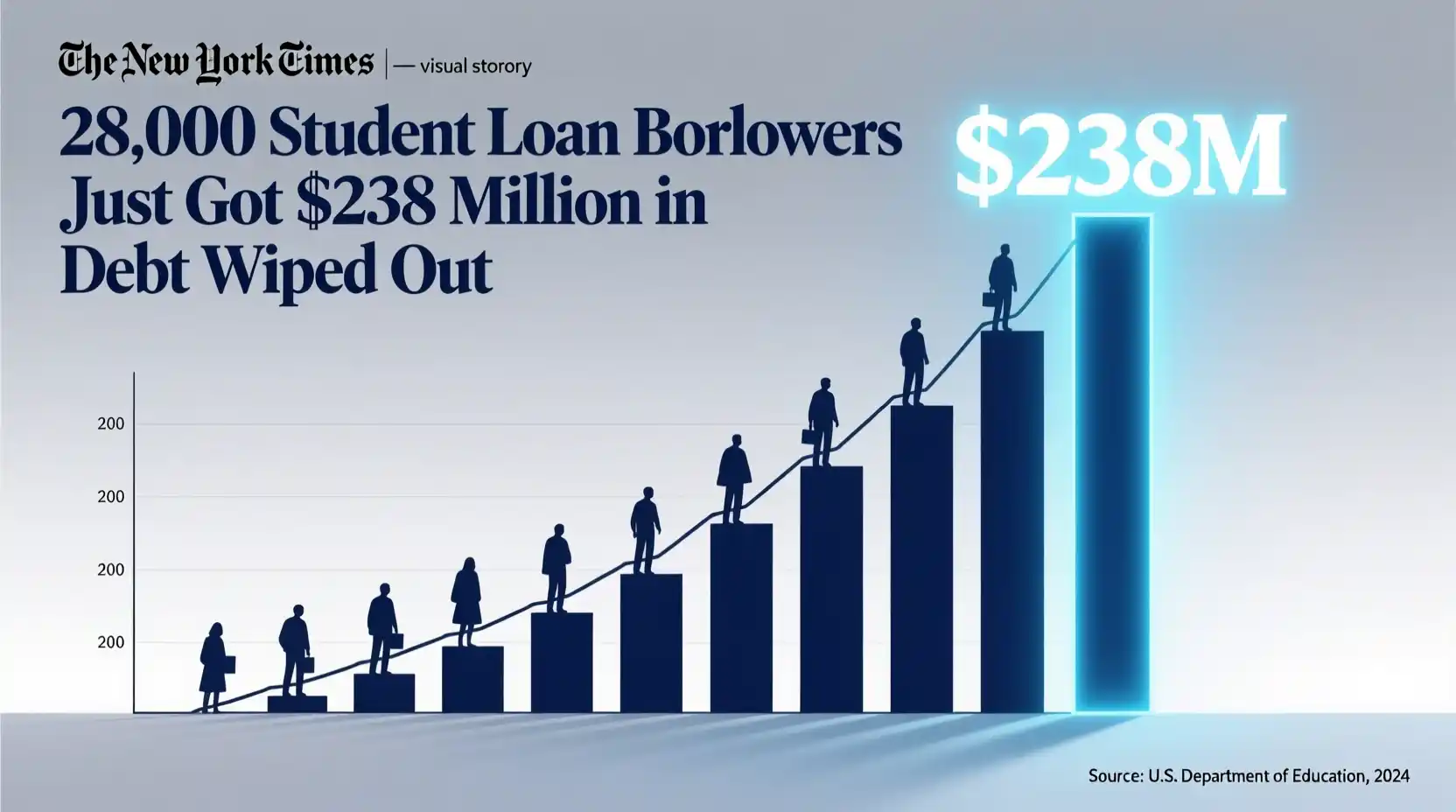
In a single stroke, the U.S. Department of Education had wiped out a collective $238 million in federal student loan debt. This wasn’t the headline-grabbing, broad-based forgiveness plan that had captured the nation’s attention and faced the wrath of the Supreme Court. This was different. It was quieter, more targeted, and rooted in a specific legal and moral premise: these borrowers had been defrauded, misled, or failed by the very system designed to fund their futures.
This act of cancellation, while a drop in the bucket of the nation’s $1.7 trillion student debt portfolio, sends ripples far beyond the 28,000 lives it immediately altered. It is a microcosm of the entire student debt saga—a story of soaring tuition costs, predatory institutions, political gridlock, administrative failure, and the enduring, painful question of who bears the cost of higher education in America.
To understand the significance of this $238 million, we must journey deep into the anatomy of the crisis. We must explore the history that created this mountain of debt, hear the stories of those buried beneath it, dissect the fierce political and economic debates that divide a nation, and examine the new, uncertain landscape that borrowers now navigate. This is the story of a zero balance, but it is also the story of the American Dream on trial.
Part I: The Anatomy of a Cancellation – Unpacking the $238 Million
The news broke with a familiar cadence: a press release from the Department of Education, a statement from the Secretary, and a flurry of news reports. But behind the headline figure lies a complex web of policies and legal justifications. The cancellation of this $238 million was not a random act of largesse; it was the culmination of years of advocacy, legal wrangling, and a fundamental shift in how the executive branch chooses to interpret its own authority.
The primary mechanism for this particular wave of relief was the Borrower Defense to Repayment (BD) rule. This is not a new concept. The Higher Education Act of 1965 included a provision that allowed federal student loans to be discharged if a borrower’s college had violated state law through certain “acts or omissions.” In essence, if a school committed fraud, the federal government wouldn’t force the borrower to pay for a worthless education.
For decades, however, this rule was largely dormant and nearly impossible to use. It required borrowers to navigate a labyrinthine process, proving not just that their school made a false promise, but that this promise was a material component of their decision to enroll and take out loans. The burden of proof was immense, and the rate of approval was minuscule.
The landscape began to shift dramatically in the mid-2010s, coinciding with the collapse of massive for-profit college chains like Corinthian Colleges and ITT Technical Institute. These institutions were accused of widespread, systemic deception—using inflated job placement statistics, misleading recruiters, and aggressive marketing to lure vulnerable students, often veterans and low-income individuals, into high-cost, low-value degree programs. The ensuing public outcry and a flood of borrower defense claims forced the Department of Education to re-examine the rule.
Under the Obama administration, new regulations were proposed to streamline the process. Under the Trump administration, those regulations were rolled back, making it harder again for students to get relief. This pendulum swing created chaos and uncertainty for hundreds of thousands of claimants whose cases were left in limbo.
The current Biden administration has made it a central tenet of its higher education policy to not only revive but aggressively expand the borrower defense process. This $238 million cancellation is a direct result of that policy shift. The Department didn’t just approve a backlog of individual claims; it began to approve claims en masse, using group discharges for entire cohorts of students who attended known fraudulent institutions during specific periods.
So, who are these 28,000 borrowers? They are the former students of these predatory schools. They are the individuals who were promised a fast track to a career as a medical assistant, a web designer, or a chef, only to find themselves with a piece of paper that employers didn’t recognize and a debt that would follow them for decades. The $238 million isn’t just debt cancellation; it is, in the eyes of the government, a form of restitution. It is an acknowledgment that the system failed them and that the federal government, as the lender of last resort, has a responsibility to right that wrong.
This targeted relief is often supplemented by other, related discharge programs. For instance, borrowers who attended a school that closed while they were enrolled or shortly after they withdrew can be eligible for a Closed School Discharge. Similarly, those who are unable to engage in any “substantial gainful activity” due to a total and permanent disability can have their loans forgiven through a TPD Discharge. The $238 million figure likely represents a combination of these approvals, with the vast majority stemming from borrower defense claims related to specific, identified institutions.
The process, once a nightmare of paperwork, has been simplified. The Department of Education has proactively identified eligible borrowers and approved relief for them automatically, requiring no action on the part of the student. This “no-action” relief is a revolutionary change, recognizing that asking victims of a predatory system to then navigate a bureaucratic one is a cruel and unnecessary burden.
While this news is a cause for celebration for those affected, it also serves to highlight the deeply fragmented and often arbitrary nature of student loan relief in the United States. Freedom from debt is currently less a matter of policy and more a matter of circumstance: Were you unlucky enough to attend a fraudulent school? Lucky enough to have your case approved in this particular wave? The 28,000 borrowers who received this cancellation are a testament to the power of targeted action, but their story also underscores the millions more who remain trapped, their debts not the result of fraud, but simply the cost of an increasingly expensive public or private education.
Part II: A Nation in Hock – The Genesis of the Student Debt Crisis
To understand how we arrived at a point where $238 million in debt cancellation feels both monumental and woefully insufficient, we must turn back the clock. The student debt crisis did not appear overnight; it was cultivated over decades by a confluence of economic, political, and social forces that fundamentally reshaped the relationship between Americans and higher education.
The Post-War Golden Age and the Promise of the GI Bill
In the immediate aftermath of World War II, the United States made a transformative investment in its citizens. The Servicemen’s Readjustment Act of 1944, universally known as the GI Bill, paid for tuition and provided living stipends for millions of returning veterans to attend college and trade schools. This wasn’t framed as a loan; it was a public good, a reward for service and an investment in the nation’s future economic prosperity. The result was an explosion in the educated workforce, the creation of a robust middle class, and the cementing of higher education as a cornerstone of the American Dream. During this era, a student could work a summer job and afford a year’s tuition at a state university. College was accessible, affordable, and seen as a clear pathway to upward mobility.
The Great Shift: From Grants to Loans
The turning point began in the late 1960s and accelerated through the 1970s and 1980s. The Higher Education Act of 1965, signed by President Lyndon B. Johnson, was a landmark piece of legislation aimed at expanding access. It created federal grant programs like the Pell Grant, which provided money to low-income students that did not need to be repaid. For a time, grants and loans coexisted in a healthier balance.
However, a series of economic shocks and ideological shifts began to alter this equation. The stagflation of the 1970s and the Reagan-era tax cuts of the 1980s led to significant cuts in state funding for public higher education. As state subsidies dried up, colleges and universities were forced to shift the cost burden onto students. Tuition began to rise at a rate far outpacing inflation.
Simultaneously, a philosophical shift was taking place in Washington. The idea of higher education as a public good began to be replaced by the notion of it as a private investment. If an individual benefits from a degree with higher lifetime earnings, the logic went, then that individual should bear the cost. This led to a deliberate pivot in federal financial aid policy, away from grants and towards loans.
The creation of the Sallie Mae corporation in 1972, initially as a government-sponsored enterprise, helped to create a robust secondary market for student loans, making it easier and more profitable for banks to lend to students. The federal government guaranteed these loans, removing the risk for private lenders. By the 1990s, the federal government had moved to a system of direct lending, becoming the primary lender to students, but the fundamental principle remained: debt, not grants, was now the primary tool for financing college.
The For-Profit Onslaught
As the cost of traditional college soared and federal loan money became readily available, a new and powerful player entered the field: the for-profit college sector. These institutions, often run by publicly-traded corporations with a fiduciary duty to maximize shareholder value, saw a vast, untapped market. They aggressively recruited students, capitalizing on the federal loan system.
Their business model was, in many cases, brilliantly simple and deeply cynical. They spent enormous sums on marketing, targeting demographics that were most vulnerable to promises of a better life: low-income individuals, single parents, and veterans. They would enroll students en masse, who would then take out the maximum federal loans allowed to cover exorbitant tuition fees. The federal money would flow directly from the U.S. Treasury to the college’s coffers. The quality of the education provided was often secondary to the recruitment and enrollment process. When students dropped out or graduated with degrees that held no weight in the job market, the college had already been paid. The student was left with the debt.
This model, which critics dubbed a “recruit-to-default” machine, was a major driver of the debt crisis and a primary source of the borrower defense claims that led to the $238 million cancellation. Institutions like Corinthian Colleges, which operated Everest and Heald colleges, became infamous for their deceptive practices, leading to massive fines, lawsuits, and eventual collapse, leaving hundreds of thousands of students in the lurch.
The Vicious Cycle of Rising Costs
The easy availability of federal loan money had another, unintended consequence: it enabled tuition inflation. With a virtually limitless pool of federally-backed borrowers, colleges faced little market pressure to control costs. They could raise tuition, knowing that students could simply borrow more to cover the difference. This created a vicious cycle: higher tuition led to more borrowing, which in turn enabled colleges to raise tuition even further.
Between 1980 and 2020, the average cost of tuition, fees, and room and board for an undergraduate degree increased by 169% at private nonprofit institutions and by 213% at public institutions, after adjusting for inflation. During the same period, median household income grew by only 19%. The math is stark and unforgiving. A bachelor’s degree, once attainable through hard work and modest savings, now requires a financial commitment that can dwarf a down payment on a house.
This is the genesis of the crisis. It is a story of a nation slowly withdrawing its collective investment in its people, replacing a system of grants and public funding with one of individual debt. It is a story of predatory actors exploiting a broken system. And it is a story of a fundamental promise—the promise that education is the great equalizer—being undermined by the very financial mechanisms meant to support it. The 28,000 borrowers who just had their debt wiped out are casualties of this system. The millions who remain in debt are its living legacy.
Part III: The Human Ledger – Stories from the Brink
Statistics, no matter how staggering, can feel abstract. $1.7 trillion is a number too large for the human mind to truly comprehend. To grasp the true weight of the student debt crisis, we must move from the macro to the micro, from the national ledger to the personal stories etched in the lives of millions. While the 28,000 borrowers who received relief are now free, their stories before the cancellation mirror the ongoing reality for countless others.
The Story of Maria, the Public Servant
Maria is a 45-year-old high school English teacher in a rural community. She has dedicated her life to public service, a path she chose with the understanding of a promise: the Public Service Loan Forgiveness (PSLF) program. Enacted in 2007, PSLF promised to forgive the remaining federal student loan balance for borrowers who worked full-time for a qualifying public service employer and made 120 qualifying monthly payments.
Maria took out over $80,000 in loans to get her master’s degree in education. She meticulously tracked her payments, submitting employment certification forms annually to her loan servicer. For ten years, she paid on time, every time. She stayed in her teaching job, despite offers from higher-paying private schools, because she was counting on that forgiveness.
When she finally applied for forgiveness after her 120th payment, she was met with a devastating rejection. Her loan servicer, one of several that had been contracted by the Department of Education over the years, had misinformed her. They had placed her on the wrong repayment plan, a “forbearance” that paused her payments but didn’t count toward PSLF. A decade of payments, a decade of service, was rendered null by administrative error. Her balance, barely dented by years of payments that mostly went to interest, was still over $70,000.
Maria’s story is not unique. The PSLF program was plagued by a 99% denial rate in its early years, largely due to poor guidance from servicers and confusing, Byzantine rules. The despair and betrayal felt by public servants like Maria—teachers, nurses, social workers, first responders—is a profound and painful feature of the crisis. While recent regulatory overhauls have made PSLF more accessible, for many like Maria, the damage is already done, eroding their faith in the systems they serve.
The Story of David, the For-Profit Graduate
David is a 32-year-old veteran who served two tours in Afghanistan. When he returned home, he struggled to adjust to civilian life and was looking for a clear path to a career. He saw a slick TV commercial for a for-profit technical institute promising a high-paying job as a cybersecurity analyst in just 18 months. The recruiters were aggressive and empathetic, telling him his GI Bill benefits wouldn’t cover everything, but that federal student loans would easily fill the gap. They boasted of a 90% job placement rate and partnerships with major tech companies.
He enrolled, taking out $35,000 in loans. The “campus” was a drab office building with outdated computers. The instructors seemed underqualified. The promised “career services” department consisted of a person who handed him a printout of job postings from Indeed.com. When he graduated, he found his degree meant nothing to employers. He was competing with candidates from accredited four-year universities. The “90% placement rate” turned out to include anyone who had worked for a single day at any job, even flipping burgers.
David is one of the lucky ones. He was part of a group of borrowers from his now-defunct school who had their loans discharged through the borrower defense rule—the very mechanism that wiped out the $238 million. But for years before that, he lived with a crushing sense of failure and anger. He had served his country, only to be taken advantage of by a predatory corporation here at home, with the U.S. government as its unwitting financier. His debt was a constant reminder of a promise broken, a betrayal that left him financially and emotionally scarred.
The Story of Sarah and Ben, the Millennial Couple
Sarah and Ben are both 34. They have been together for ten years, married for five. They have stable jobs in marketing and graphic design. They have a dog, a modest apartment they’ve carefully decorated, and a shared dream of buying a small house with a backyard. The only thing standing in their way is their combined student debt: $195,000.
Their monthly student loan payment is over $1,500, a sum that dwarfs their car payment and is nearly half their rent. This debt-to-income ratio makes it impossible for them to qualify for a mortgage. They’ve tried to save for a down payment, but every time they build a small nest egg, an unexpected expense arises, or they have to make a choice between saving and aggressively paying down loans with interest rates over 7%.
The debt has cast a long shadow over their life together. They’ve postponed having children, feeling they can’t afford the added expense on top of their loan payments. They talk about the “what ifs”—what if they had gone to less expensive schools? What if they had chosen different careers? These conversations are tinged with regret and a sense of being trapped. They followed all the rules: they went to good colleges, they got degrees, they found decent jobs. Yet, the fundamental milestones of the American Dream—homeownership, starting a family—remain just out of reach. Their story is the story of a generation whose economic potential is being throttled by the legacy of their education.
These stories represent the human ledger of the crisis. They are tales of broken promises, predatory practices, and deferred dreams. They highlight the immense psychological toll of debt—the anxiety, the shame, the feeling of being a perpetual financial adolescent. The $238 million cancellation gave 28,000 people like David a second chance. But for the millions of Marias and Sarahs and Bens, the struggle continues, a daily negotiation with a past that refuses to let them build their future.
Part IV: The Political Colosseum – A Nation Divided Over Debt
The student debt crisis is not merely an economic or social issue; it is one of the most polarizing political battlegrounds in contemporary America. The cancellation of $238 million for 28,000 borrowers, while relatively uncontroversial as it targets victims of fraud, exists within a much larger, fiercer debate over whether and how to address the debt of the millions who borrowed in good faith for a standard education. This debate has raged in Congress, in the White House, and ultimately, in the highest court in the land.
The Case for Broad Forgiveness: An Economic and Moral Imperative
Proponents of large-scale student debt cancellation frame it as both a moral and an economic necessity.
- Economic Stimulus: The argument is that millions of borrowers are shackled by debt payments that suppress their spending. Canceling that debt would unleash a massive wave of consumer spending, boosting the economy. Borrowers would be more likely to buy homes, start businesses, and make major purchases, driving economic growth. A study by the Roosevelt Institute estimated that canceling all student debt could increase GDP by up to $108 billion a year and add up to 1.5 million jobs per year.
- Racial and Economic Equity: The student debt crisis is not felt equally. Black and Latino borrowers, on average, owe more debt and have higher default rates than their white counterparts, due in large part to centuries of systemic wealth inequality that leaves them with fewer family resources to pay for college. Forgiveness is therefore framed as a critical tool for closing the racial wealth gap. Similarly, it addresses class inequality, disproportionately benefiting low- and middle-income families for whom college debt is a major burden.
- Correcting a Systemic Failure: Advocates argue that the current system is fundamentally broken. The cost of college has risen to unsustainable levels due to state disinvestment and institutional greed. Forcing young people to bear the entire cost of this systemic failure is unjust. Forgiveness is not a “handout” but a correction of a societal wrong, akin to a bailout for a generation that was sold a faulty product.
- Mental Health and Well-being: Beyond the economics, there is a profound moral argument. The constant stress and anxiety of student debt have demonstrably negative effects on mental health. Alleviating this burden would improve the well-being of millions of Americans, allowing them to lead fuller, more productive lives.
The Case Against Forgiveness: Arguments of Fairness and Fiscal Responsibility
Opponents of broad debt cancellation present a counter-narrative rooted in principles of fairness, personal responsibility, and fiscal prudence.
- Moral Hazard and Unfairness: This is the most potent argument. Why should some borrowers get a “free ride” while others—those who scrimped and saved to pay off their loans, those who worked their way through college, those who chose not to go to college because of the cost—receive nothing? This is seen as fundamentally unfair, creating a two-tiered system of winners and losers based on a lottery of timing and policy.
- The Taxpayer Burden: The cost of broad cancellation is immense. A plan to cancel $10,000 per borrower would cost an estimated $400 billion; canceling $50,000 per borrower could cost over $1 trillion. Opponents argue that this debt is not simply “vanished”; it is transferred to the federal budget, and thus, to the American taxpayer. This would increase the national debt and potentially lead to higher taxes or cuts in other government services.
- Inflationary Concerns: Pumping hundreds of billions of dollars into the economy by canceling debt could, critics argue, exacerbate inflation. With more disposable income, demand for goods and services would surge, potentially driving up prices and hurting the very people the policy is intended to help.
- It Doesn’t Solve the Root Problem: This is a crucial point made by critics on both sides. Canceling existing debt is a one-time fix. It does nothing to address the underlying problem of skyrocketing tuition. Without a plan to control college costs, the next generation of students will simply accrue a new mountain of debt, requiring another round of cancellation in the future. It treats the symptom, not the disease.
The Supreme Court Saga: The Death of a Plan and the Birth of Another
This political battle reached its zenith with President Biden’s signature student loan policy. Announced in August 2022, the plan proposed to cancel up to $20,000 in debt for Pell Grant recipients and up to $10,000 for all other borrowers earning less than $125,000 per year. It was an ambitious, sweeping proposal designed to provide relief to over 40 million Americans.
The administration justified its authority to enact this plan using the HEROES Act, a 2003 law passed after the 9/11 attacks that gives the Secretary of Education the power to “waive or modify” statutory provisions to assist borrowers in connection with a “war or other military operation or national emergency.” The administration argued that the COVID-19 pandemic constituted such a national emergency and that the financial hardship it caused justified the relief.
Immediately, a coalition of Republican-led states sued to block the plan, arguing that the administration was overstepping its legal authority. The case, Biden v. Nebraska, made its way to the Supreme Court. In June 2023, the Court delivered a 6-3 decision striking down the forgiveness plan. The majority, in an opinion written by Chief Justice John Roberts, agreed with the states, ruling that the HEROES Act did not grant the Secretary of Education the sweeping authority to enact a mass debt cancellation program of this magnitude. They argued that such a significant political and economic decision required clear authorization from Congress, which had not been given.
The decision was a major political blow to the Biden administration and a devastating disappointment for millions of borrowers who had been holding their breath for relief.
However, the administration pivoted quickly. It announced a “Plan B,” a two-pronged approach that did not rely on the HEROES Act. The first prong was to use the department’s existing legal authorities—like the borrower defense rule that led to the $238 million cancellation—to provide targeted relief to specific groups of borrowers. The second, and far more significant, prong was the creation of the SAVE (Saving on a Valuable Education) plan.
This new plan, an overhaul of the existing income-driven repayment (IDR) system, is the administration’s most powerful tool for providing relief in the post-Supreme Court landscape. It dramatically lowers monthly payments for millions, prevents interest from ballooning (a feature called an interest subsidy), and offers a shorter path to forgiveness for those who borrowed smaller amounts. The SAVE plan is not a one-time cancellation; it is a permanent restructuring of the repayment system.
The $238 million cancellation, therefore, is not an isolated event. It is a key component of this new, post-Supreme Court strategy. It represents a shift from a single, grand gesture to a series of smaller, more legally defensible actions, combined with a fundamental overhaul of the repayment system. The political colosseum has not quieted; the fights over the SAVE plan’s legality and the cost of higher education rage on. But the battlefield has irrevocably changed.
Part V: The Road Ahead – Navigating the New Landscape of Student Loans
For the 28,000 borrowers celebrating a zero balance, the immediate road ahead is one of financial and emotional recovery. But for the other 43 million+ federal student loan borrowers, the landscape is complex, filled with new opportunities, lingering uncertainties, and a critical need for information. The era of waiting for a single, sweeping cancellation plan is over. The new era is one of proactive, individual navigation.
The SAVE Plan: A New Foundation for Repayment
The most important development for borrowers is the SAVE plan. It is not just another income-driven repayment (IDR) option; it is a fundamental redesign that could be the most significant student loan policy in a generation. Understanding its key features is essential for any borrower with an income-driven repayment need.
- Lower Monthly Payments: Under previous IDR plans, payments were typically calculated as 10-15% of a borrower’s discretionary income. SAVE cuts this to 5% of discretionary income for undergraduate loans. For borrowers with graduate school loans, the payment is a weighted average between 5% and 10%. For many borrowers, this will cut their monthly payments in half, or even more.
- Protection from Interest Growth: This is arguably the most transformative feature. Under other plans, if a borrower’s monthly payment was less than the interest that accrued each month, their loan balance would grow (this is called “negative amortization”). Under SAVE, the government covers 100% of the unpaid interest. This means that as long as a borrower makes their required payment, their loan balance will never increase, even if the payment is $0. This effectively stops the debt from snowballing.
- Shorter Path to Forgiveness: The timeline for loan forgiveness has also been shortened for certain borrowers. Those with original principal balances of $12,000 or less will receive forgiveness after just 120 payments (10 years), instead of the standard 240 or 300 payments (20 or 25 years). For every additional $1,000 borrowed above $12,000, the borrower adds 12 months of payments before reaching forgiveness. This recognizes that borrowers with smaller debts should not be in repayment for decades.
The Department of Education has automatically moved millions of borrowers into the SAVE plan from the old REPAYE plan. For others, it requires a simple application on the federal student aid website. For millions, this plan will provide the breathing room they need, making payments manageable and preventing their balances from spiraling.
Practical Steps for Borrowers Today
In this new environment, borrowers should take a proactive approach to managing their loans.
- Confirm Your Status: The first step is to log in to your account on StudentAid.gov. Check which repayment plan you are on. If you are on an income-driven plan, see if you have been moved to SAVE. If not, you can apply.
- Recertify Your Income: IDR plans require annual recertification of your income and family size. It is crucial to do this on time to prevent your payments from shooting up to a standard 10-year plan amount. Mark your calendar and set reminders.
- Explore Loan Consolidation: For some borrowers, especially those with older loans from the Federal Family Education Loan (FFEL) Program, consolidating into a Direct Consolidation Loan is a necessary step to become eligible for programs like PSLF and SAVE. However, consolidation can also reset the clock on certain types of forgiveness, so it’s important to understand the pros and cons.
- Investigate Public Service Loan Forgiveness (PSLF): If you work for a non-profit or government agency, PSLF is still a powerful tool. The rules have been temporarily relaxed through the PSLF Waiver, which allows past payments that wouldn’t normally qualify to count. It’s essential to submit the PSLF form to have your employment and payments certified.
- Beware of Scams: Whenever there is a major change in student loan policy, scammers emerge. Be extremely wary of any company that promises immediate loan forgiveness or asks you to pay a fee to enroll in a federal program like SAVE. All legitimate applications for federal programs are done for free through the official StudentAid.gov website.
The Unresolved Question: The Cost of College
While the SAVE plan and targeted relief are significant steps, they are, as critics note, a treatment for the symptoms, not a cure for the underlying disease: the astronomical and ever-rising cost of higher education. The long-term solution to the student debt crisis must involve a concerted effort to make college more affordable in the first place.
This is a much harder problem, with no easy answers. Potential solutions that are frequently debated include:
- Increasing Pell Grants: Expanding the size and reach of the federal Pell Grant, which provides aid to low-income students that doesn’t need to be repaid, would reduce the need for borrowing.
- Free Community College: Proposals to make two years of community college tuition-free for all have gained political traction, providing a low-cost pathway to a degree or a transfer to a four-year institution.
- State Investment: Reversing the decades-long trend of state disinvestment in public higher education is crucial. States must recommit to funding their universities to keep tuition down.
- Accountability for Institutions: Holding colleges and universities, particularly for-profits, accountable for student outcomes—such as graduation rates and post-graduate earnings—could incentivize them to control costs and improve quality.
The fight over these larger solutions will continue to define the political landscape for years to come. The $238 million cancellation is a recognition of failure; the future of American higher education depends on building a system that doesn’t fail in the first place.
Conclusion: A Zero Balance and the Unfinished Business of the American Dream
The notification of a zero balance is a moment of profound personal liberation. For the 28,000 borrowers who received it, it represents the end of a chapter marked by financial anxiety and the beginning of one filled with new possibilities. It is the government saying, in a tangible way, “We recognize you were wronged, and we are making it right.”
This act of targeted relief is a victory for justice and a testament to the power of persistent advocacy. It serves as a critical reminder that within the sprawling, impersonal bureaucracy of the federal government, policy can be wielded to correct specific injustices.
Yet, as we have explored, this $238 million is a symbolic drop in the ocean of a $1.7 trillion crisis. It highlights the arbitrary nature of who gets relief and who does not. It underscores the deep, structural problems—a disinvestment in public goods, the rise of a predatory for-profit industry, and a political system too divided to enact comprehensive solutions—that have created this quagmire.
The student debt crisis is more than an economic issue. It is a test of national values. It forces us to ask fundamental questions: Is higher education a public good or a private commodity? What is the social contract between a generation and its government? What is the price of the American Dream, and who should pay it?
The Biden administration’s pivot to the SAVE plan and targeted discharges represents a new, more sustainable, albeit less dramatic, approach to managing the crisis. It provides a lifeline to millions, preventing balances from exploding and making payments manageable. It is a significant policy achievement born from the ashes of a defeated Supreme Court case.
But the work is far from finished. The journey toward a truly equitable and accessible system of higher education is long and arduous. It will require political courage, innovative thinking, and a renewed national commitment to investing in people.
The story of the 28,000 borrowers who found freedom is a beacon of hope. It proves that change is possible. But it also serves as a call to action, a reminder of the millions more who are still waiting—waiting for a system that doesn’t trap them, waiting for a policy that gives them a fair shot, and waiting for their own chance to see a zero balance and the promise of a future unburdened by the past. The American Dream is not supposed to be a debt sentence. The unfinished business of our time is ensuring it becomes a reality once more.
Disclaimer
This article is for informational and educational purposes only. The information contained herein is based on publicly available data and reports from sources such as the U.S. Department of Education, news agencies, and policy research institutions. The content is intended to provide a comprehensive overview of the student loan landscape and should not be considered financial or legal advice. The student loan system is complex and subject to frequent legislative, regulatory, and judicial changes. Readers should not make any financial decisions based solely on the information provided in this article. For personalized advice regarding your specific student loan situation, it is strongly recommended that you consult with a qualified financial advisor or a student loan expert. Always refer to the official U.S. Department of Education website, StudentAid.gov, for the most accurate and up-to-date information on federal student loan programs, repayment options, and forgiveness eligibility. The author and publisher of this article disclaim any liability for any loss or damage incurred by readers as a result of the information provided herein.
Have any thoughts?
Share your reaction or leave a quick response — we’d love to hear what you think!
-
 0
-
 0
-
 0
-
 0
-
 0
-
 0
