
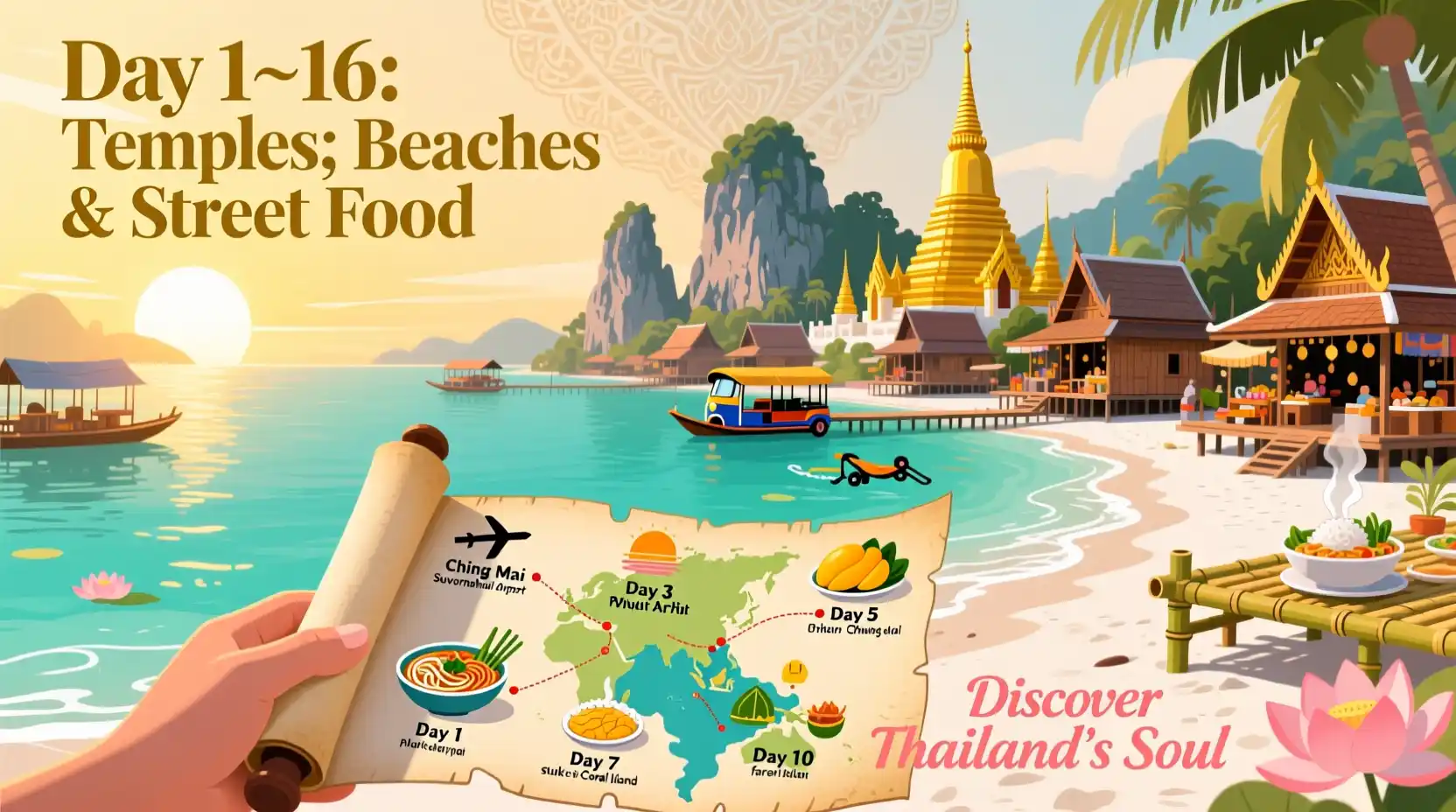

A Perfect 10 Day Thailand Itinerary Temples, Beaches, and Street Food Adventures
A Perfect 10-Day Thailand Itinerary: Temples, Beaches, and Street Food Adventures
A Journey Through the Land of Smiles: From Golden Spires to Turquoise Shores
Thailand. The very name conjures a symphony of sensations: the heady perfume of street-side jasmine garlands, the sizzle of woks firing up a spicy Pad Thai, the glint of gold on a temple spire piercing a brilliant blue sky, and the gentle lap of turquoise water against powder-white sand. It’s a country that simultaneously invigorates the soul and calms the spirit, a place where ancient traditions seamlessly blend with modern vibrancy. It is, in short, a traveler’s paradise.
But how do you begin to unravel the magic of the “Land of Smiles” in a limited time? How do you experience the dizzying energy of Bangkok, the profound serenity of its temples, the hedonistic bliss of its islands, and the life-altering deliciousness of its street food, all without feeling completely overwhelmed?
This is your answer. This is not just an itinerary; it’s a meticulously crafted 10-day narrative designed to immerse you in the very heart of Thailand. We’ve balanced the cultural deep dives with moments of pure relaxation, the iconic landmarks with hidden local gems, and the adventurous spirit with practical, on-the-ground advice. We’ll guide you from the chaotic, beautiful heart of the capital to the breathtaking, limestone karst-studded shores of the south, ensuring every single day is a new chapter in your Thai adventure.
Whether you’re a solo backpacker, a couple seeking a romantic escape, or a family with a thirst for culture, this guide is your key to unlocking a perfect 10 days. So, pack your bags, bring an open mind and an empty stomach, and let’s begin the journey of a lifetime.
Part I: The Essential Pre-Travel Blueprint
Before you even set foot on Thai soil, a little preparation can transform your trip from good to unforgettable. Think of this section as your mission briefing.
When to Go: Chasing the Perfect Season
Thailand’s climate is tropical, which generally means it’s hot and humid year-round. However, there are distinct seasons that can dramatically impact your experience.
- The Cool Season (November – February): This is, by consensus, the best time to visit most of the country, including Bangkok and the south. Temperatures are more manageable (averaging 25-32°C / 77-90°F), rainfall is minimal, and the humidity is at its lowest. This is peak tourist season, so expect larger crowds and higher prices for flights and accommodation, especially around Christmas and New Year.
- The Hot Season (March – May): Temperatures soar, often pushing past 35°C (95°F) with high humidity. It can be uncomfortably hot for extensive temple exploration in the middle of the day. The upside? Fewer tourists and lower prices. The Songkran festival (Thai New Year) in mid-April is a massive, nationwide water fight and a unique cultural experience, but it also means peak domestic travel.
- The Rainy Season (June – October): Don’t be deterred by the name. It doesn’t rain all day, every day. You’ll typically experience a heavy, but short, downpour in the afternoon, which can be a welcome relief from the heat. The landscape is at its most lush and green, and this is the best time for diving and snorkeling in certain areas like the Gulf of Thailand (Koh Samui, Koh Pha Ngan). You’ll find the best deals and the fewest crowds during this period.
For this 10-day itinerary, which covers Bangkok and the Andaman coast (Krabi/Phuket), the cool season (Nov-Feb) is ideal.
Visas & Officialdom: Crossing the T’s and Dotting the I’s
Visa regulations can change, so always check the official Royal Thai Embassy website for your home country before booking.
- Visa Exemption Scheme: Many nationalities (including the US, UK, Canada, Australia, and most of Europe) do not require a visa for tourist stays of up to 30 days if entering by air or land. You will need a passport valid for at least six months, a confirmed outbound ticket, and proof of sufficient funds (though this is rarely checked).
- Tourist Visa: If you plan to stay longer than 30 days or are from a country not on the exemption list, you’ll need to apply for a Tourist Visa (TR) beforehand. This typically grants a 60-day stay.
Budgeting for Bliss: What Does Thailand Really Cost?
Thailand can be as cheap or as expensive as you make it. Here’s a realistic breakdown for a mid-range traveler (not a shoestring backpacker, but not a luxury resort-dweller either).
- Accommodation: $25 – $60 USD per night. This will get you a clean, comfortable room with air conditioning, a private bathroom, and often a small pool in a guesthouse or 3-star hotel.
- Food: $15 – $30 USD per day. This is where you can save a fortune. A delicious, filling street food meal costs $1-3 USD. Even a sit-down meal at a local restaurant is rarely more than $10 USD.
- Transportation: $5 – $15 USD per day. A mix of public transport (BTS/MRT in Bangkok), Grab (Southeast Asia’s Uber), and the occasional long-distance taxi or domestic flight.
- Activities: $10 – $40 USD per day. This covers temple entry fees, a cooking class, a day trip to the islands, etc.
- Total Estimated Daily Budget: $55 – $145 USD per person per day. This doesn’t include international flights.
Pro-Tip: Always carry cash. While major hotels and restaurants accept cards, street food vendors, small shops, and tuk-tuk drivers operate on a cash-only basis.
Packing Like a Pro: The Thailand Essentials
Packing light is the key to stress-free travel, especially when navigating crowded markets or hopping between islands.
- Clothing:
- Lightweight, breathable fabrics (cotton, linen) are your best friends.
- T-shirts, tank tops, shorts, and sarongs.
- At least one pair of long, lightweight trousers and a shirt that covers your shoulders (essential for temple visits).
- A swimsuit (or two!).
- A light rain jacket or poncho, even in the dry season.
- A sweater or pashmina for air-conditioned buses, planes, and cinemas.
- Footwear:
- Comfortable walking sandals or trainers.
- A pair of flip-flops for the beach and easy on-off at temples.
- Health & Toiletries:
- High-SPF sunscreen (the sun is strong!).
- Insect repellent with DEET.
- Any personal medications, plus a basic first-aid kit (band-aids, antiseptic wipes, pain relievers, Imodium).
- Hand sanitizer.
- Tech & Gear:
- A universal power adapter (Thailand uses Type A, B, C, and O plugs, but a universal one is safest).
- A portable power bank.
- A waterproof bag or pouch for boat trips and beach days.
- Your smartphone, with a VPN installed for security.
- Important Documents:
- Passport (with photocopies).
- Flight and hotel confirmations (digital and hard copies).
- Travel insurance details.
- Several credit/debit cards and some Thai Baht in cash.
Health, Safety, and Cultural Etiquette: Respecting the Land of Smiles
- Health: Drink only bottled water. Be cautious with ice (in established restaurants and hotels it’s usually fine, made from filtered water). “Delhi belly” can happen, so stick to busy, popular street food stalls (high turnover means fresh food) and peel fruits you buy yourself.
- Safety: Thailand is generally very safe. The biggest risks are scooter accidents (if you choose to rent one, wear a helmet and have an international driving permit) and petty theft in tourist areas. Be aware of your surroundings.
- The Royal Family: This is paramount. The King and Royal Family are deeply revered. Never, ever say anything disrespectful about them. Lèse-majesté laws are strictly enforced. You’ll see portraits of the King everywhere; treat them with respect.
- Temples (Wats): Dress modestly. Shoulders and knees must be covered. Take off your shoes before entering the main prayer hall. Don’t point your feet at Buddha images or people (feet are considered the lowliest part of the body). Be quiet and respectful.
- Social Interactions: The traditional Thai greeting is the wai—a slight bow with palms pressed together in a prayer-like fashion. You don’t need to initiate it, but returning one is a nice gesture. Avoid touching someone’s head, as it’s considered the most sacred part of the body. A smile goes a long way!
Part II: The 10-Day Itinerary – A Day-by-Day Deep Dive
Here we go. The main event. Each day is a new adventure, packed with detail, logistics, and insider tips.
Days 1-4: Bangkok – The Electric Heartbeat of Thailand
We start in the capital, a sprawling, chaotic, and utterly captivating metropolis. It’s a city of contrasts: golden temples sit next to gleaming skyscrapers, serene canals (khlongs) run alongside roaring expressways, and the aroma of sacred incense mingles with the smell of sizzling garlic.
Day 1: Arrival and Sensory Immersion
- Morning (Arrival): You’ll land at either Suvarnabhumi Airport (BKK), the main international hub, or Don Mueang Airport (DMK), which serves many budget airlines.
- Logistics: After clearing immigration, your first mission is connectivity. Head to a kiosk for AIS, TrueMove, or DTAC (the main providers) to get a local SIM card. A tourist SIM with unlimited data for 8-15 days is cheap (around 300-600 THB / $9-18 USD) and essential for using maps and Grab. Next, withdraw some Thai Baht from an ATM (look for ones from major banks like Kasikornbank or Siam Commercial Bank for reliability).
- Getting to Your Hotel:
- Airport Rail Link (from BKK): The cheapest and fastest way to get into the city center, connecting to the BTS Skytrain.
- Grab/Airport Taxi: Grab is the Uber of Southeast Asia. Use the app to book a car; the price is fixed, so no haggling. A regular taxi meter is also an option, but make sure they turn it on. Expect to pay for tolls in addition to the fare.
- Afternoon (Settle In & First Foray): Check into your hotel. Areas like Sukhumvit (great for transport and nightlife), Silom/Sathorn (more business-centric but with great food), and the riverside area (more scenic and luxurious) are all good choices. Don’t plan anything strenuous. Your goal is to acclimatize. Take a walk around your immediate neighborhood. Let the sights, sounds, and smells wash over you. Stop at a 7-Eleven (they’re everywhere!) for a cold drink and a snack—try a Pocky stick or a sweet bun.
- Evening (Street Food Initiation): This is not just dinner; it’s a rite of passage. You don’t need to go to a famous restaurant. The best food is often on a plastic stool on the sidewalk.
- What to Eat: Look for a stall with a long line of locals. That’s the seal of approval. Start with something simple and universally loved:
- Moo Ping (หมูปิ้ง): Grilled pork skewers, marinated in a sweet and savory sauce. Smoky, tender, and delicious.
- Gai Tod (ไก่ทอด): Thai-style fried chicken, marinated in garlic and fish sauce before being deep-fried to crispy perfection.
- Som Tum (ส้มตำ): A spicy and sour green papaya salad. A true explosion of flavor. Ask for mai pet (not spicy) if you have a low tolerance for heat.
- The Experience: Order your food, grab a tiny plastic stool, and watch the world go by. Wash it down with a cold Chang or Singha beer, or a bottle of water. Welcome to Thailand.
- What to Eat: Look for a stall with a long line of locals. That’s the seal of approval. Start with something simple and universally loved:
Day 2: The Grand Triangle of Temples & River Majesty
Today is for the icons. We’re diving headfirst into Bangkok’s spiritual and historical heart. Dress code is critical today: long pants or skirts that cover the ankles, and shirts that cover the shoulders. No tank tops or short shorts. Shawls are often not permitted at the Grand Palace.
- Morning (The Grand Palace & Wat Phra Kaew): Go early. Be there by 8:30 AM when it opens to beat the immense crowds and the midday heat. The Grand Palace (500 THB / ~$15 USD entry) was the official residence of the Kings of Siam from 1782 to 1925. Within its walls is the most sacred Buddhist temple in Thailand, Wat Phra Kaew, which houses the Emerald Buddha. This 66cm-tall statue carved from a single piece of jade is breathtaking. Spend at least 2-3 hours exploring the intricate architecture, the golden chedis, and the detailed murals depicting the Ramakien (Thailand’s national epic).
- Pro-Tip: Beware of scammers outside the palace who will tell you it’s “closed for a Buddhist holiday” and offer to take you on a tuk-tuk tour instead. The palace is only closed on official holidays. Ignore them politely and walk to the entrance.
- Late Morning (Wat Pho – The Reclining Buddha): A short walk from the Grand Palace is Wat Pho (200 THB / ~$6 USD). This temple is famous for its enormous, 46-meter-long and 15-meter-high Reclining Buddha, whose feet are inlaid with mother-of-pearl. It’s a truly awe-inspiring sight. Wat Pho is also widely considered the birthplace of traditional Thai massage. The temple has a massage school on-site, and getting a massage here is a fantastic, authentic experience.
- Afternoon (Cross the River to Wat Arun): Take a 3-THB ferry across the Chao Phraya River to Wat Arun, the Temple of Dawn (100 THB / ~$3 USD). This temple is different from the others. Instead of gold, its central prang (tower) is encrusted with colorful porcelain and seashells, which glitters spectacularly in the sun. You can climb the steep steps for a stunning view of the river and the city.
- Evening (Sunset on the River): You have two fantastic options for sunset:
-
- Budget-Friendly: Grab a drink at one of the riverside bars on the Bangkok side (opposite Wat Arun) and watch the temple light up as the sun goes down.
- Splurge-Worthy: Book a dinner cruise on the Chao Phraya River. It’s touristy, yes, but for good reason. You’ll glide past illuminated landmarks like the Grand Palace and Wat Arun while enjoying a buffet dinner and live music. It’s a magical way to see the city from a different perspective.
Day 3: Markets, Cooking, and Sky-High Views
Today is about engaging with Bangkok’s vibrant culture and culinary scene on a deeper level.
- Morning (Market Mania):
- If it’s a weekend: Your destination is the legendary Chatuchak Weekend Market. This is not just a market; it’s a city within a city. With over 15,000 stalls selling everything from vintage clothing and home decor to live animals and exotic foods, it’s an assault on the senses in the best way possible. Go early (it opens at 9 AM), wear comfortable shoes, and bring water. Don’t miss the food section in the middle (Sections 2, 3, 4) for an incredible lunch.
- If it’s a weekday: Head to the Pak Khlong Talat, the 24-hour flower market. It’s a chaotic, beautiful explosion of color and fragrance, with vendors meticulously crafting elaborate garlands. Alternatively, explore the Or Tor Kor Market, ranked one of the best fresh markets in the world. It’s cleaner and more organized than most, with impeccable produce, delicious ready-to-eat foods, and a fantastic food court.
- Afternoon (Become a Thai Chef): A Thai cooking class is one of the best travel experiences you can have. Most classes start with a guided tour of a local market, where the instructor will teach you about fresh ingredients like lemongrass, galangal, kaffir lime leaves, and different types of chilies. Then, you’ll head to the kitchen to learn to make classic dishes like Pad Thai, Tom Yum Goong (spicy shrimp soup), and Green Curry from scratch. You’ll leave with a full stomach and skills that will last a lifetime. Schools like “Sompong Thai Cooking School” or “Smile Organic Farm Cooking School” are highly recommended. Book in advance!
- Evening (Rooftop Bar Revelry): See Bangkok’s glittering skyline from above. The city is famous for its rooftop bars.
- The Icon: Sky Bar at Lebua State Tower (of Hangover 2 fame). The views are unparalleled, but the drinks are astronomically expensive and there’s a strict dress code (smart casual, no sandals).
- The Chic Alternative: Vertigo and Moon Bar at the Banyan Tree hotel. Equally stunning views and a slightly more relaxed (but still upscale) vibe.
- The Budget-Friendly Gem: Octave Rooftop Lounge at the Marriott Hotel Sukhumvit. It offers a 360-degree view and has three levels, with more reasonable drink prices than the super-famous spots. Arrive before sunset to snag a good spot.
Day 4: Canals, Shopping, and a Final Bangkok Feast
Your last day in Bangkok is for exploring its quieter side and grabbing any last-minute souvenirs.
- Morning (The Venice of the East): Explore Bangkok’s remaining canals, or khlongs. Take the BTS to Saphan Taksin station and then a long-tail boat tour from the central pier. You’ll glide past stilted houses, see riverside life unfold, and visit hidden gems like the Wat Arun (if you missed it) or the Royal Barge Museum. It’s a peaceful and fascinating contrast to the city’s chaotic streets. You can also visit a floating market like Khlong Lat Mayom, which is less touristy than Damnoen Saduak.
- Afternoon (Retail Therapy): Depending on your style:
- Mega-Malls: Siam Paragon and CentralWorld are air-conditioned cathedrals of consumerism, with international brands, a huge aquarium (in Siam Paragon), and incredible food courts.
- Boutique & Local: Siam Square and the surrounding Sois (alleys) are filled with small, independent Thai designer shops, quirky cafes, and art spaces.
- Evening (A Final Culinary Hurrah): For your last night, treat yourself to something special.
- Street Food Supreme: Head to Yaowarat (Chinatown). At night, this street transforms into one of the world’s greatest street food markets. The energy is electric. Must-tries include the seafood BBQ, Hoi Tod (crispy mussel omelet), and Bua Loy (rice balls in coconut milk).
- Sit-Down Splurge: For a world-class Thai fine-dining experience, book a table at a restaurant like Sra Bua by Kiin Kiin (for molecular gastronomy) or Supanniga Eating Room (for refined, authentic family recipes). It’s a fantastic way to appreciate the depth and complexity of Thai cuisine.
Days 5-10: Krabi & The Islands – Turquoise Dreams and Limestone Spires
From the urban jungle, we fly south to the tropical paradise of Krabi. While Phuket is more famous, Krabi offers a more laid-back, stunningly beautiful base for exploring the Andaman Sea’s iconic islands. The landscape here is dramatic, with sheer limestone karsts rising vertically from emerald-green waters.
Day 5: Transition to Paradise
- Morning (Flight South): Take a Grab or taxi from your Bangkok hotel to either DMK or BKK airport for your flight to Krabi Airport (KBV). Airlines like AirAsia, Thai Smile, and Nok Air run this route frequently. The flight is about 1.5 hours.
- Afternoon (Arrival in Krabi & Settle In): Arrive at Krabi’s small, efficient airport. From here, you have a few options for getting to your base:
- Ao Nang: The main tourist hub. It’s a bustling beach town with hundreds of restaurants, bars, travel agents, and shops. It’s the best base for convenience and transport. A taxi from the airport takes about 30 minutes.
- Railay Beach: Accessible only by long-tail boat, Railay is the stuff of dreams. It’s cut off from the mainland by towering cliffs, creating a secluded, idyllic paradise with four stunning beaches. It’s more expensive and quieter. You’ll take a taxi to Ao Nang, then a 10-15 minute long-tail boat from there.
- Tonsai/Klong Muang: Tonsai is a rock-climbing and backpacker haven (adjacent to Railay, but accessible by land at low tide). Klong Muang is a quieter, more upscale resort area.
- Evening (First Sunset in Paradise): Check into your hotel, drop your bags, and head straight for the beach. Find a spot at a beach bar in Ao Nang or on Railay West, order a cocktail, and watch the sun dip below the horizon, painting the limestone cliffs in hues of orange and pink. This is the moment you’ll realize you’ve truly arrived.
Day 6: The Iconic Phi Phi Islands Adventure
Today is the classic postcard day. A trip to the Phi Phi Islands is a must-do, but it can be crowded. The key is to go with a good tour operator that gets you to the key spots early or late.
- Full Day (Phi Phi Islands Tour): You’ll book a “Phi Phi Islands Tour by Speedboat” from any agent in Ao Nang. A typical itinerary includes:
- Maya Bay: The stunning location from the movie The Beach. It was closed for years to rehabilitate the coral and is now carefully managed. You can no longer swim on the beach itself, but the boat will anchor nearby, and you can walk along a designated path to see the bay. It’s still breathtaking.
- Pileh Lagoon: A stunning emerald-green lagoon enclosed by cliffs, perfect for a quick swim.
- Monkey Beach: A beach populated by… you guessed it, monkeys. Be cautious, they are wild animals and can be aggressive. Keep your belongings secure and don’t feed them.
- Viking Cave: A cave where swifts’ nests (for bird’s nest soup) are harvested. You’ll usually just see it from the boat.
- Snorkeling: The tour will include 2-3 snorkeling stops at spots with vibrant coral and colorful fish. Gear is provided.
- Lunch: A buffet lunch is usually provided on Phi Phi Don, the main inhabited island.
- Evening (Relax and Recover): A full day on a speedboat in the sun is exhausting. Have a low-key evening. Grab a fantastic seafood dinner at a restaurant like The Hilltop in Ao Nang for panoramic views, or find a simple spot on the beach in Railay.
Day 7: Rock Climbing, Kayaking, or Lounging: Your Choice of Adventure
Krabi is a playground for both adrenaline junkies and those seeking ultimate relaxation. Choose your own adventure today.
- Option A (Adventure): Rock Climbing on Railay: Railay is one of the world’s premier rock-climbing destinations. The sheer limestone cliffs offer over 700 bolted routes for all levels, from absolute beginner to expert. Book a half-day introductory course with a reputable company like Railay Rock Climbing School or Real Rocks Climbing. They’ll provide all the gear and a guide to teach you the basics. The feeling of scaling these incredible cliffs with the ocean below is unbeatable.
- Option B (Exploration): Sea Kayaking: Rent a sea kayak and explore the coastline at your own pace. You can paddle from Railay to the pristine Phra Nang Cave Beach (home to a sacred princess cave) and around the dramatic headlands. You can also book a guided kayaking tour that will take you through mangrove forests and to hidden lagoons (hongs) that are only accessible at low tide.
- Option C (Relaxation): The Art of Doing Nothing: This is a perfectly valid option. Pick a beach—Railay West is stunning for sunsets, Phra Nang has the most dramatic scenery, Tonsai has a cool, bohemian vibe—and just be. Read a book, swim in the warm water, take a nap in a hammock, and treat yourself to a traditional Thai massage on the beach. This is what a tropical vacation is all about.
- Evening: No matter what you did during the day, treat yourself to a beachfront BBQ. Many restaurants in Railay and Ao Nang will grill fresh seafood—red snapper, barracuda, prawns—right in front of you.
Day 8: Island Hopping to the “4 Islands”
While the Phi Phi tour gets the most fame, the “4 Islands” tour is arguably just as beautiful and often a bit more relaxed. It focuses on the islands closer to the Krabi mainland.
- Full Day (4 Islands Tour): This is another classic speedboat tour. The “4 Islands” are typically:
- Ko Poda: A picture-perfect island with a long stretch of white sand and clear turquoise water. It’s the ideal “desert island” fantasy.
- Ko Tup & Ko Mor: These two islands are connected by a sandbar that you can walk across during low tide. It’s a great spot for photos and shallow snorkeling.
- Ko Gai (Chicken Island): Named for a rock formation that resembles a chicken’s head and neck. The snorkeling here is excellent.
- Phra Nang Cave Beach: Often included on this tour as well, for its stunning beauty and the famous cave shrine.
- Evening: Explore Ao Nang town. Walk the main street, browse the shops for souvenirs, and have dinner at a less-touristy restaurant on one of the side streets (Sois). Try some local Southern Thai dishes, which tend to be spicier than the food in Bangkok.
Day 9: Elephants, Waterfalls, or Last-Minute Bliss
Your penultimate day. Choose one final experience that speaks to you.
- Option A (Ethical Wildlife): Elephant Sanctuary Visit: Please, do not ride elephants. The practice is cruel and harmful to the animals. Instead, visit an ethical elephant sanctuary like Elephant Jungle Sanctuary or WFFT Wildlife Rescue Centre. Here, you can interact with rescued elephants in a humane way—feeding them, walking with them through the jungle, and helping bathe them in a river. It’s a moving and educational experience.
- Option B (Nature): Emerald Pool & Hot Springs: If you need a break from the beach, take a trip inland to the Khao Phanom Bencha National Park. Here you can swim in the stunning, crystal-clear Emerald Pool (Sa Morakot) and then relax in the natural hot springs nearby. It’s a refreshing change of scenery.
- Option C (Pure Indulgence): Make it your ultimate beach day. Find your perfect spot. Order a fresh fruit shake. Get another massage. Buy some trinkets from a wandering vendor. Write in your journal. Soak up every last moment of paradise.
- Evening (Sunset Farewell Dinner): This is your last night. Make it special. Book a table at a restaurant known for its sunset views. Jungle Kitchen in Railay (a steep climb but worth it for the views) or a high-end resort in Klong Muang are great choices. Reflect on your incredible journey over a delicious meal and a glass of wine.
Day 10: One Last Coconut and Homeward Bound
All good things must come to an end.
- Morning: Enjoy a leisurely Thai breakfast. Maybe one last plate of Pad Thai or a bowl of Khao Soi (a Northern Thai curry noodle soup). Take one final walk on the beach, dip your toes in the Andaman Sea one last time, and buy some last-minute souvenirs for loved ones back home.
- Afternoon: Depending on your flight time, take a long-tail boat back to Ao Nang (if you’re in Railay) and then a taxi to Krabi Airport (KBV). Fly back to Bangkok (BKK/DMK) to connect with your international flight home, or if your international flight departs from Krabi, head straight there.
- Departure: As you fly away, look down at the turquoise waters and green islands. You’re leaving with a full stomach, a camera full of photos, and a heart full of memories. Thailand will have left its mark on you, calling you back to its golden shores and smiling faces. Until next time, Sawasdee krap/ka.
Part III: Themed Deep Dives
To round out your knowledge, here are some focused guides to the key themes of your trip.
The Ultimate Street Food Guide: Eat Like a Local, Not a Tourist
Street food is the lifeblood of Thailand. It’s cheap, delicious, and culturally significant.
- The Golden Rule: The busiest stall is almost always the best. High turnover means fresh ingredients.
- Must-Try Dishes:
- Savory: Pad Thai (stir-fried noodles), Som Tum (papaya salad), Tom Yum Goong (spicy shrimp soup), Pad See Ew (stir-fried wide noodles), Khao Pad (fried rice), Gai/Moo Tod (fried chicken/pork), Satay (grilled skewers with peanut sauce).
- Desserts & Drinks: Mango Sticky Rice (khao neeo mamuang), Roti (pancake with banana and egg), fresh fruit shakes, Cha Yen (Thai iced tea), coconut ice cream.
- How to Order: Point and smile is a universal language. Most vendors in tourist areas will have a menu with pictures and English. To specify spice level, use: Mai Pet (not spicy), Pet Nit Noi (a little spicy), Pet (spicy), Pet Mak (very spicy).
- Stall Etiquette: Don’t be shy about squeezing onto a small plastic table. Condiments are usually shared on the table (fish sauce, chili flakes, sugar, vinegar). Feel free to customize your dish to your taste.
A Temple Hopper’s Guide: More Than Just Pretty Buildings
Understanding the context of Thailand’s temples will enrich your visit tenfold.
- Wat (วัด): The Thai word for a temple complex, which serves as a monastery and a center for the community.
- Chedi (เจดีย์) / Stupa: A bell-shaped structure that typically contains a relic of the Buddha or a revered monk.
- Prang (ปรางค์): A tall, corn-cob shaped tower, influenced by Khmer architecture (like at Wat Arun).
- Viharn (วิหาร): The assembly hall where monks and laypeople gather to pray. It usually contains the principal Buddha images.
- Bot (โบสถ์): The ordination hall, the most sacred building in the complex, where new monks are ordained. It is often surrounded by eight boundary stones (Sema).
- Buddha Images: You’ll see many different postures, each with a specific meaning:
- Meditating (Dhyani Mudra): The Buddha achieving enlightenment.
- Calling the Earth to Witness (Bhumisparsha Mudra): The most common pose, representing the moment of his enlightenment.
- Reclining: The Buddha passing into Nirvana.
- Teaching (Vitarka Mudra): The Buddha giving his first sermon.
Conclusion: Your Thai Story Awaits
This 10-day itinerary is a blueprint, a carefully constructed path through the wonders of Thailand. But the magic of travel lies in the unplanned moments: the conversation with a friendly vendor, the discovery of a hidden beach, the taste of a dish you can’t pronounce but will never forget.
Embrace the chaos. Savor the flavors. Respect the culture. Let the warmth of the Thai people envelop you. This journey will be more than just a vacation; it will be a collection of vibrant, indelible memories that will stay with you long after the tan has faded.
Thailand is waiting. Now go and write your own story.
Disclaimer
Important Notice Regarding Travel Information
The information provided in this blog post, “A Perfect 10-Day Thailand Itinerary,” is intended for general informational and entertainment purposes only. While every effort has been made to ensure the accuracy and currency of the details, including but not limited to pricing, opening hours, visa requirements, transportation logistics, and safety recommendations, travel conditions are subject to constant change.
The author and publisher of this blog post are not travel agents, tour operators, or official representatives of Thailand or any of its businesses. We accept no liability for any loss, injury, damage, inconvenience, or financial cost incurred as a result of relying on the information contained herein.
Travelers are strongly advised to:
- Conduct Independent Research: Verify all critical information, such as visa regulations, travel advisories, health and vaccination requirements, and local laws, by consulting official government sources (e.g., your country’s foreign affairs department and the Royal Thai Embassy or Consulate in your country) before booking and before traveling.
- Check Current Conditions: Prices, operating hours, and availability of tours, restaurants, and transportation can change seasonally or without notice. Always check official websites or contact service providers directly for the most up-to-date information.
- Exercise Personal Discretion and Caution: Travel inherently involves risks. You are solely responsible for your personal safety, health, and security. Be aware of your surroundings, secure your belongings, and make informed decisions regarding activities such as swimming, rock climbing, scooter rental, and consuming food and drink.
- Purchase Comprehensive Travel Insurance: It is highly recommended that you obtain travel insurance that covers medical emergencies, trip cancellation, lost luggage, and other unforeseen circumstances for the entire duration of your trip.
By using this itinerary, you acknowledge and agree that you assume all risks associated with travel and that the author and publisher shall not be held liable for any issues that may arise during your journey. Travel safely and responsibly.
Have any thoughts?
Share your reaction or leave a quick response — we’d love to hear what you think!
-
 0
-
 0
-
 0
-
 0
-
 0
-
 0
