
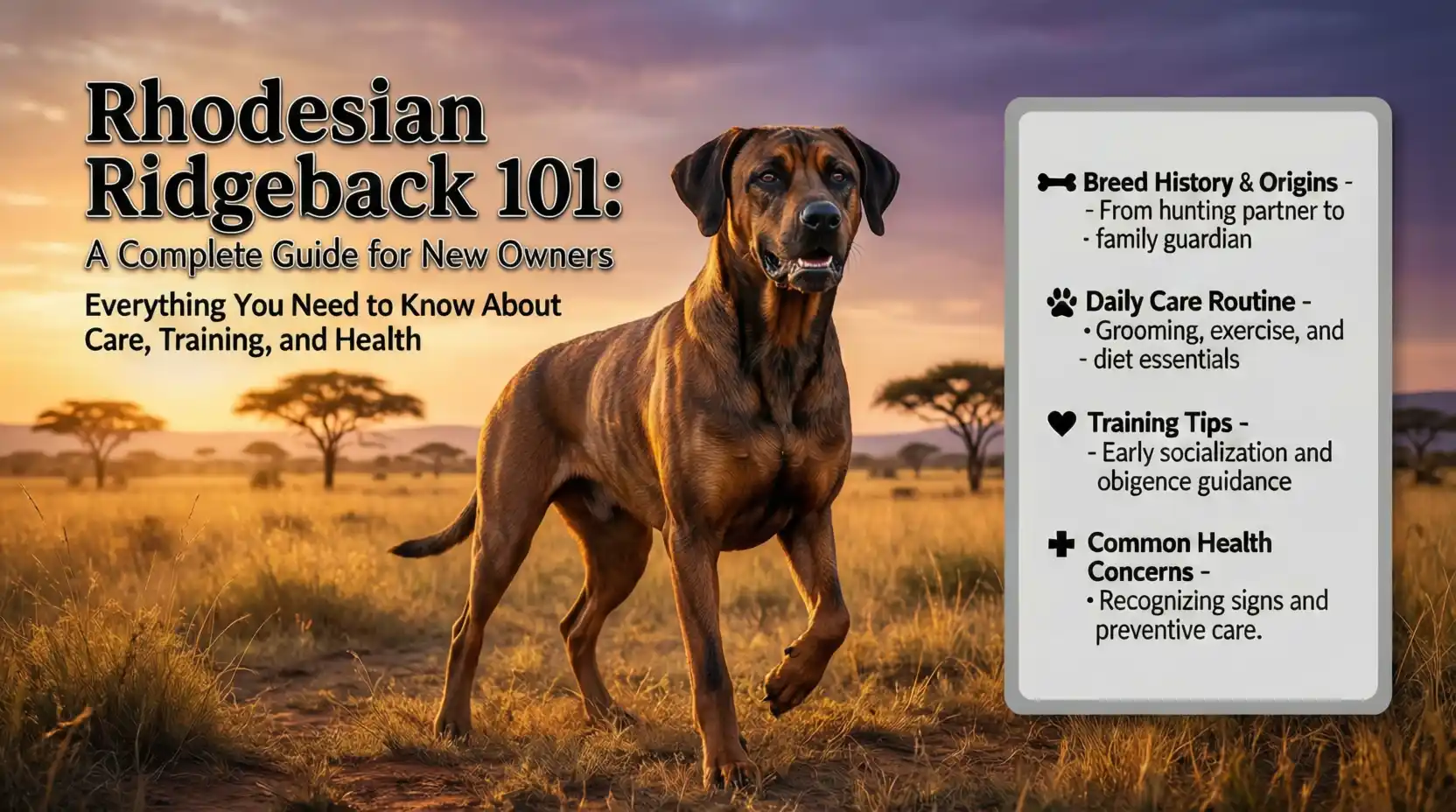
Rhodesian Ridgeback 101: A Complete Guide for New Owners
Welcome to the world of the Rhodesian Ridgeback, a breed that captures the imagination with its striking silhouette and dignified bearing. Known as the “Lion Dog” of Africa, this hound possesses a unique combination of speed, power, and loyalty that is unmatched in the canine world. However, owning a Ridgeback is not for the faint of heart. This is not a Golden Retriever in a funny suit; it is a protective, intelligent, and independent athlete that requires a specific type of owner.
This comprehensive guide is designed to take you on a deep dive into every aspect of living with this magnificent breed. From their historical roots in Southern Africa to the nuances of Rhodesian Ridgeback temperament, and from specific Ridgeback training tips to managing their health, we will cover everything you need to know to raise a happy, healthy, and well-adjusted companion.
Chapter 1: The History and Origins of the Lion Dog
To understand the Rhodesian Ridgeback, you must first understand where they came from. They are a breed shaped by the harsh landscape of South Africa and the necessities of survival.
The Foundation: The Khoikhoi Dog
The story begins centuries ago with the Khoikhoi people (formerly known as the Hottentots), indigenous pastoralists in Southern Africa. They owned a distinct, small-to-medium-sized dog with a ridge of hair growing backward along its spine. These dogs were fiercely loyal guard dogs and hunting companions. They possessed incredible stamina and an innate ability to bay game, meaning they would harass and corner a wild animal without killing it, keeping it at bay until the hunter arrived.
The European Influence
In the mid-19th century, European colonists, specifically Boer farmers, began settling in the region. They brought their own dogs—Great Danes, Greyhounds, Bloodhounds, Terriers, and Bulldogs—to the Cape. However, many of these European breeds struggled with the harsh African climate, the tsetse flies, and the rugged terrain.
Cornelius van Rooyen
The creation of the modern breed is largely credited to Cornelius van Rooyen, a big-game hunter living in Rhodesia (now Zimbabwe). In the late 1870s, van Rooyen crossed his own pack of hunting dogs with the ridged Khoikhoi dogs. His goal was to create the ultimate hunting dog: a dog that could withstand the heat, track prey over miles of rough terrain, and hold a lion at bay.
The result was a dog with the speed of a sighthound, the scenting ability of a scenthound, the endurance of a terrier, and the power of a mastiff—topped with the distinctive ridge of the Khoikhoi dog. These dogs became known as “Van Rooyen’s Lions Dogs.”
Standardization and Recognition
By the 1920s, a group of enthusiasts in Bulawayo (in what was then Rhodesia) formed a club to standardize the breed. They wrote the first standard, which prioritized the ridge and the dog’s working ability above all else. Interestingly, the breed was originally known as the Rhodesian Lion Dog, but the name was eventually changed to Rhodesian Ridgeback to emphasize the defining physical characteristic.
Chapter 2: The Distinctive Appearance
The Ridgeback is a dog of balance and functional strength. They are a “sighthound” build, meaning they are built for speed, but they are heavier and more muscular than a Greyhound.
The Ridge
The trademark of the breed is the ridge of hair on the back. It runs forward from the shoulders to the hips, in the opposite direction of the rest of the coat. This ridge is caused by a genetic mutation.
- The Crowns: Ideally, the ridge should have two identical “crowns” (whorls) directly opposite each other.
- The Box: The ridge should be clearly defined and taper only slightly toward the hips.
- The Faults: While only dogs with ridges can be shown in conformation, Ridgebacks are occasionally born without a ridge. These dogs are generally healthy and make excellent pets, though they are disqualified from the show ring. Other ridge faults include having only one crown, having the crowns too far back, or having multiple loose crowns.
Size and Build
- Males: Stand 25 to 27 inches at the shoulder and weigh roughly 85 pounds.
- Females: Stand 24 to 26 inches and weigh roughly 70 pounds.
- They should be slightly longer than tall, with a deep chest and a strong, level topline. Their movement is light and effortless, covering the ground with great strides.
Coat and Color
The coat is short, dense, sleek, and glossy. It is designed to protect them from the African sun and thorny brush. They are very low shedders for most of the year, though they do “blow coat” seasonally.
- Wheaten: This ranges from a light fawn to a deep, rich red-gold.
- Red-Wheaten: A darker, more intense red shade.
- Nose Pigmentation: The nose should be black or liver, matching the eye rims and claws. A black nose is preferred in the standard.
Chapter 3: Understanding Rhodesian Ridgeback Temperament
This is the most critical chapter for a potential owner. The Rhodesian Ridgeback temperament is often misunderstood. They are frequently described as having a “hard” personality. This does not mean they are mean; it means they are resilient, stoic, and not prone to fawning over people they do not know.
The “Aloof” Nature
Ridgebacks are famously reserved with strangers. Unlike a Labrador Retriever who might greet an intruder with a wagging tail and a tennis ball, a Ridgeback will stand back, observe, and assess. This aloofness is what makes them excellent guard dogs. They do not bark without cause, but when they do, you should pay attention. Their warning bark is a deep, serious sound.
The Velcro Dog Paradox
Despite being aloof with strangers, Ridgebacks are often referred to as “Velcro dogs” by their owners. They bond incredibly deeply with their chosen family. They want to be in the same room as you, often leaning against your legs or draping their heavy head across your lap. They crave physical contact with “their people.”
The Prey Drive
This is a non-negotiable aspect of the breed. They are hounds. If they see something running—a squirrel, a cat, a rabbit, or a neighbor’s small dog—their instinct is to chase.
- The Chase: It is thrilling for them. Once they lock on, they can be difficult to recall.
- New Owners Beware: If you have small pets like rabbits or hamsters, a Ridgeback is a high-risk choice. If you have cats, they can coexist, but usually only if the Ridgeback is raised with the cat from puppyhood.
The Stubborn Streak
Ridgebacks are intelligent, but they are independent thinkers. They were bred to hunt miles away from their human handlers, making decisions on their own. This means they often ask, “What’s in it for me?” before obeying a command. They are not submissive dogs like Collies or Shepherds.
Affection Levels
They are surprisingly affectionate and goofy with their family. They are known for the “Ridgeback Roll,” where they throw themselves onto their backs and wiggle ecstatically. They are often very gentle with children of their own family, tolerating ear pulling and roughhousing, though their sheer size means interactions should always be supervised.
Chapter 4: Ridgeback Training Tips
Training a Ridgeback requires patience, consistency, and a sense of humor. You cannot force a Ridgeback to do anything; you must convince them it was their idea in the first place.
- Start Early and Keep It Short
Puppyhood is crucial. However, Ridgeback puppies have short attention spans. Keep training sessions to 5 or 10 minutes, multiple times a day. End on a positive note.
- The Power of Positive Reinforcement
This is the golden rule of Ridgeback training tips. These dogs are sensitive to harsh corrections. If you yell at them or physically manhandle them, they will likely shut down or become defensive.
- Food Motivation: Most Ridgebacks are food motivated. Use high-value treats (cheese, hot dogs, soft training treats).
- Play Motivation: Many Ridgebacks love tug-of-war. Using play as a reward works well for high-energy dogs.
- Recall: The Holy Grail
Recall (coming when called) is the most difficult command to teach a sighthound. Because their prey drive is so strong, they are selectively deaf when a rabbit is involved.
- Never punish a dog for coming late: If you yell at your Ridgeback when they finally return after chasing a squirrel, they will associate coming back with being scolded. They will come back slower next time.
- Use a Long Line: Until you are 100% sure, do not let them off-leash in unsecure areas. A 30-foot long line allows them freedom but gives you control.
- Leash Walking
Ridgebacks are strong. They can pull you over if they decide to lunge at a squirrel.
- No-Pull Harness: Avoid choke chains or prong collars initially; a good front-clip harness is safer for their tracheas.
- Red Light, Green Light: If the leash goes tight, stop moving immediately. The reward for loosening the leash is moving forward.
- Socialization
Because they can be aloof and territorial, socialization is vital. You must expose them to as many people, dogs, sounds, and environments as possible within their first four months of life. This does not mean they have to like everyone, but they must learn to tolerate the presence of strangers without reacting aggressively.
Chapter 5: Exercise and Lifestyle Needs
A bored Ridgeback is a destructive Ridgeback. These are athletic dogs that were bred to run all day in the African heat.
Physical Requirements
- Daily Exercise: Aim for at least 60 to 90 minutes of vigorous exercise daily.
- Running and Hiking: Ridgebacks make excellent jogging partners once their growth plates have closed (usually around 18-24 months). They are also great hiking dogs because they have good endurance.
- Sighthound Sprints: You don’t just need to tire their body; you need to tire their legs. Sighthounds run in bursts. A fenced yard where they can sprint at top speed for 30 seconds is often more valuable to them than a 3-mile slow walk.
The “Couch Potato” Mode
One of the endearing qualities of the breed is that when they are done with exercise, they are done. They are indoor dogs who love to lounge on the sofa. They are generally calm inside the house, making them suitable for apartment living if the owner is dedicated to providing outdoor exercise.
Climate Considerations
- Heat: They handle heat surprisingly well due to their short coat and origin. However, they still need shade and water in extreme heat.
- Cold: They do not tolerate cold well. Their short coat offers little insulation. In winter climates, they will need a coat or sweater for walks, and they may refuse to go outside in snow or rain.
Chapter 6: Nutrition and Feeding
Because they are a large, deep-chested breed, diet plays a significant role in their overall health.
Puppy Nutrition: The Growth Controversy
Large breed puppies are prone to skeletal issues if they grow too fast. For Ridgebacks, “slow and steady” wins the race.
- Do NOT overfeed: You want your puppy to be lean. You should be able to feel their ribs easily. A chubby puppy puts too much stress on developing joints, leading to hip dysplasia later.
- Large Breed Formula: Use a high-quality food specifically formulated for large breed puppies. These formulas have controlled calcium and phosphorus levels.
The Threat of Bloat (Gastric Dilatation-Volvulus)
Bloat is a life-threatening condition where the stomach fills with gas and twists on itself. Ridgebacks are deep-chested and are at high risk.
- Symptoms: Distended abdomen, retching without producing vomit, pacing, drooling, and signs of pain.
- Immediate Action: This is a medical emergency. If you suspect bloat, get to a vet immediately. Death can occur within hours.
- Prevention Strategies:
- Wait before exercise: Do not exercise your dog for at least an hour before or two hours after eating.
- Slow Feeders: Use a bowl with obstacles inside to force the dog to eat slower.
- Smaller Meals: Feed two smaller meals a day instead of one giant meal.
Chapter 7: Rhodesian Ridgeback Health Issues
While generally a healthy and robust breed, they are prone to specific conditions. Understanding potential Rhodesian Ridgeback health issues is part of responsible ownership.
- Dermoid Sinus
This is the most specific genetic condition for the breed. It is a neural tube defect that occurs during embryonic development. It results in a tubular tract connecting the skin to the spinal cord.
- Diagnosis: These can often be felt or seen along the dog’s back (usually near the ridge) as small dimples or holes that may seep fluid.
- Treatment: Surgical removal is necessary to prevent severe infection and neurological damage. Responsible breeders screen for this and will not breed affected dogs.
- Hip and Elbow Dysplasia
Like all large breeds, Ridgebacks can suffer from malformation of the hip or elbow sockets, leading to arthritis.
- Prevention: Buying from a breeder who screens the parents (OFA or PennHIP scores) reduces the risk. Keeping the puppy lean during growth is also the #1 preventative measure owners can take.
- Degenerative Myelopathy (DM)
DM is a progressive disease of the spinal cord. It typically affects older dogs (8+ years). It starts with weakness in the hind legs and eventually leads to paralysis. It is painless but fatal in terms of mobility. There is a genetic test for this marker.
- Wobblers Syndrome (Cervical Spondylomyelopathy)
This condition affects the cervical spine (neck) and causes compression of the spinal cord. Symptoms include a “wobbly” gait, neck pain, and difficulty standing. It is more common in large, fast-growing breeds.
- Hypothyroidism
Some Ridgebacks suffer from an underactive thyroid gland. Symptoms include weight gain (despite a good diet), hair loss, and lethargy. This is easily managed with daily medication.
- Eye Problems
They can be prone to progressive retinal atrophy (PRA) and cataracts. Annual eye exams by a veterinary ophthalmologist are recommended.
Chapter 8: Grooming and Maintenance
The Ridgeback is a “wash-and-wear” dog. They do not require professional grooming, but they do need regular maintenance.
Brushing
They have a short, dense coat that sheds moderately. Weekly brushing with a rubber curry mitt or a bristle brush removes dead hair and distributes skin oils. During shedding season (spring and fall), daily brushing might be needed.
Bathing
They have low odor and only need a bath when dirty—perhaps every 2-3 months. Over-bathing can strip the natural oils from their coat.
Nail Trimming
This is often a battle. Ridgebacks are touchy about their feet, especially if they haven’t been handled enough as puppies. Because of their black nails, it can be hard to see the “quick” (the blood vessel inside). Use a grinder (like a Dremel) instead of clippers to reduce the risk of cutting the quick.
Dental Care
Large breed dogs are prone to periodontal disease. Brushing their teeth 2-3 times a week with dog-safe toothpaste is highly recommended to prevent expensive dental work later in life.
Chapter 9: Finding a Ridgeback and Bringing Them Home
If you have decided you can handle the independence, the prey drive, and the slobber, the next step is finding a dog.
Finding a Reputable Breeder
This is not a breed where you should cut corners. Because of the prevalence of Dermoid Sinus and Hip Dysplasia, you need a breeder who does health testing.
- Ask for Health Certificates: Ask to see OFA (Orthopedic Foundation for Animals) clearances for hips, elbows, and eyes.
- Visit the Facility: The puppies should be raised in the home, not a kennel run. The mother should be on-site (or you should be able to ask about her temperament).
- Temperament Testing: A good breeder will know which puppy is high-drive (good for sports) and which is more laid back (good for a pet home). Be honest about your lifestyle.
Adopting or Rescuing
There are dedicated Ridgeback rescues. Many dogs end up in rescue because their owners underestimated their energy or prey drive. Rescue dogs can be wonderful, but you must be prepared for potential baggage, such as separation anxiety or a lack of leash manners.
Puppy-Proofing Your Home
Before the puppy arrives:
- Secure the Fence: Ridgebacks are houdinis. They can dig under or jump over a 4-foot fence. A 6-foot privacy fence is recommended.
- Remove Valuables: Puppies chew. Shoes, remote controls, and charging cables must be kept out of reach.
Chapter 10: Integrating a Ridgeback into Your Family
Ridgebacks and Children
When raised together, Ridgebacks are generally amazing with children. They are sturdy enough to handle rough play and gentle enough to be careful. However, they are large dogs and can accidentally knock over a toddler. Supervision is mandatory.
Ridgebacks and Other Pets
- Dogs: They usually get along well with other dogs of the opposite sex. Same-sex aggression is not uncommon in the breed.
- Cats: If you have a cat, getting a puppy is your best bet. Introducing an adult Ridgeback to a cat is risky and requires careful management (separation, baby gates, leashed introductions).
The “Teenager” Phase
Beware the Ridgeback adolescence (roughly 6 months to 2 years). This is when they test their boundaries. They may suddenly “forget” their recall or challenge your leadership. This is the time when many owners give up. Stay consistent, keep up the training, and you will come out the other side with a wonderful adult dog.
Conclusion
The Rhodesian Ridgeback is a breed that stays with you. They are not just a pet; they are a lifestyle. They are the dog that runs 5 miles with you in the morning, sleeps soundly at your feet while you work, and stands guard at the door at night.
Their dignity and loyalty are unmatched. If you are looking for a dog that will hang on your every word and live to please, this is not the dog for you. But if you are looking for an intelligent, athletic partner who will challenge you, make you laugh, and love you with a quiet, fierce intensity, then the Ridgeback might just be your soulmate.
Owning a Lion Dog is a journey. It requires patience, humor, and a firm hand, but the reward is a bond unlike any other in the canine world.
Disclaimer
The information provided in this guide (“Rhodesian Ridgeback 101”) is for general informational and educational purposes only. It is not intended to be a substitute for professional veterinary advice, diagnosis, or treatment. Always seek the advice of your veterinarian or other qualified animal health provider with any questions you may have regarding the health, medical condition, or behavior of your pet. Never disregard professional veterinary advice or delay in seeking it because of something you have read in this guide. Reliance on any information provided here is solely at your own risk.
Have any thoughts?
Share your reaction or leave a quick response — we’d love to hear what you think!
-
 0
-
 0
-
 0
-
 0
-
 0
-
 0
