
Disclaimer: The following account is a detailed examination of the alleged paranormal events surrounding the doll known as Annabelle, as reported by the subjects involved (Ed and Lorraine Warren) and the primary witnesses (Donna and Angie). It is presented for informational and entertainment purposes only. The existence of ghosts, demons, or hauntings is a subject of skepticism and debate within the scientific community. Reader discretion is advised.
Keywords: Paranormal Investigation, Ed and Lorraine Warren, Demonic Haunting
Hashtags: #Annabelle #TrueStory #Paranormal
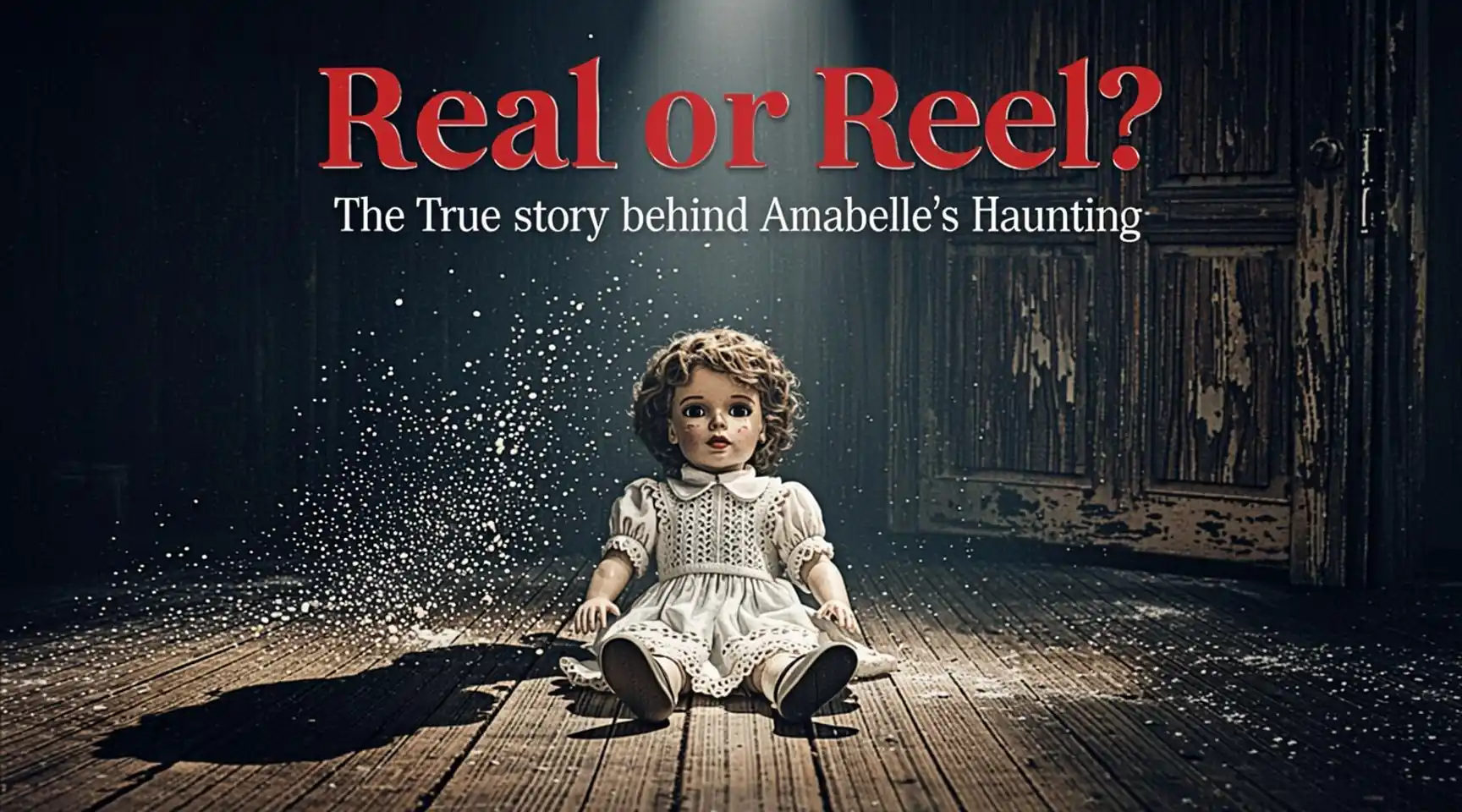
Real or Reel? The True Story Behind Annabelle’s Haunting
Part I: The Porcelain Deception vs. The Raggedy Reality
When the lights dim in a movie theater and the iconic score of The Conjuring swells, audiences are introduced to a nightmare of porcelain and lace. The cinematic Annabelle is a towering, grotesque antique doll with hollow eyes and a chilling, frozen grin. She is the stuff of visceral terror, a visual shorthand for evil that has permeated pop culture. However, the truth behind the haunting is far stranger, and arguably more unsettling, because the true Annabelle was not a porcelain figure crafted for terror, but a harmless, innocent-looking Raggedy Ann doll.
This dichotomy between the “Reel” and the “Real” is the cornerstone of understanding the Annabelle phenomenon. In Hollywood, fear is manufactured through aesthetics. In the real world, fear often comes from the corruption of the familiar. The real Annabelle was soft, made of cloth, with a sewn-on smile and red yarn hair. She was a toy designed to be cuddled. This inherent innocence made the malevolence that allegedly possessed her all the more horrifying. It suggested that evil was not confined to the dark and grotesque, but could infiltrate the bright and safe corners of a suburban nursing student’s apartment.
The story begins not in a gothic mansion, but in Hartford, Connecticut, in 1970. It was a time of social upheaval and changing norms, but for Donna, a nursing student, and her roommate Angie, life was structured around exams and clinical rotations. It was Donna’s mother who gifted her the doll for her birthday. The Raggedy Ann doll was seated on her bed as a decoration, a nostalgic nod to childhood rather than a plaything.
At first, the doll was inert. It sat propped up against the pillow, unmoving and unremarkable. But subtle shifts soon occurred. It wasn’t a sudden leap to horror; it was a slow, insidious creep. The girls would return home to find the doll in a different position than when they left. Its arms, once by its side, would be crossed. Its legs, once straight, would be bent. It was the kind of movement that could be dismissed—perhaps they bumped it, perhaps a draft moved it. The human mind is wired to rationalize, to find logical explanations for the illogical. This rationalization phase is common in early hauntings, a period where the investigators later refer to as “infestation.” The entity is testing the waters, seeing how much it can move before it is noticed.
Part II: The Escalation – Movement and Messages
As the weeks turned into months, the activity surrounding the Raggedy Ann doll intensified beyond mere repositioning. The phenomenon graduated from passive movement to active, aggressive relocation. Donna and Angie would leave the apartment with the doll sitting comfortably in Donna’s room. Upon returning, they would find it in the living room, sometimes sitting on the couch, other times lying on the floor.
It was easy to dismiss a doll moving its arms. It was significantly harder to dismiss a doll moving from room to room, especially when the doors were closed. The girls began to suspect a prank. They had friends who had access to the apartment; perhaps someone was sneaking in to mess with them. To test this theory, they employed a classic countermeasure: they locked the door before leaving.
When they returned and found the doll in the living room despite the locked door, the prank theory began to fray. There was no sign of forced entry, no indication that anyone had been in the apartment. But the human need for order is strong. They clung to the idea of an intruder, perhaps someone with a key, rather than accepting the alternative—that the inanimate object was animate.
Then came the writings.
The turning point, the moment where the possibility of a mundane explanation evaporated, involved the discovery of parchment paper. Neither Donna nor Angie used parchment paper. Yet, one day, they found small, distinct scraps of parchment paper scattered around the apartment. On these scraps were childish scribblings, messages that seemed to ask for help. The phrases were brief, desperate. “Help Us,” and “Help Lou.”
This was a critical moment in the narrative. The appearance of writing introduced an intelligence behind the phenomena. It was no longer just kinetic energy; it was communication. But who was writing? And who were “Us”?
Donna was a nursing student. Her life was one of care and science. Angie was pragmatic. They were not prone to flights of fancy. They tried to confront the situation logically. They questioned if the writing was theirs, perhaps done in a fugue state or sleepwalk, but the handwriting didn’t match. They questioned the friends again, but the friends denied it, and given the locked doors, the denial held weight.
It was at this stage that a third party entered the fray: Lou. Lou was Angie’s boyfriend. He was the quintessential skeptic, the anchor to reality that Donna and Angie desperately needed. Lou did not believe in ghosts. He did not believe in spirits. He believed in physics and locks and keys. However, Lou’s skepticism was about to be brutally challenged by the doll he had begun to despise.
Lou had never liked the doll from the beginning. He described feeling an instant aversion to it, a primal revulsion. In interviews later conducted with paranormal investigators Ed and Lorraine Warren, Lou described the doll as “evil.” It wasn’t just that it was creepy; it was that it felt wrong, as if it were a receiver for something dark. He urged Donna to get rid of it. He begged Angie to make her throw it away. But Donna, feeling a strange sense of responsibility for the doll, or perhaps a subtle manipulative influence from the entity within it, refused.
Part III: The Nightmare and the Attack
The haunting moved from the psychological and the mildly physical to the violently personal with a series of events involving Lou. The first incident occurred during a visit to the apartment. Lou and Angie were sitting in the living room, reviewing maps for an upcoming road trip. Donna was out.
As they studied the map, they heard rustling noises coming from Donna’s bedroom. It sounded like someone was shuffling through papers or moving small objects. Lou, protective and suspicious, got up to investigate. He walked to the closed bedroom door and listened. The silence returned. He waited a moment, then turned back to Angie. Just as he sat down, the commotion started again, louder this time. It was the sound of something being wrestled with, a scuffling struggle.
Lou sprang to his feet and threw the bedroom door open. The room was empty—except for the doll.
Annabelle had been tossed into a corner, her ragged limbs splayed awkwardly. But as Lou watched, he saw something impossible. The doll began to slowly slide up the wall. It didn’t fall; it climbed. It dragged its cloth body against the plaster, defying gravity, until it reached the midpoint of the wall. Then, with a sudden, violent motion, it launched itself across the room and landed at Lou’s feet.
This was the shattering of Lou’s worldview. He scrambled back, retreating to the living room, his mind racing to process the kinetic impossibility he had just witnessed. He knew then, with absolute certainty, that the doll was not a toy. It was a vessel.
But the entity was not finished with Lou. It had marked him as a threat, or perhaps simply as a target for its malice.
A few nights later, Lou and Angie were preparing to leave the apartment to go to the movies. As they gathered their coats, Lou suddenly felt a distinct, tightening sensation in his chest. It wasn’t heartburn; it was a muscular constricting, as if an invisible hand were squeezing his heart. The pain was blinding, sharp and searing. He collapsed to the floor, gasping for air, clutching his chest.
The pain passed as quickly as it had arrived, leaving him shaken and sweating. He told Angie he felt fine, just a sudden spasm, but the terror in his eyes betrayed him. They decided to stay home that night.
That night, Lou had a nightmare. In the dream, he was lying in his bed, paralyzed. He couldn’t move his limbs, couldn’t scream. He looked up and saw the Raggedy Ann doll perched on his chest. It wasn’t sitting idly; it was crawling up his body. Its cloth legs moved with a grotesque, insect-like motion. It reached his neck, and its yarn hands wrapped around his throat. It began to strangle him. In the dream, he fought, thrashing against the weight, but the doll was incredibly strong. He felt the life being choked out of him, the darkness closing in.
Lou woke up screaming, his body drenched in sweat, his hands clawing at his throat. It had been so vivid, so visceral, that he could still feel the phantom pressure of the yarn hands. The line between dream and reality had blurred.
The next morning brought the physical manifestation of the nightmare. Lou woke up and went to the bathroom to splash water on his face. As he looked in the mirror, he recoiled in horror. There, on his chest, were three distinct claw marks. They were red, raw, and parallel, arranged vertically. They were hot to the touch and burned like fire. They looked exactly like claw marks, yet they were perfectly straight, as if made by an iron or a rake, not a human hand. And they healed without scarring, vanishing within two days, leaving behind only the memory and the photograph taken by Ed Warren.
Part IV: Enter the Warrens
The incident with the claw marks was the breaking point. The events had spiraled beyond the realm of pranks or bad dreams. They were now in the realm of the demonic. Donna and Angie finally contacted a priest, who in turn reached out to Ed and Lorraine Warren.
Ed and Lorraine Warren were the preeminent demonologists of the 20th century. Based in Connecticut, they investigated thousands of cases of hauntings and possessions. Their approach was a blend of Ed’s religious conviction and Lorraine’s clairvoyant abilities. When they arrived at the nursing students’ apartment, they did not find a ghost. They found something far worse.
The Warrens’ investigation began with an interview. They listened to the accounts of the moving doll, the parchment messages, and the attack on Lou. Ed noted that the doll, being an inanimate object, had no innate power. It was merely a shell. However, if an inhuman spirit attached itself to an object, it could use that object as a conduit to interact with the physical world. The spirit was using the doll to “mock” the concept of humanity, taking something innocent and twisting it.
Lorraine Warren, a trance medium, entered the apartment and immediately sensed a oppressive atmosphere. She described the presence as “inhuman.” In paranormal lore, there is a distinct difference between a human spirit (a ghost) and an inhuman spirit (a demon). A human spirit is often tied to a location or a trauma; they are often confused or repetitive. An inhuman spirit is intelligent, malevolent, and deceptive. They have never been human.
Lorraine sensed that the entity was not the spirit of a deceased little girl named Annabelle Higgins, as the notes had suggested. This was a ruse. Demons are known to be “diabolical,” a word derived from the Greek diaballein, meaning “to throw across” or “to slander.” They lie. They manipulate. By posing as a harmless, dead child, the entity hoped to gain the girls’ sympathy and trust. “Help Us” was a trap. If the girls invited the “spirit” to stay or tried to help it “cross over,” they would be giving it permission to infest their lives. Permission is a powerful legal concept in spiritual warfare.
The Warrens concluded that the doll was acting as a “spiritual battery.” The entity was drawing energy from the environment—and the fear of the occupants—to manifest. The more afraid Donna and Angie became, the stronger the entity grew.
Ed decided to perform a purification of the apartment, but he knew the danger lay in the doll itself. He told the girls that the doll was no longer a toy. It was a cursed object.
As they prepared to leave, Ed asked for the doll. He placed it in a plastic bag and instructed Donna not to open it, no matter what happened on the drive home. As Ed drove away with the doll in the back seat, the car began to stall. The engine sputtered and died. The power steering failed, making the vehicle difficult to control. Ed, experienced in these phenomena, quickly grabbed a vial of holy water from his glove compartment. He splashed the water onto the bag containing the doll and recited a prayer. The engine roared back to life, and the steering returned to normal. The entity within the doll was protesting its capture.
Part V: The Exorcism and the Museum
The Warrens brought Annabelle back to their home in Connecticut. They did not keep her in the house. Instead, they had a special building constructed in their yard to house cursed and possessed items: The Occult Museum.
Before placing her in the museum, however, the Warrens contacted a priest to perform an exorcism. It is important to note that exorcisms are typically performed on people or places, not objects. However, in extreme cases, a blessing or exorcism of an object is necessary to sever the link between the demonic entity and the item.
A priest, who has remained anonymous in most accounts, came to bless the doll. He did not take the situation lightly. He was well aware of the attack on Lou and the strange phenomena during the car ride. As he began the prayers, the priest did not hear the doll speak or see it move, but he felt a profound sense of evil. In a recounting of the event, the priest allegedly told Ed, “I don’t know what this thing is, but it is real.”
Once the ritual was complete, the entity was largely contained within the doll, unable to project its influence outward unless provoked or given an opening. The doll was placed in a glass box. The box was not just for display; it was a containment unit. The sign on the box reads: “Positively Do Not Open.”
This is where the real story of Annabelle ends and the legend begins. The Raggedy Ann doll sits in that box to this day, located at the Warrens’ Occult Museum (currently managed by their son-in-law, Tony Spera). Her yarn hair is a bit dingier, her fabric a bit more worn, but she wears the same innocent smile she did in 1970.
The museum is filled with terrifying artifacts: a conjuring mirror used for summoning spirits, a children’s toy used in a satanic ritual, and a shroud from a tomb. Yet, Annabelle remains the star attraction. Visitors report feeling uneasy near her case. Some say they feel watched. Others claim to see her move within the glass, though this is often attributed to optical illusion or the power of suggestion.
Part VI: Real or Reel – Analyzing the Differences
The transition from the real account to the cinematic universe of The Conjuring required significant creative license. This is not necessarily a criticism; horror movies require visual stakes and pacing that real life rarely provides. However, understanding the differences highlights the true nature of the alleged haunting.
- The Appearance: As established, the movie doll is a porcelain antique. The real doll is Raggedy Ann. The change in the movie makes sense for visual impact. A porcelain doll with a china face inherently carries a creepy “uncanny valley” vibe. A Raggedy Ann doll looks like it belongs in a nursery. The movie prioritizes immediate visual fear; the true story relies on the subversion of innocence.
- The Victims: In the movies, the haunting is centered around a young couple, Mia and John Gordon, set in the 1960s/70s. In real life, the victims were two nursing students and a male friend. The dynamic of young women living together, sharing a domestic space, adds a layer of violation to the real story. The sanctuary of their home was breached.
- The Manifestations: The movie Annabelle is responsible for brutal murders, self-immolation (a character setting themselves on fire), and violent physical attacks. The real Annabelle’s activity was more poltergeist-like: moving, writing, and one specific instance of physical aggression (the clawing of Lou). The real entity was more insidious, preferring psychological manipulation and slow escalation over the slasher-film violence of the cinematic version. The real horror was the uncertainty—is it moving or did I imagine it?
- The Spirit: The movies lean heavily into the “Annabelle Higgins” backstory—the spirit of a deceased 7-year-old girl seeking a mother. In the real investigation, the Warrens quickly dismissed this. They believed the “Annabelle Higgins” persona was a demonic mask. A demon pretending to a child is a classic trope in occult lore, designed to lower defenses. The movies dramatize this possession arc, whereas the real story focused more on the investigation and containment.
Part VII: The Psychology of Haunted Objects
Why does the story of Annabelle resonate so deeply? Why, despite the logical explanations offered by skeptics, do thousands of people visit the museum each year?
The fear of haunted objects—specifically dolls—is deeply rooted in the human psyche. This fear is known as pediophobia (fear of dolls) or automatonophobia (fear of things that falsely represent a sentient being).
Dolls occupy a unique space in our development. We project consciousness onto them as children. We talk to them, we treat them as real. As we grow up, we learn to stop that projection, but the neural pathways remain. A doll looks human, but it is not. It mimics life, but it possesses no vitality. It falls into the “Uncanny Valley”—that psychological state where something looks almost human but not quite, triggering a revulsion response.
When a doll is “haunted,” it validates our deepest, most primal fear: that the inanimate objects around us might be watching us. It suggests that the material world is not solid and predictable, but fluid and permeable by forces we cannot control.
Skeptics argue that the Annabelle case is a classic example of the ideomotor effect and group hysteria. The ideomotor effect refers to the process where a thought or mental image causes a subconscious, involuntary muscle movement. If Donna or Angie unconsciously moved the doll while thinking about it, or if they stared at it until their eyes played tricks (pareidolia), they could convince themselves of movement. Once the fear took hold, the group dynamic reinforced it. If one believed, the other was likely to follow.
The “claw marks” on Lou are often explained away as self-inflicted (perhaps during a nightmare or a panic attack) or as a psychosomatic manifestation. The mind is incredibly powerful; under extreme stress and belief, the body can produce physical symptoms, such as rashes or wounds, without external physical cause.
However, the Warrens and believers counter that the evidence—specifically the claw marks that healed instantly and the car stalling—points to an external intelligence. They argue that the consistency of the narrative, the corroborating witnesses, and the sheer duration of the haunting make it difficult to dismiss as mere pranksterism or hysteria.
Part VIII: The Legacy of Annabelle
Regardless of where one stands on the spectrum of belief, the cultural impact of Annabelle is undeniable. She has become a modern icon of horror, rivaling Chucky and the Twilight Zone’s Talky Tina. She represents the bridge between the folkloric ghosts of the past and the cinematic slashers of the present.
The Conjuring universe has kept the story alive, introducing Annabelle to new generations. The doll’s face is emblazoned on t-shirts, posters, and merchandise. She has become a brand.
But there is a solemnity to the real Annabelle that the movies sometimes miss. She sits in her box, a quiet testament to a terrifying experience for three young people fifty years ago. She represents the Warrens’ life work and their belief that the battle between good and evil is real, ongoing, and happening in our living rooms.
The warning on her case, “Positively Do Not Open,” serves a dual purpose. Practically, it is a safety measure to keep the curious from potentially unleashing something harmful. Metaphorically, it serves as a warning to the living. There are doors—between the living and the dead, the known and the unknown—that perhaps should remain closed.
Part IX: Conclusion – The Final Verdict
So, is it Real or Reel?
The “Reel” is a masterful work of fiction. It takes the bare bones of a true story and dresses them in the gore and jump-scares required to sell tickets. It invents a mythology of devil worshippers and sacrificial rituals to provide a clear antagonist and a high-stakes climax.
The “Real” is far more ambiguous. It is a story of a Raggedy Ann doll that moved, wrote notes, and may have clawed a young man. It is a story of fear escalating slowly, of rationalizations crumbling under the weight of impossible evidence. It is a story of Ed and Lorraine Warren, two people who dedicated their lives to fighting these shadows.
If you ask a skeptic, the answer is clear: the Real is a hoax born of stress, suggestion, and the human propensity for storytelling. If you ask a believer, the answer is equally clear: the Real is a documented case of demonic infestation.
The truth, as it often does, likely lies somewhere in the murky middle, obscured by the passage of time and the retelling of tales. But perhaps the most chilling aspect of the true story is not the doll itself, but the idea that Donna’s mother bought it as a gift of love. It was intended to bring comfort. Instead, it brought chaos. It serves as a grim reminder that we do not always know what we are inviting into our homes.
Annabelle remains in her box. She does not speak. She does not move. She waits. And in that waiting, she generates more fear than any Hollywood screenwriter could hope to script. Whether you believe she is possessed by a demon or merely a piece of pop-culture history, one thing is certain: you will never look at a Raggedy Ann doll the same way again.
Have any thoughts?
Share your reaction or leave a quick response — we’d love to hear what you think!
-
 0
-
 0
-
 0
-
 0
-
 0
-
 0
