
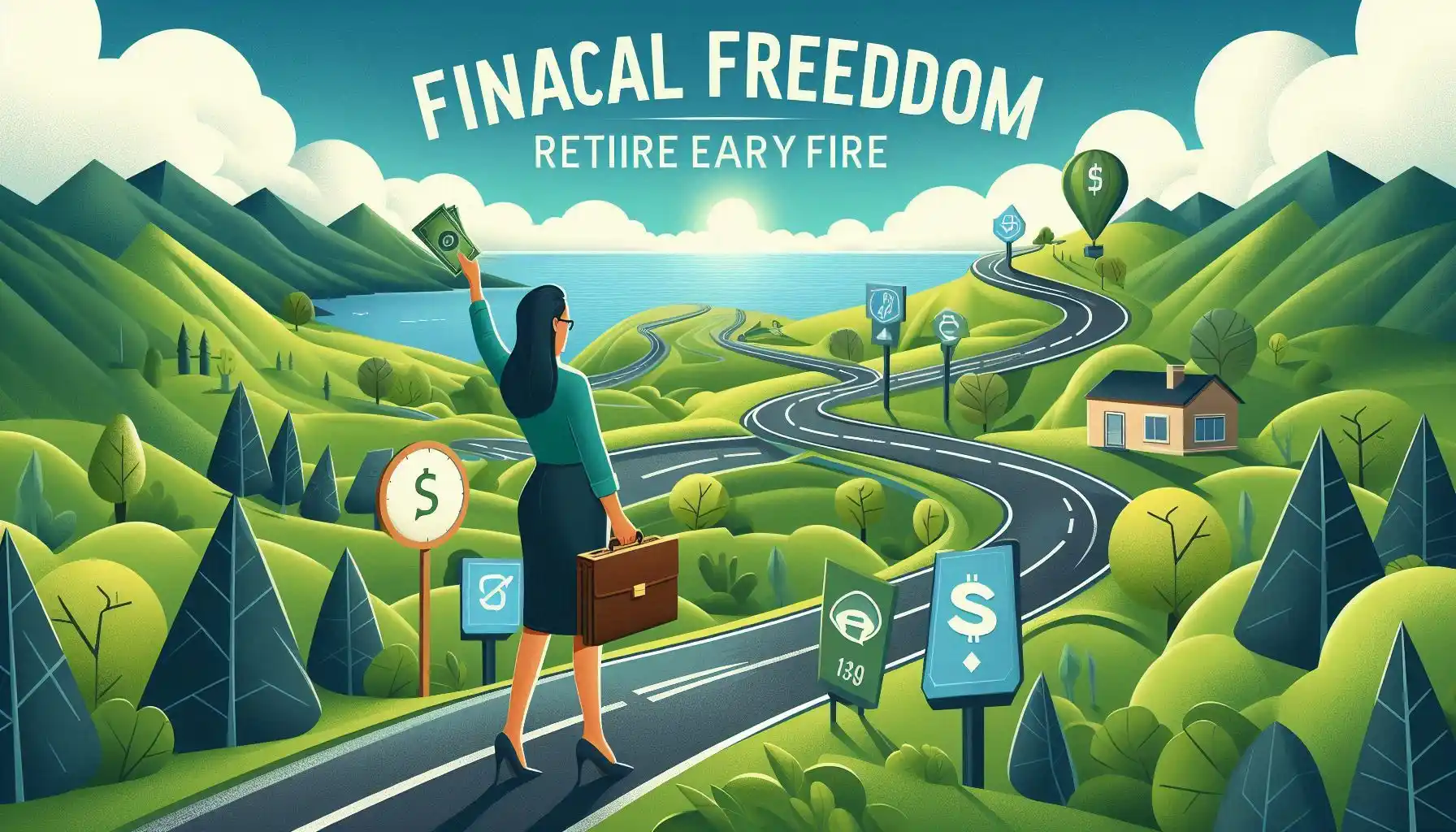
Financial Independence, Retire Early (FIRE): A Realistic Roadmap to Early Independence
Introduction: Beyond the Hype – The True Meaning of Freedom
The phrase “Financial Independence, Retire Early,” or FIRE, burns brightly in the modern consciousness. It conjures images of twenty-somethings bidding farewell to cubicle life, traveling the world with backpacks, and living a life unburdened by the 9-to-5 grind. Social media is awash with stories of miraculous savings rates and stock market triumphs, making it seem like an exclusive club for the financially gifted or the obsessively frugal.
But peel back the layer of hype, and you’ll find a movement that is far more profound, nuanced, and accessible than these sensationalist portrayals suggest. At its core, FIRE is not about escaping work; it’s about escaping compulsory work. It is the deliberate and systematic process of building a life where you have ultimate control over your most precious resource: your time. It’s the freedom to choose how you spend your days, whether that’s starting a passion project, volunteering, traveling, spending more time with family, or simply continuing to work on your own terms without the looming pressure of a paycheck.
This guide is not a get-rich-quick scheme. It is a realistic roadmap. It acknowledges the challenges, the sacrifices, and the undeniable privilege that can make the journey easier for some. It will dismantle the myths, break down the complex math into understandable concepts, and explore the profound psychological shifts required to walk this path. This is about building a sustainable, resilient financial foundation that doesn’t just allow you to retire early, but provides a lifetime of security and options. Whether your goal is to stop working at 35, 45, or 55, or simply to achieve a state of complete financial security while you continue to work, the principles of FIRE are the blueprint. Welcome to the real, unvarnished, and ultimately empowering world of Financial Independence.
Part 1: The Philosophical Bedrock – Why Do We Seek FIRE?
Before diving into spreadsheets, investment strategies, and savings rates, it is crucial to start with the most important question: Why? The “why” is the fuel that will power you through decades of discipline, motivate you when the market crashes, and guide your decisions when faced with lifestyle trade-offs. Without a strong “why,” the pursuit of FIRE can become a hollow exercise in accumulating numbers for their own sake.
Redefining “Retirement”
The “Retire Early” in FIRE is arguably the most misunderstood part of the acronym. For many, it doesn’t mean a permanent vacation of golf courses and cruise ships. Traditional retirement is often framed as an end—a cessation of contribution. In the FIRE community, it’s more accurately seen as a beginning.
It’s the retirement from a job you need to do, to a life you get to do. This could mean:
- The Portfolio Career: Dabbling in multiple part-time jobs or consulting roles in fields you genuinely love, without worrying about the salary.
- The Entrepreneurial Leap: Finally starting that business you’ve always dreamed of, able to weather the initial unprofitable years because your living expenses are covered.
- The Creative Pursuit: Writing a novel, becoming a full-time artist, or dedicating yourself to music, pursuits that often offer little financial reward but immense personal fulfillment.
- The Caregiver: Having the flexibility to care for aging parents or young children without the immense stress of juggling a demanding job.
- The Volunteer: Dedicating your time and skills to a cause you are passionate about.
Redefining retirement in this way transforms the goal from “not working” to “working on what matters most to me.” This shift is fundamental. It makes the journey less about deprivation and more about intentional design.
The Quest for Autonomy and Control
At its heart, the desire for FIRE is a deep-seated human need for autonomy. The traditional career path often involves ceding control. You work when your employer tells you to, take vacation when you’re allowed, and your income is ultimately determined by someone else’s assessment of your value. This lack of control can lead to stress, burnout, and a feeling that your life is not your own.
FIRE is about reclaiming that control. It’s about building a system where your assets, not your boss, dictate your options. This financial autonomy creates a powerful buffer against life’s uncertainties. A toxic work environment becomes a temporary inconvenience, not a life sentence. A layoff is an opportunity, not a catastrophe. This sense of security and self-determination is perhaps the greatest prize on the FIRE journey.
The Antidote to Lifestyle Inflation
We live in a consumer-driven culture that constantly pushes us to want more. A raise at work is often immediately followed by a bigger house, a nicer car, or more expensive vacations. This phenomenon, known as lifestyle inflation, is the single greatest enemy of wealth-building for most high-income earners. It’s a treadmill: no matter how fast you run, you never get ahead.
The FIRE philosophy provides a powerful framework for resisting this trap. By focusing on happiness derived from experiences, relationships, and personal growth—rather than material possessions—you intentionally decouple your spending from your income. Every raise becomes an opportunity to accelerate your journey to freedom, not an excuse to buy more stuff. This conscious consumption is not about deprivation; it’s about optimization. It’s spending lavishly on the things that truly bring you joy and ruthlessly cutting costs on the things that don’t.
Part 2: The Engine of FIRE – The Uncompromising Math
While the philosophy provides the “why,” the math provides the “how.” The beauty of the FIRE movement is that its core principles are based on simple, powerful mathematical truths. Understanding these concepts is non-negotiable. They are the engine that will drive your progress.
The 4% Rule: The North Star of FIRE
The most famous (and debated) concept in the FIRE world is the 4% Rule. Originating from the 1994 “Trinity Study,” this rule of thumb provides a simple answer to a complex question: “How much money can I safely withdraw from my investment portfolio each year without ever running out of money?”
The rule states that you can withdraw 4% of your initial portfolio value in your first year of retirement, and then adjust that amount for inflation each subsequent year. There is a very high probability (historically around 95-96% based on U.S. market data) that your portfolio will last for at least 30 years.
Example:
- Your desired annual spending in retirement is $40,000.
- According to the 4% rule, you need a portfolio valued at: $40,000 / 0.04 = $1,000,000.
This $1,000,000 figure is your “FIRE Number” or “Crossing the Finish Line.” Once you have this amount invested, you can theoretically live off the returns indefinitely, leaving the principal intact to continue growing.
Crucial Caveats to the 4% Rule: This is a “realistic roadmap,” so we must be honest about the rule’s limitations:
- It’s a Guideline, Not a Guarantee: The Trinity Study was based on historical U.S. market data. Past performance is not a guarantee of future results. A prolonged global market downturn could challenge its assumptions.
- Sequence of Returns Risk: The biggest risk is a major market crash occurring in the first few years of retirement. If you are forced to sell investments at a low point to cover your living expenses, you can permanently damage your portfolio’s ability to recover. This is why many in the FIRE community advocate for a more conservative 3% or 3.5% withdrawal rate, or for flexible spending strategies during down markets.
- Asset Allocation Matters: The study assumed a balanced portfolio of roughly 50-75% stocks and 25-50% bonds. Being 100% in stocks or 100% in bonds changes the outcomes significantly.
- Time Horizon: The study was for a 30-year retirement. If you retire at 30, you might have a 60+ year retirement, which increases the uncertainty. This is why many pursue a “Lean FIRE” with lower expenses (allowing for a lower withdrawal rate) or build in a buffer.
Despite these caveats, the 4% rule remains an invaluable tool for setting a target and understanding the relationship between your savings and your future income.
The Savings Rate: The Most Powerful Lever
If the 4% rule is the destination, your savings rate is the vehicle that gets you there. It is, without question, the single most important factor in determining how quickly you reach FIRE.
Your savings rate is the percentage of your take-home pay that you save and invest. It’s not just what you put in a savings account; it’s everything you put towards your future: 401(k) contributions, IRA deposits, taxable investments, etc.
Why is it so powerful? Because it works on both sides of the equation simultaneously. A higher savings rate means you’re investing more money each year and your annual expenses are lower, meaning you need a smaller “FIRE Number” to live on.
Let’s look at a hypothetical example of someone earning $60,000 a year after taxes:
| Savings Rate | Annual Savings | Annual Spending | FIRE Number (25x Spending) | Years to FIRE (Assuming 5% Real Return) |
| 10% | $6,000 | $54,000 | $1,350,000 | ~51 years |
| 20% | $12,000 | $48,000 | $1,200,000 | ~37 years |
| 35% | $21,000 | $39,000 | $975,000 | ~25 years |
| 50% | $30,000 | $30,000 | $750,000 | ~17 years |
| 70% | $42,000 | $18,000 | $450,000 | ~9 years |
Note: The “Years to FIRE” is a simplified calculation and doesn’t account for everything, but it illustrates the dramatic effect.
Notice the staggering difference. Moving from a 10% to a 20% savings rate shaves 14 years off your journey. Jumping from a standard 20% to an aggressive 50% cuts the time to freedom by another 20 years. This is why the FIRE community is so obsessed with minimizing expenses and maximizing income. Your savings rate is the direct expression of that obsession.
The Two Sides of the Savings Rate Coin: Income and Expenses
To increase your savings rate, you have two levers to pull: increase your income or decrease your expenses. The most successful FIRE adherents work on both with equal intensity.
1. Mastering Your Expenses (The “Fire” in FIRE): This is where most people start. It’s the most immediate way to increase your savings rate. This isn’t about being a miser; it’s about being a conscious consumer.
- The Big Three: Housing, transportation, and food typically consume 60-70% of most households’ budgets. Optimizing these three categories will have a far greater impact than cutting out your daily coffee.
- Housing: Can you house-hack (rent out a room or a portion of your house)? Can you live in a smaller, less expensive home or a lower cost-of-living area? Can you refinance your mortgage to a lower rate?
- Transportation: Can you live a car-free or car-light lifestyle? Can you buy a reliable, used car and drive it for 15 years instead of leasing a new one every three?
- Food: Can you cook more meals at home? Can you meal plan to reduce food waste? Can you buy generic brands?
- The “Latte Factor” (with a caveat): Small, recurring expenses do add up. A $5 daily habit is over $1,800 a year. However, don’t focus on these to the exclusion of the Big Three. It’s better to save $500 a month on housing than to agonize over a $50 a month streaming bill. Focus your energy where the biggest impact lies.
2. Maximizing Your Income (The Accelerator): There is a limit to how much you can cut, but theoretically, there is no limit to how much you can earn. Increasing your income is a powerful way to supercharge your savings rate without feeling deprived.
- Career Advancement: This is often the most effective path. Negotiate your salary at every opportunity. Acquire new skills that make you more valuable. Seek promotions or change companies to secure significant pay bumps. A 10% raise is far easier to achieve than cutting your expenses by another 10%.
- Side Hustles and Entrepreneurship: The “gig economy” has made it easier than ever to earn extra money. This could be freelancing, consulting, driving for a ride-share service, tutoring, or turning a hobby into a small business. This income can be directed 100% towards your investments, dramatically accelerating your timeline.
- Passive Income: This is the holy grail. Building income streams that require little to no active effort, such as from dividend-paying stocks, real estate rentals, or digital products (like an e-book or online course). This is a more advanced strategy, but it’s a key component for many who achieve FIRE quickly.
Part 3: The Three Pillars of Your Financial Fortress
With the philosophy and the core math in place, we can now build the practical structure. Your journey to FIRE rests on three essential pillars. Neglect one, and the entire structure becomes unstable.
Pillar 1: Budgeting and Expense Tracking – The Blueprint
You cannot optimize what you do not measure. A budget is not a tool of restriction; it is a tool of awareness. It tells you where your money is actually going, which is often very different from where you think it’s going.
Methods for Tracking:
- The App-Based Approach: Tools like YNAB (You Need A Budget), Mint, or Personal Capital automatically sync with your bank accounts and credit cards, categorizing your spending. This is a great “set it and forget it” method for getting a high-level overview.
- The Spreadsheet Method: For those who love data and customization, a simple spreadsheet (like Google Sheets) can be incredibly powerful. You can track your net worth, savings rate, and spending in minute detail. This method requires more manual effort but provides deeper insight.
- The Cash Envelope System: A more tactile method for those who struggle with credit card overspending. You allocate cash to different spending categories (groceries, gas, entertainment) each month. When the envelope is empty, you’re done spending in that category.
The Goal: The initial goal of budgeting isn’t necessarily to slash and burn every expense. It’s to gain clarity. After tracking for 1-3 months, you will have a clear picture of your spending habits. From there, you can make conscious, informed decisions about where to cut back and where you’re happy to spend lavishly.
Pillar 2: Aggressive Saving and Debt Elimination – The Foundation
Before your money can work for you, it must be freed from working against you. High-interest debt is like trying to run a race with an anchor tied to your waist.
The Debt Hierarchy:
- Toxic High-Interest Debt: Credit card debt, payday loans, and personal loans with interest rates above 8-10% must be eliminated with extreme prejudice. The interest on this debt almost always outpaces any realistic investment return. Use either the Debt Avalanche (paying off the highest-interest debt first) or the Debt Snowball (paying off the smallest balance first for psychological wins) method. The Avalanche is mathematically superior, but the Snowball can be more motivating.
- “Good” Debt: Low-interest debt like a mortgage (under 5-6%) or student loans doesn’t typically need to be paid off with the same urgency. The math often favors investing your extra money rather than paying off this low-rate debt early. However, there is a powerful psychological benefit to being completely debt-free, which is a valid goal in itself.
- Building Your Emergency Fund: Before you invest aggressively, you must build a safety net. This is 3-6 months of essential living expenses, held in a high-yield savings account. This fund is not for investing; it’s for life’s unexpected events (job loss, medical emergency, car repair). It prevents you from derailing your investment plan or going into debt when life happens.
Once your high-interest debt is gone and your emergency fund is established, every extra dollar can be funneled into your investment accounts with laser focus.
Pillar 3: Investing – The Wealth Multiplier
Saving money is important, but saving alone will never make you financially independent. Inflation will erode the value of your cash over time. Investing is how you put your money to work, harnessing the power of compound interest to build real wealth.
The Magic of Compound Interest: Albert Einstein reportedly called compound interest the “eighth wonder of the world.” It’s the process where your investment earnings start generating their own earnings. A simple example: If you invest $10,000 and it earns 7% a year, you’ll have $10,700 in year one. In year two, you earn 7% on $10,700, not just your original $10,000. This creates an exponential growth curve that is almost unbelievable over long time horizons. The key ingredients are time and consistency.
The Investment Philosophy for FIRE: Simplicity Wins
You don’t need to be a stock-picking genius to achieve FIRE. In fact, trying to beat the market is a fool’s errand for most people. The most effective and proven strategy is simple, low-cost, and passive.
1. Asset Allocation: Stocks and Bonds Your portfolio should be diversified across different asset classes. For most people pursuing a long-term goal like FIRE, this means a mix of stocks and bonds.
- Stocks (Equities): Represent ownership in a company. They are the engine of growth in your portfolio. They are volatile in the short term but have historically provided the highest long-term returns (averaging around 10% annually in the U.S. market).
- Bonds (Fixed Income): Are essentially loans to governments or corporations. They provide stability and income. They don’t grow as much as stocks but are less volatile.
A common rule of thumb for asset allocation is “110 minus your age” in stocks. So, a 30-year-old would have 80% in stocks and 20% in bonds. As you approach and enter retirement, you gradually shift to a more conservative allocation (e.g., 60% stocks, 40% bonds) to reduce risk.
2. The Vehicle: Index Funds and ETFs Instead of buying individual stocks, you buy the entire market through index funds or Exchange-Traded Funds (ETFs). An S&P 500 index fund, for example, holds a small piece of the 500 largest companies in the U.S.
- Why Index Funds?
- Diversification: Instantly diversifies your holdings across hundreds or thousands of companies.
- Low Cost: They are passively managed, not actively trying to beat the market, so their expense ratios are incredibly low (often less than 0.05%).
- Proven Performance: Over the long run, very few active fund managers consistently outperform their benchmark index. By owning the index, you are guaranteed to capture the market’s average return, which has historically been excellent.
This “Boglehead” philosophy (named for Vanguard founder John C. Bogle) is the cornerstone of most successful FIRE journeys. It’s a “set it and forget it” strategy that frees up your mental energy to focus on earning and saving, not on worrying about the daily fluctuations of the stock market.
3. The Tax-Advantaged Accounts: The Legal Cheatsheet
The government gives you powerful tools to build wealth tax-free or tax-deferred. Maxing these out should be your top priority.
- 401(k) / 403(b): The cornerstone of most retirement plans.
- Traditional 401(k): Contributions are pre-tax, lowering your taxable income today. Money grows tax-deferred, and you pay income tax on withdrawals in retirement.
- Roth 401(k): Contributions are made with post-tax money. Money grows completely tax-free, and withdrawals in retirement are 100% tax-free. This is often the preferred choice for those who expect to be in a higher tax bracket in retirement (a common goal for FIRE seekers).
- The Employer Match: This is free money. If your employer offers a 50% match on the first 6% you contribute, that is an instantaneous 50% return on your investment. Always contribute at least enough to get the full employer match. There is no better investment in the world.
- Individual Retirement Arrangement (IRA): An account you open yourself.
- Traditional IRA: Similar to a Traditional 401(k), contributions may be tax-deductible. Growth is tax-deferred.
- Roth IRA: Similar to a Roth 401(k), contributions are post-tax, but growth and withdrawals are tax-free. Income limits apply. The Roth IRA is an incredibly powerful tool for FIRE due to its flexibility and tax-free growth.
- Health Savings Account (HSA): The ultimate triple-tax-advantaged account, but only available if you have a high-deductible health plan.
- Contributions are pre-tax (or tax-deductible).
- Money can be invested and grows tax-free.
- Withdrawals for qualified medical expenses are 100% tax-free. After age 65, you can withdraw money for any reason, paying only income tax (like a Traditional IRA). It functions as a stealth retirement account.
The Order of Operations for Investing:
- Contribute to your 401(k) up to the full employer match.
- Max out a Roth IRA (if eligible).
- Max out an HSA (if eligible).
- Go back and max out your 401(k) up to the annual limit.
- Invest any additional money in a taxable brokerage account, using the same low-cost index fund strategy.
Part 4: Navigating the Human Element – The Psychology of FIRE
A financial plan on paper is useless if you can’t stick to it. The journey to FIRE is as much a psychological marathon as it is a financial one. Understanding the mental and emotional challenges is critical to long-term success.
The Spectrum of Frugality: From Smart to Self-Defeating
Frugality is a core tenet of FIRE, but it can be a double-edged sword. Healthy frugality is about optimizing your spending to maximize your life satisfaction. Unhealthy frugality, or miserliness, is about minimizing spending at all costs, even to the detriment of your happiness and relationships.
Smart Frugality:
- Focusing on high-impact cuts (housing, transport).
- Learning DIY skills for home and car maintenance.
- Enjoying free or low-cost hobbies like hiking, reading from the library, or potlucks with friends.
- Buying high-quality, used items that will last, rather than cheap, new ones that need frequent replacement.
Self-Defeating Frugality:
- Neglecting your health to save on a gym membership or healthy food.
- Isolating yourself from friends and family because you’re unwilling to spend money on social activities.
- Spending hours of your time to save a few dollars (e.g., driving across town to save $0.10 on gas).
- Extreme couponing that leads you to buy things you don’t need.
The goal is to find a sustainable balance. Your FIRE plan should enhance your life, not make you miserable. If you find yourself feeling deprived or resentful all the time, your plan is not sustainable. You may need to adjust your savings rate or re-evaluate your “why.”
The Social Challenge: Swimming Against the Current
The FIRE path is counter-cultural. While your peers are upgrading their homes, buying new cars, and taking lavish vacations, you will be consciously choosing a different path. This can lead to social friction and feelings of isolation.
- Keeping Up with the Joneses: You must actively resist the pressure to conform. This requires a strong sense of your own goals and values. Remember your “why.”
- Communicating with Your Partner: FIRE is nearly impossible to achieve if you and your partner are not aligned. You must have open, honest, and frequent conversations about your shared goals, fears, and expectations. One person cannot drag another along this path.
- Navigating Friendships: Be open with close friends about your goals. You don’t have to preach, but explaining that you’re saving for a major life goal can help them understand why you might suggest a hike instead of an expensive restaurant. Find your “tribe”—online communities or local groups of like-minded people who understand and support your journey.
Dealing with Market Volatility: The Ultimate Test of Conviction
You will experience market crashes. It is a certainty. The 2008 financial crisis, the COVID-19 crash of 2020, and future, unnamed downturns are all part of the journey. How you react during these times will determine your success.
- The Panic Response: The natural instinct is to sell everything to “stop the bleeding.” This is the single worst thing you can do. It locks in your losses and guarantees you miss the inevitable recovery.
- The Rational Response: Remember your plan. You are a long-term investor. Market volatility is the price of admission for the high long-term returns of stocks. In fact, market downturns are a massive opportunity. When you continue to invest your fixed dollar amount each month (dollar-cost averaging), your money buys more shares when prices are low. You are essentially buying stocks on sale.
- Stay the Course: The best strategy during a crash is to do nothing. Turn off the financial news, log out of your investment accounts, and go for a walk. Trust in your diversified portfolio of low-cost index funds and the long-term upward trajectory of the market. This is where your conviction is truly tested and forged.
Part 5: The Flavors of FIRE – Finding Your Path
FIRE is not a one-size-fits-all concept. There is a spectrum of approaches, allowing you to tailor the philosophy to your own lifestyle, goals, and risk tolerance. Understanding these “flavors” can help you find a version of FIRE that feels authentic and achievable.
Lean FIRE
This is the most stereotypical version of FIRE. It involves living an extremely frugal lifestyle, both before and after retirement. The goal is to minimize your “FIRE Number” by keeping annual expenses as low as possible—often in the range of $25,000-$40,000 per year for an individual or couple.
- Who it’s for: Individuals with a very high tolerance for frugality, minimalists, or those who derive little happiness from material possessions.
- Pros: Requires a smaller nest egg, allowing for a much faster path to financial independence.
- Cons: Can feel restrictive. Offers less of a buffer for unexpected major expenses (like a significant health issue) in retirement. A lean budget can be difficult to maintain for decades.
Fat FIRE
This is the opposite end of the spectrum. Fat FIRE involves saving and investing to support a more traditional or even luxurious lifestyle in retirement. The “FIRE Number” here is much higher, often $2 million, $3 million, or more, supporting annual spending of $80,000-$150,000+.
- Who it’s for: High-income earners who want to maintain their current standard of living, enjoy expensive hobbies, travel extensively, and have a large financial buffer.
- Pros: Provides a high degree of financial security and flexibility in retirement. Less need to scrutinize every expense.
- Cons: Requires a very high income and/or a much longer working career. The pursuit of a “Fat FIRE” number can become its own form of golden handcuffs.
Barista FIRE
This is a popular hybrid approach. The individual saves and invests enough to cover most of their basic living expenses, but not quite enough for full retirement. Upon reaching “Barista FI,” they quit their high-stress, full-time job and take on a part-time, low-stress job that they enjoy.
- Who it’s for: People who want the structure and social interaction of work without the pressure. They want to pursue a passion project that may not be fully profitable.
- Pros: Provides a soft landing into retirement. The part-time job covers health insurance (a major concern in the U.S.) and provides extra spending money, reducing the strain on the investment portfolio.
- Cons: You are still, to some extent, tied to a paycheck. It’s not complete financial independence.
Coast FIRE
This is a more passive, long-term approach. With Coast FIRE, you front-load your investments very aggressively in your 20s and 30s. You save enough that, even if you stop contributing new money, your existing investments will compound and grow to a traditional retirement number (e.g., $1 million) by a traditional retirement age (e.g., 65).
- Who it’s for: Young, high-income earners who want to build a strong financial foundation early on and then relax their savings rate later in life, perhaps to raise a family or pursue a lower-paying but more fulfilling career.
- Pros: Provides immense flexibility and peace of mind early in life. Allows you to “coast” through your middle years without the intense pressure of a high savings rate.
- Cons: It is not early retirement. You still need to work and cover your living expenses until a traditional retirement age. It relies heavily on the assumption of continued market growth.
Part 6: The Practical Roadmap – Your Step-by-Step Guide to FIRE
Theory is essential, but action is what creates change. Here is a practical, step-by-step roadmap to begin your FIRE journey today.
Step 1: Define Your “Why” and Your Vision Don’t skip this. Write it down. What does an ideal day, week, and year look like for you in financial independence? Who are you with? What are you doing? This vision will be your anchor.
Step 2: Calculate Your FIRE Number
- Track your spending for 1-3 months to get a realistic baseline for your current annual expenses.
- Adjust this number to reflect your desired retirement lifestyle (will it be Lean, Fat, or somewhere in between?).
- Multiply your desired annual expenses by 25 (this is the inverse of the 4% rule). This is your target “FIRE Number.” For a more conservative approach, multiply by 28 or 30.
Step 3: Track Everything Ruthlessly Choose your budgeting method (app, spreadsheet, etc.) and commit to it. You need to know your exact income, expenses, and, most importantly, your current savings rate.
Step 4: Optimize the Big Three Focus your energy here first.
- Housing: Can you refinance? Rent out a room? Downsize?
- Transportation: Can you go down to one car? Sell a gas-guzzler for a fuel-efficient model?
- Food: Implement a meal plan. Commit to cooking an extra meal or two at home each week.
Step 5: Destroy High-Interest Debt Create a plan (Avalanche or Snowball) to eliminate all credit card and high-interest personal loan debt. This is your top priority before aggressive investing.
Step 6: Build Your Emergency Fund Automate transfers to a high-yield savings account until you have 3-6 months of essential expenses saved. Do not touch this money for anything other than a true emergency.
Step 7: Maximize Your Income
- Research your market value and prepare to negotiate your salary at your next performance review.
- Consider one actionable step to increase your income: learn a new skill, update your resume and LinkedIn, or research one potential side hustle.
Step 8: Automate Your Investments Set up automatic contributions from every paycheck, following the order of operations outlined earlier (401k match -> Roth IRA -> Max 401k -> Taxable). Choose simple, low-cost, broad-market index funds (e.g., an S&P 500 fund and a total international stock market fund). Set it and forget it.
Step 9: Review and Adjust Annually Once a year, sit down and review your progress.
- Has your income changed?
- Have your expenses or goals changed?
- Do you need to rebalance your portfolio? (This just means selling some of what’s done well and buying more of what hasn’t, to get back to your target asset allocation).
- Revisit your “why” and celebrate your progress.
Part 7: Crossing the Finish Line and Beyond
Reaching your FIRE Number is a monumental achievement, but it’s not the end of the road. It’s the beginning of a new chapter with its own set of challenges and considerations.
The Transition: From Accumulation to Decumulation
For decades, your entire financial life has been about accumulation—adding money to your accounts. Now, you must switch to decumulation—taking money out. This psychological shift can be difficult. After a lifetime of saving, watching your portfolio balance go down, even by a planned 4%, can be nerve-wracking.
Strategies for a Smooth Transition:
- Create a “Paycheck” for Yourself: Set up automatic monthly transfers from your investment account to your checking account. This mimics a regular paycheck and makes the income feel stable and predictable.
- The Bucket System: A popular strategy where you divide your assets into different “buckets.”
- Bucket 1 (Cash): 1-2 years of living expenses in cash or a high-yield savings account. This is what you live on, insulating you from short-term market volatility.
- Bucket 2 (Bonds): 5-7 years of living expenses in safe bonds and CDs. You replenish Bucket 1 from this bucket each year.
- Bucket 3 (Stocks): The rest of your money in stocks and growth-oriented investments. This is the engine that continues to grow over the long term. You only sell from this bucket to replenish Bucket 2 after years when the market has performed well.
The Healthcare Conundrum (Especially in the U.S.)
For early retirees in the United States, healthcare is the single largest and most complex expense. You lose employer-sponsored health insurance years before becoming eligible for Medicare at age 65.
- The Affordable Care Act (ACA) Marketplace: This is the most common route. The key is to manage your income to qualify for subsidies (Premium Tax Credits). Since your income will be low (just your investment withdrawals), you will likely qualify for significant subsidies, making the plans more affordable. This is another reason why a Roth IRA is so powerful for FIRE; Roth withdrawals are generally not counted as income for ACA subsidy calculations.
- COBRA: Allows you to continue your former employer’s coverage for up to 18 months, but it is extremely expensive as you pay the full premium plus an administrative fee. It’s usually a short-term bridge, not a long-term solution.
- Spousal Coverage: If your partner continues to work, getting on their plan is often the best and most cost-effective option.
- Health Sharing Ministries: These are non-insurance arrangements where members share medical costs. They are not regulated like insurance and have significant limitations, but they are a lower-cost option for some.
Finding Purpose in the “Third Act”
You’ve conquered your career and achieved financial freedom. Now what? For many, this is the most surprising challenge. Work provides structure, social connection, and a sense of identity. Without it, you must be intentional about building a new life.
- The “One-Year Rule”: Give yourself permission to do nothing for a year. Decompress. Travel. Rest. Don’t feel pressured to immediately find a new grand purpose.
- Experiment: Use your new freedom to try new things. Take a class in pottery, learn to code, volunteer for different organizations, work on a small business idea.
- Focus on Health and Relationships: Invest time in your physical and mental health. Deepen your connections with family and friends. These are the foundations of a happy life, and you finally have the time to nurture them.
Conclusion: The Marathon of a Lifetime
Financial Independence, Retire Early is not a magic formula. It is not a simple life hack. It is a long-term, disciplined, and deeply personal journey. It requires a willingness to be different, to delay gratification, and to confront your own relationship with money and work.
The path is not always easy. There will be sacrifices, moments of doubt, and the gut-wrenching fear of market crashes. But the reward is not just a pile of money. The reward is freedom. It’s the peace of mind that comes from knowing you can handle whatever life throws at you. It’s the autonomy to spend your precious time on this Earth in a way that is authentic and meaningful to you.
This roadmap is not a prescription, but a framework. Take the pieces that resonate with you, adapt them to your life, and begin. Start by tracking your spending. Open that Roth IRA. Have that honest conversation with your partner. The first step is the most important.
The journey to a thousand miles of freedom begins with a single, intentional step. Take it today.
Disclaimer
This article is for informational and educational purposes only. It is not intended as, and should not be construed as, financial, investment, tax, or legal advice. The information provided is based on the author’s research and experience, but every individual’s financial situation is unique. Before making any financial decisions, you should consult with a qualified financial professional, tax advisor, or attorney who can provide advice tailored to your specific circumstances. The author and publisher of this article are not licensed financial advisors and disclaim any liability for any financial losses or damages that may result from reliance on the information contained herein. All investment strategies carry the risk of loss, including the possible loss of principal.
Have any thoughts?
Share your reaction or leave a quick response — we’d love to hear what you think!
-
 0
-
 0
-
 0
-
 0
-
 0
-
 0
