
The Unseen Feast: Why Our Global Food System is Crumbling Under a Changing Climate
For the better part of a century, humanity has engaged in a breathtaking act of alchemy. We have turned the earth’s raw materials into a global food system of unprecedented scale and efficiency. A marvel of logistics, chemistry, and genetics, this system feeds billions, a feat that would have seemed impossible to our ancestors. Supermarkets in Stockholm stock avocados from Mexico, while restaurants in Tokyo serve salmon caught off the coast of Chile. This abundance, however, is built on a fragile, unspoken assumption: a stable and predictable climate.
That assumption is now obsolete. The climate crisis is no longer a distant forecast; it is a present-day reality, its fingerprints already smudging the pages of our agricultural history. The stable weather patterns that our grandparents relied on to plant their crops have been replaced by a chaotic symphony of extremes: punishing droughts, biblical floods, searing heatwaves, and unprecedented freezes. Our food system, designed for a world that no longer exists, is showing deep, structural cracks. It is a system optimized for yield, not for resilience.
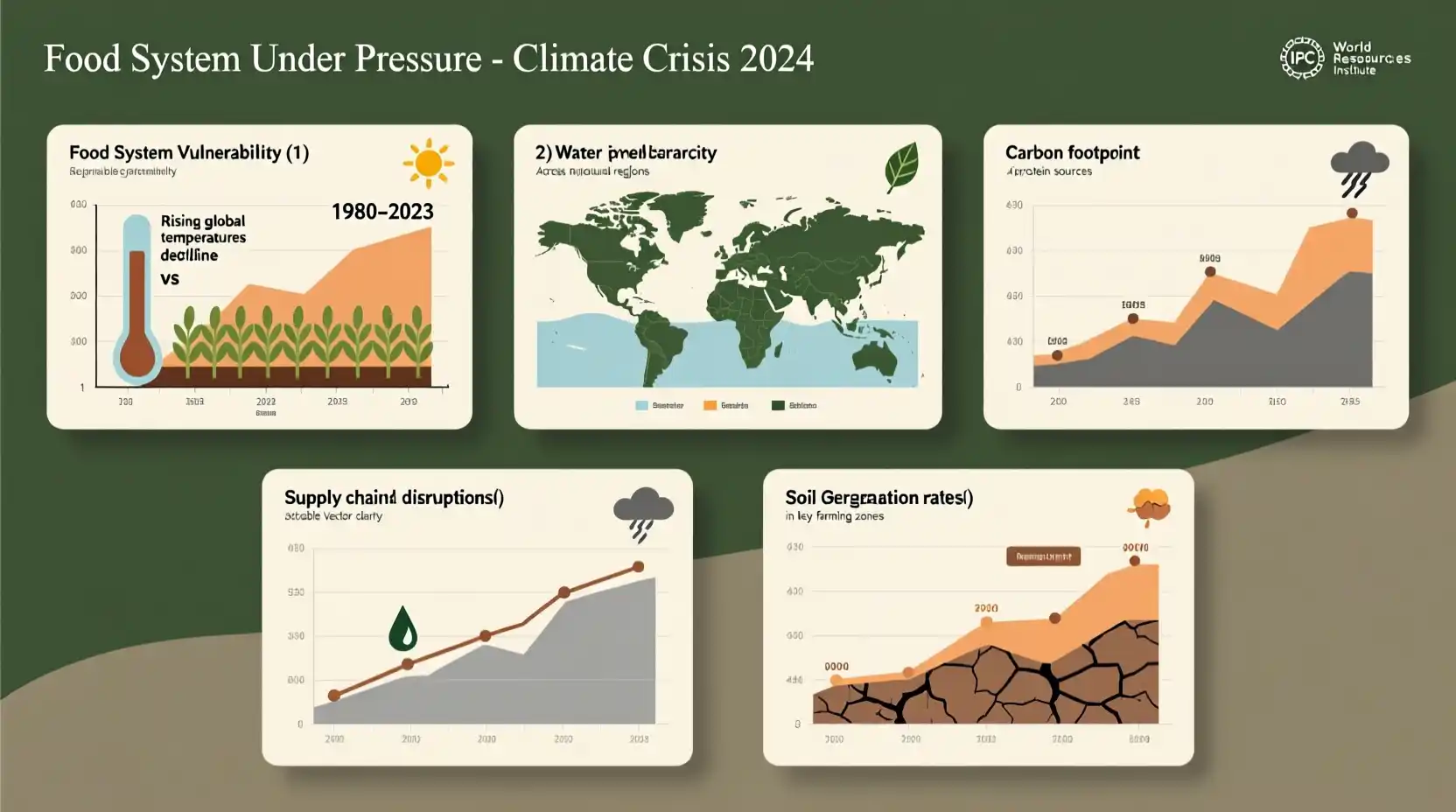
To understand the depth of this vulnerability, we can move beyond abstract warnings and examine the data. Five conceptual charts, each a window into a different facet of the problem, reveal the profound unpreparedness of our global food supply. They tell a story of erratic harvests, shifting continents, depleted resources, brittle supply chains, and a deeply unjust burden of suffering. Together, they paint a stark picture: our food is not ready for the climate crisis, and the time to build a new system is running out.
Chart 1: The Erratic Harvest – A Graph of Yield Volatility
The Chart: Imagine a line graph. The horizontal axis represents time, from 1970 to the present day. The vertical axis represents the annual yield of a staple crop, like wheat, in a major agricultural region, such as the U.S. Great Plains or the Ukrainian steppe. In the first decades of the graph, from 1970 to roughly 2000, the line trends steadily upward, a testament to the Green Revolution’s advancements in fertilizers, pesticides, and high-yield varieties. The year-to-year fluctuations are minor, a gentle wave around a strong upward trajectory. From 2000 onwards, however, the character of the line changes. The overall upward trend slows significantly, and the annual fluctuations become wild and dramatic. Sharp, jagged peaks are followed by devastating troughs. The line no longer looks like a gentle wave but a seismograph recording an earthquake, with the “quakes”—the bad years—becoming more frequent and more severe.
The Story It Tells: The End of Predictability
This first chart is the most direct and visceral representation of the climate threat to our food supply. It shows that the fundamental promise of modern agriculture—consistent, ever-increasing yields—is breaking down. The era of predictable weather is over, and with it, the era of predictable harvests.
The mechanisms behind this volatility are multifaceted and interconnected, all driven by a warming planet.
- Heat Stress: Plants, like humans, have an optimal temperature range for growth and reproduction. When temperatures soar beyond this range, critical processes begin to fail. For many staple crops like corn, wheat, and rice, the most vulnerable stage is pollination. Extreme heat can sterilize pollen, leading to poor fertilization and a dramatically reduced grain set. A single week of 95°F (35°C) temperatures during corn’s pollination phase can slash yields by as much as 20-30%. The 2021 heat dome in the Pacific Northwest, an event deemed “virtually impossible” without climate change, devastated fruit crops and caused wheat to “abort” its development. These events are no longer black swans; they are becoming part of the new climatic norm.
- Water Scarcity and Drought: The chart’s jagged troughs often correspond directly to years of severe drought. Climate change is altering precipitation patterns globally, making dry areas drier and wet periods more intense. Reliance on rainfall becomes a high-stakes gamble. In regions like the Sahel in Africa or the Horn of Africa, successive failed rainy seasons, supercharged by climate change in the Indian and Pacific Oceans, have led to catastrophic crop failures and widespread famine. Even in developed nations, the threat is existential. The American West is in the throes of a “megadrought,” the worst in over 1,200 years. The Colorado River, the lifeblood for agriculture across seven states, is dwindling, forcing mandatory water cutbacks for farmers and threatening the viability of vast swaths of irrigated land.
- The Onslaught of Pests and Diseases: Warmer winters and longer growing seasons are not just a boon for crops; they are a paradise for pests, pathogens, and weeds. Insects that were once killed off by cold snaps now survive through the winter, expanding their range and population. The mountain pine beetle, no longer kept in check by freezing temperatures, has decimated millions of acres of forest in North America. Similarly, crop pests like the fall armyworm, a native of the Americas, has spread across Africa and Asia at an alarming rate, thriving in warmer temperatures and causing billions of dollars in damage to maize, sorghum, and rice. Fungal pathogens, such as wheat rust, also find more favorable conditions in a warmer, wetter world, threatening to unleash new epidemics that can wipe out harvests.
- Extreme Weather Events: The chart’s dramatic drops are also caused by singular, catastrophic events. Unprecedented rainfall can lead to flooding that not only destroys standing crops but also saturates soils, delaying planting and harvesting. In 2022, Pakistan experienced a “monsoon on steroids,” with a third of the country underwater. The floods submerged over 4 million acres of agricultural land, wiping out the cotton, rice, and vegetable crops and threatening the food security of millions. Conversely, sudden, late-spring freezes can kill off fruit tree blossoms that have emerged early due to a warm winter, a phenomenon that has become increasingly common for apple and peach growers in the eastern United States.
The Economic and Social Consequences:
This yield volatility is not just an agricultural problem; it is an economic and social one.
- Price Spikes and Market Instability: Global commodity markets operate on a delicate balance of supply and demand. When a major breadbasket like Ukraine, Brazil, or the United States experiences a significant yield drop, the ripple effects are felt worldwide. Reduced supply leads to soaring prices for staple grains, which in turn increase the cost of everything from bread and pasta to meat and dairy (as livestock feed becomes more expensive). These price spikes disproportionately hurt the poorest populations, who spend a larger percentage of their income on food. The food price crises of 2007-2008 and 2010-2011, partially driven by weather-related harvest failures in key regions, were linked to social unrest and political instability around the globe.
- Farmer Livelihoods at Risk: For farmers, this new era of volatility is a recipe for financial ruin. Agriculture is already a high-risk business, but climate change is amplifying that risk exponentially. A farmer can invest hundreds of thousands of dollars in seed, fertilizer, and equipment, only to see their investment wiped out by a two-week heatwave or a single hailstorm. This makes it harder to secure loans, plan for the future, and attract the next generation to a life of farming. The psychological toll is immense, with farmer suicide rates tragically high in many parts of the world, a crisis often linked to financial stress caused by crop failures and debt.
The gentle, predictable upward slope of the 20th century has given way to the violent, unpredictable swings of the 21st. Our first chart reveals a fundamental truth: we have built a global food system on the promise of stability, and that promise has been broken. We are now gambling with our harvests every single year.
Chart 2: The Great Migration – A Map of Shifting Agricultural Zones
The Chart: This visualization is a world map. It uses a series of overlapping, colored polygons to represent the prime “climate suitability zones” for three major staple crops: maize (corn), wheat, and rice. There are three sets of polygons on the map. The first set, in a muted, historical color, shows the suitability zones as they were in the late 20th century (circa 1980). The second set, in a brighter, more alarming color, shows the projected suitability zones for the middle of this century (circa 2050) under a moderate emissions scenario. The third set, perhaps in a stark, urgent color, shows the projections for the end of the century (circa 2080). The map is animated, showing the zones shifting over time. The most striking feature is a massive poleward migration. The prime zones for wheat and maize in the North American Midwest and the Ukrainian steppe shrink and move north into Canada and Russia. The zones in South America and Southern Africa retreat towards the southern tip of their continents. Vast areas, particularly in the tropics and subtropics, are rendered unsuitable for their traditional crops, marked in a “climate-excluded” red or gray.
The Story It Tells: The Redrawing of the Global Breadbasket
This second chart tells a story of geographic upheaval. Climate change is not just making farming harder in existing locations; it is fundamentally remaking the map of where food can be grown. This northward shift of agricultural potential is one of the most profound and geopolitically charged consequences of the climate crisis.
The Winners and Losers of a New World Order:
The map clearly delineates between “winning” and “losing” regions.
- The “Winners”: The High-Latitude Countries. Countries like Canada, Russia, and Scandinavia are projected to see significant increases in the length of their growing seasons and the land area suitable for agriculture. The thawing of permafrost and the retreat of polar ice could, in theory, open up vast new territories for farming. This has led to talk of a new “Arctic breadbasket.” Russia, in particular, has already seen its wheat production boom in recent years, partly due to warmer weather, allowing it to become one of the world’s top wheat exporters.
- The “Losers”: The Tropics and Subtropics. The regions that will suffer the most are those closest to the equator. Areas like Sub-Saharan Africa, South Asia, and parts of Latin America and the Middle East are projected to experience temperatures that regularly exceed the physiological limits of key staple crops. Combined with increased drought stress, this will lead to catastrophic declines in agricultural productivity. For many nations in these regions, whose economies and food security are heavily dependent on local agriculture, this is an existential threat. The map shows that the countries that have contributed the least to the problem of climate change are poised to lose the most.
The Geopolitical and Ecological Minefield:
This geographic shift is far from a simple solution; it is a Pandora’s box of new risks and conflicts.
- Geopolitical Tension and Conflict: As traditional breadbaskets falter, nations will become increasingly dependent on imports, concentrating power in the hands of the few remaining major exporters. This creates a dangerous vulnerability. We saw a preview of this with the Russian invasion of Ukraine, which disrupted grain supplies and sent shockwaves through the global food market. In a climate-stressed future, such disruptions could become commonplace, leading to “food wars” where access to grain is used as a geopolitical weapon. Furthermore, the opening of new agricultural lands in the Arctic is already sparking territorial disputes and competition for resources among northern nations.
- The Great Land Grab: The prospect of fertile new land in the north is likely to trigger a new era of colonialism, this time driven by climate necessity. Wealthy but food-insecure nations and multinational corporations may seek to buy or lease vast tracts of land in Canada and Russia to secure their own food supplies. This could lead to the displacement of indigenous communities, the destruction of pristine ecosystems, and a new wave of resource exploitation.
- Ecological Catastrophe: Converting these “new” northern lands into productive farmland would come at an immense environmental cost. The boreal forests and tundra ecosystems that currently occupy these regions are massive carbon sinks, storing vast amounts of carbon in their soils and vegetation. Plowing them under would release gigatons of stored carbon into the atmosphere, creating a devastating feedback loop that would accelerate climate change even further. These ecosystems are also critical habitats for countless species of wildlife. Their destruction would be an irreversible blow to global biodiversity.
- The Challenge of Soil: The soils in these newly thawed regions are often thin, acidic, and lacking in the deep, rich organic matter found in traditional breadbaskets like the American Midwest. It would take decades, if not centuries, of careful management to build them into productive agricultural land. There is no simple “copy and paste” of Midwestern agriculture onto the Canadian Shield.
This map of shifting zones forces us to confront an uncomfortable reality. The solution to climate-induced agricultural failure in one part of the world is not simply to pack up and move farming operations elsewhere. The costs—geopolitical, social, and ecological—are far too high. It underscores the urgent need to adapt and build resilience in place, rather than betting on a risky and destructive planetary reshuffling of our farms.
Chart 3: The Emptying Cup – A Graph of Resource Depletion
The Chart: This is a dual-axis chart that tells a story of a system drinking its own lifeblood. The left vertical axis shows the volume of water stored in a critical aquifer, such as the Ogallala Aquifer in the United States or the Indo-Gangetic Plain Aquifer in South Asia. The line on this axis shows a steady, precipitous decline over the past 50 years, with the rate of depletion accelerating in recent decades. The right vertical axis shows the average annual temperature for the same region. The line on this axis shows a clear, rising trend. The two lines are starkly correlated: as the temperature rises, the rate of water depletion increases. A secondary, smaller chart could be inset, showing the percentage of agricultural land worldwide suffering from moderate to severe soil degradation, with the bar rising steadily over time.
The Story It Tells: Mining the Foundation of Life
Our modern agricultural system is a prodigious consumer of two fundamental, finite resources: fresh water and healthy soil. This third chart reveals that we are not merely using these resources; we are mining them. We are drawing them down faster than they can be naturally replenished, a practice that is fundamentally unsustainable and is being dramatically accelerated by the climate crisis.
The Water Crisis: From Abundance to Scarcity
Freshwater is the lifeblood of agriculture, accounting for approximately 70% of all freshwater withdrawals globally. But this reliance is becoming a critical vulnerability.
- The Disappearing Snowpack: In many of the world’s most important agricultural regions, from the Western US to the Himalayas, farmers don’t rely on rain for their primary water source. They rely on the slow, steady melt of winter snowpack from mountains, which feeds rivers throughout the dry summer growing season. Climate change is turning this reliable system on its head. Warmer winters mean more precipitation falls as rain instead of snow, and warmer springs cause the snowpack to melt earlier and faster. This leads to a situation where rivers are swollen in the spring, when farmers don’t need the water, and are perilously low in late summer, when crops are most thirsty. The Colorado River, a classic snowpack-fed system, is a prime example of this crisis in action.
- The Draining of the Fossil Waters: To compensate for less reliable surface water, farmers have turned to what lies beneath: aquifers. Some of these are “renewable” aquifers, recharged by rainfall. But many of the world’s most productive agricultural regions, including the US Great Plains (Ogallala Aquifer), North China Plain, and California’s Central Valley, sit atop “fossil” aquifers—ancient underground reservoirs that are not being replenished on any human timescale. We are pumping this water out, a one-time drawdown of a non-renewable resource. The Ogallala Aquifer, for instance, has seen its water levels decline by more than 150 feet in some areas, threatening the irrigation of millions of acres of farmland that produce a significant portion of America’s corn, soy, and wheat. Once this water is gone, it’s gone for good.
- The Vicious Cycle of Irrigation: Ironically, irrigation itself can exacerbate local warming. The large-scale application of water to fields can increase humidity and alter local weather patterns, but the energy required to pump and transport that water, often from deep underground, contributes to greenhouse gas emissions.
The Silent Crisis Beneath Our Feet: Soil Degradation
If water is the lifeblood, soil is the flesh. Healthy soil is a complex, living ecosystem, teeming with microbes, fungi, and organic matter. It is not just a medium for holding up plants; it is a critical source of nutrients and a massive sponge for water. Yet, we are treating it like dirt.
- Erosion: Intensive tilling, the removal of natural vegetation, and leaving fields bare after harvest leave soil exposed to the elements. Wind and water then carry this precious topsoil away. The UN estimates that 24 billion tonnes of fertile soil are lost to erosion every single year. Extreme weather events, supercharged by climate change, dramatically accelerate this process. A single intense downpour can wash away years of soil accumulation.
- Loss of Organic Matter: Monoculture farming, the practice of planting the same crop year after year, depletes soil of specific nutrients. The conventional response is to apply synthetic fertilizers, which provide nitrogen, phosphorus, and potassium but do little to rebuild the soil’s structure or organic matter. This organic matter, or humus, is crucial for water retention. Soil rich in organic matter can hold its own weight in water, making it resilient to both drought and flood. As organic matter declines, the soil becomes less a sponge and more like a brick: hard, compacted, and unable to absorb water. When it rains, the water runs off, taking topsoil with it. When it’s dry, the soil bakes and cracks.
- Salinization and Desertification: In arid and semi-arid regions, a lack of rainfall to flush salts from the soil leads to a buildup of salinity from irrigation water, eventually rendering the land sterile. Overgrazing and deforestation, often driven by the need for more agricultural land, can lead to desertification, the process by which fertile land turns into desert.
This chart of resource depletion is perhaps the most damning indictment of our current system. It shows that our short-term focus on maximizing yield is systematically undermining the very natural capital—water and soil—upon which all future agricultural productivity depends. We are eating our seed corn, and the climate crisis is pushing us to consume it ever faster.
Chart 4: The Broken Chain – A Flowchart of Supply Chain Disruption
The Chart: This visualization is a complex, global flowchart. It traces the journey of a single food product, say a smartphone-sized box of strawberries, from a farm in a region like Southern Spain or California to a consumer’s plate in a major city like London or Tokyo. The flowchart is composed of a series of connected nodes and lines: Farm -> Local Processing Plant -> Refrigerated Truck -> Port -> Container Ship -> Major Canal (e.g., Panama or Suez) -> Distribution Center -> Supermarket -> Consumer. Now, overlay this flowchart with a series of pulsing red warning icons. A “heatwave” icon flashes over the farm. A “flood” icon blocks the major highway used by the refrigerated truck. A “hurricane” icon shuts down the port. A “drought” icon lowers the water level in the canal, restricting ship traffic. A “labor shortage” icon, linked to a climate-related event, hovers over the distribution center. The chart visually demonstrates how a single climate shock at any one of these dozens of chokepoints can bring the entire chain to a grinding halt.
The Story It Tells: The Peril of “Just-in-Time” in a “Just-in-Case” World
This fourth chart shifts the focus from production to distribution. Even if we manage to grow the food, a new set of challenges emerges: getting it to the people who need it. Our modern food supply chain is a modern miracle of efficiency, built on a “just-in-time” logistics model that minimizes storage and waste. But this efficiency has come at the cost of resilience. The chain is long, complex, and globally interconnected, with numerous, often invisible, single points of failure. The climate crisis is actively targeting these weak links.
The Brittleness of a Globalized System:
The journey of food is a long and perilous one, exposed to climate risks at every stage.
- Transportation Corridors Under Threat: Our food travels the world on a network of roads, railways, ports, and shipping lanes. This network is highly vulnerable to extreme weather.
- Waterways: Rivers like the Mississippi in the US, the Rhine in Europe, and the Yangtze in China are critical arteries for moving bulk commodities like grain, soy, and fertilizer. In recent years, severe droughts have caused water levels on these rivers to drop so low that barge traffic has been severely restricted or halted entirely, creating massive bottlenecks and driving up transportation costs. Similarly, sea-level rise and more powerful storms threaten the world’s coastal ports. A single major hurricane hitting a port like Houston or New Orleans can disrupt fuel and grain supplies for the entire country. The 2021 blockage of the Suez Canal by a single ship was a stark reminder of how fragile these global chokepoints are. Now, imagine that vulnerability compounded by the fact that the Panama Canal’s operations are being curtailed due to a climate-change-fueled drought that has lowered the level of Gatun Lake.
- Roads and Railways: Extreme heat can cause railway lines to buckle and asphalt roads to soften and melt. Wildfires can destroy key transport infrastructure, while floods can wash out roads and bridges, isolating agricultural regions for weeks or months.
- Energy and Inputs: The Hidden Dependencies: The modern food supply chain doesn’t just move food; it runs on fossil fuels. The tractors on the farm, the refrigerated trucks, the container ships, and the processing plants all require a constant supply of diesel and electricity. Climate-related disruptions to energy production—whether from damage to oil refineries in a storm or reduced hydropower output from a drought—create a cascading failure that directly impacts the food system. The same applies to agricultural inputs like fertilizer. The production of nitrogen fertilizer is an energy-intensive process. A spike in natural gas prices, often linked to geopolitical or climate events, directly translates into higher fertilizer costs, which in turn raises food prices.
- The Human Element: The supply chain is not just machines and infrastructure; it is people. Climate change impacts the human labor that drives the system. Farmworkers face life-threatening heat stress in the fields. A climate disaster can displace workers, leading to labor shortages at critical times for harvesting or processing. The COVID-19 pandemic provided a chilling preview of how a disruption to the workforce can ripple through the food chain, leading to processing plant shutdowns and animals being euthanized on farms with no way to get them to market.
- The Cold Chain is a Hot Commodity: A huge portion of our food supply—meat, dairy, fresh produce, frozen goods—is dependent on an unbroken “cold chain” of refrigeration. This chain is incredibly energy-intensive. A power outage during a heatwave can lead to the spoilage of millions of dollars worth of food in a matter of hours. As the climate warms, maintaining the cold chain will become more difficult and more expensive, putting fresh, nutritious food further out of reach for many.
This flowchart of disruption reveals a critical paradox: the very efficiency that has given us an abundance of choice and low-cost food has made us dangerously vulnerable. The “just-in-time” system is woefully unprepared for a “just-in-case” world of climate shocks. It is a system designed for a stable climate, and it is starting to break.
Chart 5: The Unjust Burden – A Graph of Disproportionate Impact
The Chart: This is a composite bar chart that compares three different metrics for three groups of countries: 1) Developed Nations (e.g., G7), 2) Emerging Economies (e.g., BRICS), and 3) Developing Nations (e.g., Least Developed Countries, LDCs).
- The first set of bars (in gray) shows the cumulative historical CO2 emissions per capita for each group. The bars for Developed Nations are by far the highest.
- The second set of bars (in orange) shows an index of climate vulnerability to agriculture (e.g., from the Notre Dame Global Adaptation Initiative). The bars for Developing Nations are the highest, indicating they are most exposed to climate risks like drought, floods, and heat stress.
- The third set of bars (in red) shows the percentage of the population facing moderate or severe food insecurity. Again, the bars for Developing Nations are dramatically higher. The visual message is stark and unequivocal: the nations that have contributed the least to the climate crisis are the most vulnerable to its impacts on food security and are already suffering the most.
The Story It Tells: A Crisis of Climate and Food Justice
This final chart moves beyond the technical and logistical failures of the food system to address its human and ethical dimensions. The climate crisis is not a great equalizer; it is a threat multiplier that preys on and exacerbates existing inequalities. The burden of a destabilized food system is falling, and will continue to fall, most heavily on those who have the least capacity to adapt.
The Plight of the Smallholder Farmer:
At the heart of this story of injustice is the smallholder farmer. There are over 500 million smallholder farms in the world, and they produce roughly 80% of the food consumed in Asia and Sub-Saharan Africa. These farmers are on the front lines of the climate crisis.
- Lack of a Safety Net: Unlike large, industrialized farms in developed nations, most smallholders lack access to crop insurance, stable credit, government subsidies, and advanced irrigation technology. Their entire livelihood, and often their family’s survival, is tied to the success of a single harvest. A single drought or flood can be catastrophic, pushing a family from subsistence into destitution and hunger.
- The Gender Gap: The burden is even heavier for women, who make up a significant portion of the agricultural labor force in many developing countries. Women farmers often have less access to land, credit, training, and resources than their male counterparts, making them even more vulnerable to climate shocks.
- The Adaptation Trap: Smallholders are often forced into maladaptive strategies. In the face of failing rains, they may be forced to sell their livestock (their primary savings), take on high-interest debt, or migrate to cities, abandoning their land. They lack the capital to invest in long-term adaptation solutions like drought-resistant seeds, water harvesting systems, or soil regeneration techniques.
The Vicious Cycle of Poverty, Hunger, and Instability:
This chart illustrates a vicious, self-reinforcing cycle.
- Climate Shock: A region experiences a major drought or flood.
- Crop Failure: Smallholder farmers lose their harvests and their primary source of income and food.
- Food Insecurity and Malnutrition: Local food prices skyrocket, and families cannot afford to eat. This leads to acute malnutrition, which has devastating long-term impacts, especially on children’s physical and cognitive development.
- Economic Ruin: Farmers fall into debt and may lose their land. The local economy collapses.
- Social Unrest and Migration: Desperation can lead to social unrest and conflict over scarce resources. It also forces people to migrate, often to overcrowded urban slums or across borders, creating humanitarian crises.
- Reduced Adaptive Capacity: The community, now poorer and less stable, has even less capacity to prepare for the next climate shock, making the cycle repeat with greater intensity each time.
This cycle is already playing out across the globe. The recurring droughts in the Horn of Africa have pushed millions to the brink of famine. In Central America’s “Dry Corridor,” climate-related crop failures are a major driver of the migration that we see at the U.S. southern border.
This chart of disproportionate impact is a moral indictment. It shows that our failure to prepare the global food system for the climate crisis is not just a technical oversight; it is a profound injustice. The comfortable abundance enjoyed by the world’s wealthy nations is, in part, built on an unstable and exploitative system that is now breaking down, with the most vulnerable paying the highest price.
The Path Forward: From a Fragile System to a Resilient One
The five charts paint a daunting picture. They reveal a global food system that is volatile, geographically unstable, depleting its foundational resources, logistically brittle, and deeply unjust. It is a system that is failing the stress test of climate change. To simply continue on our current path is to march towards a future of chronic food shortages, soaring prices, and widespread social and political instability.
But this future is not inevitable. The same human ingenuity that created the current system can be harnessed to build a new one—a system that is not just productive, but also resilient, equitable, and regenerative. The transformation required is monumental, touching every part of the system from the farm to the plate. It demands a systemic shift away from the industrial, extractive model of the 20th century towards an ecological, adaptive model for the 21st.
The solutions can be grouped into three key areas: transformation on the farm, re-engineering the supply chain, and enacting visionary policy.
- On the Farm: Building a Climate-Resilient Agriculture
The foundation of a new food system must be a new approach to farming itself. The goal is to move from a system that fights against nature to one that works with it, building farms that can absorb and recover from climate shocks.
- Embrace Agroecology and Regenerative Agriculture: This is perhaps the most important shift. Instead of vast monocultures dependent on chemical inputs, this approach focuses on diversity and soil health.
- Practices: This includes crop rotation, planting cover crops, reducing or eliminating tillage (no-till farming), and integrating trees and livestock into farming systems (agroforestry and silvopasture).
- Benefits: Healthy soil, rich in organic matter, acts like a sponge, absorbing and holding vast amounts of water, making farms resilient to both drought and flood. It also reduces erosion and sequesters carbon from the atmosphere, turning agriculture from a carbon source into a carbon sink. Diverse farms are less vulnerable to pest and disease outbreaks and provide a more stable income for farmers.
- Crop Diversification and Breeding for Resilience: We cannot rely on a handful of staple crops. We need to diversify our agricultural portfolio.
- Forgotten Crops: Rediscovering and promoting traditional, hardy crops like millets, sorghum, cowpeas, and amaranth, which are naturally more tolerant of heat and drought.
- Modern Breeding: Investing heavily in public and private research to use advanced breeding techniques (including, where appropriate and safe, genetic modification and gene editing) to develop new varieties of our major staples that are more resistant to heat, drought, and salinity.
- Revolutionize Water Management: Water is too precious to be wasted.
- Efficiency: Shifting from inefficient flood irrigation to highly efficient technologies like drip irrigation and micro-sprinklers, which deliver water directly to the plant’s roots, cutting water use by up to 70%.
- Water Harvesting: Building on-farm infrastructure like ponds, swales, and check dams to capture and store rainwater during wet periods for use during dry spells.
- In the Supply Chain: Building Redundancy and Regionalism
The “just-in-time” global supply chain must be re-engineered for a “just-in-case” world. This means building in redundancy and shortening distances.
- Regionalize Food Systems: While global trade will always have a role, we need to shift a greater portion of food production to serve local and regional markets. This shortens supply chains, reduces transportation costs and emissions, and makes communities less dependent on distant, vulnerable chokepoints. This means supporting local farmers, investing in regional processing facilities, and creating robust local food hubs.
- Invest in Resilient Infrastructure: We must harden our existing infrastructure against the impacts of climate change. This means reinforcing ports against sea-level rise and storm surges, building more resilient roads and railways, and ensuring our energy grid is robust enough to power the cold chain through extreme weather events.
- Reduce Food Waste: Approximately one-third of all food produced globally is wasted. This is a monumental moral and environmental failure. Tackling waste is one of the most effective ways to increase food availability without growing a single extra grain. This requires improvements in storage and refrigeration in developing countries, changes in retail and consumer behavior in wealthy countries, and policies that discourage waste throughout the supply chain.
- At the Policy Level: Creating the Rules for a New System
Individual farmers and companies cannot make this transition alone. It requires bold, transformative leadership from governments and international institutions.
- Reform Agricultural Subsidies: Globally, hundreds of billions of dollars in public subsidies are poured into agriculture each year. The vast majority of these subsidies currently support the status quo: monoculture production of a few commodity crops, heavy water use, and environmentally harmful practices. These subsidies must be radically reformed to reward farmers for the outcomes we need: carbon sequestration, improved water quality, enhanced biodiversity, and resilient food production.
- Invest in Research, Development, and Education: We need a massive public investment in the science of sustainable agriculture. This includes research into agroecology, resilient crop breeding, and new technologies for smallholders. Equally important is the extension services needed to get this knowledge and technology into the hands of the farmers who need it most.
- Strengthen Social Safety Nets: We need robust systems to protect the most vulnerable. This includes crop insurance programs for smallholders, strategic grain reserves to buffer against price shocks, and robust social safety nets to ensure no one goes hungry when a harvest fails.
- Integrate Food and Climate Policy: For too long, food systems have been an afterthought in international climate negotiations. This must change. We need strong global agreements that recognize the critical role of agriculture in both causing and solving the climate crisis, and that provide the financial and technological support to help developing countries adapt.
Conclusion: A Harvest of Hope or a Famine of Our Own Making?
The five charts are a warning. They are a data-driven diagnosis of a global food system that is dangerously out of sync with the planet it inhabits. They show us a future of erratic harvests, shrinking breadbaskets, depleted resources, broken supply chains, and profound human suffering. To ignore these warnings is to consciously choose a future of famine and conflict.
But the charts are also a map. They illuminate the specific points of failure, giving us a clear understanding of the problems we must solve. And in understanding the problem, we find the seeds of its solution.
The transition to a climate-resilient food system is the defining challenge of our time. It is a challenge as great as the Green Revolution of the 20th century, but with a different goal. Where the previous revolution sought to maximize yield at all costs, this new revolution must seek to optimize for resilience, equity, and ecological regeneration.
It will not be easy. It will require a fundamental rethinking of our relationship with food, with the land, and with each other. It will require political will, technological innovation, and a collective commitment to change. But the alternative—a world of chronic hunger, instability, and injustice—is unacceptable.
The choice is ours. We can continue to cling to a fragile, failing system and reap the bitter harvest of our inaction. Or we can embrace the difficult but necessary work of building a new food system, one that can nourish humanity and the planet for generations to come. The climate crisis is here, and it is at our dinner table. The time to act is now.
Have any thoughts?
Share your reaction or leave a quick response — we’d love to hear what you think!
-
 0
-
 0
-
 0
-
 0
-
 0
-
 0
