
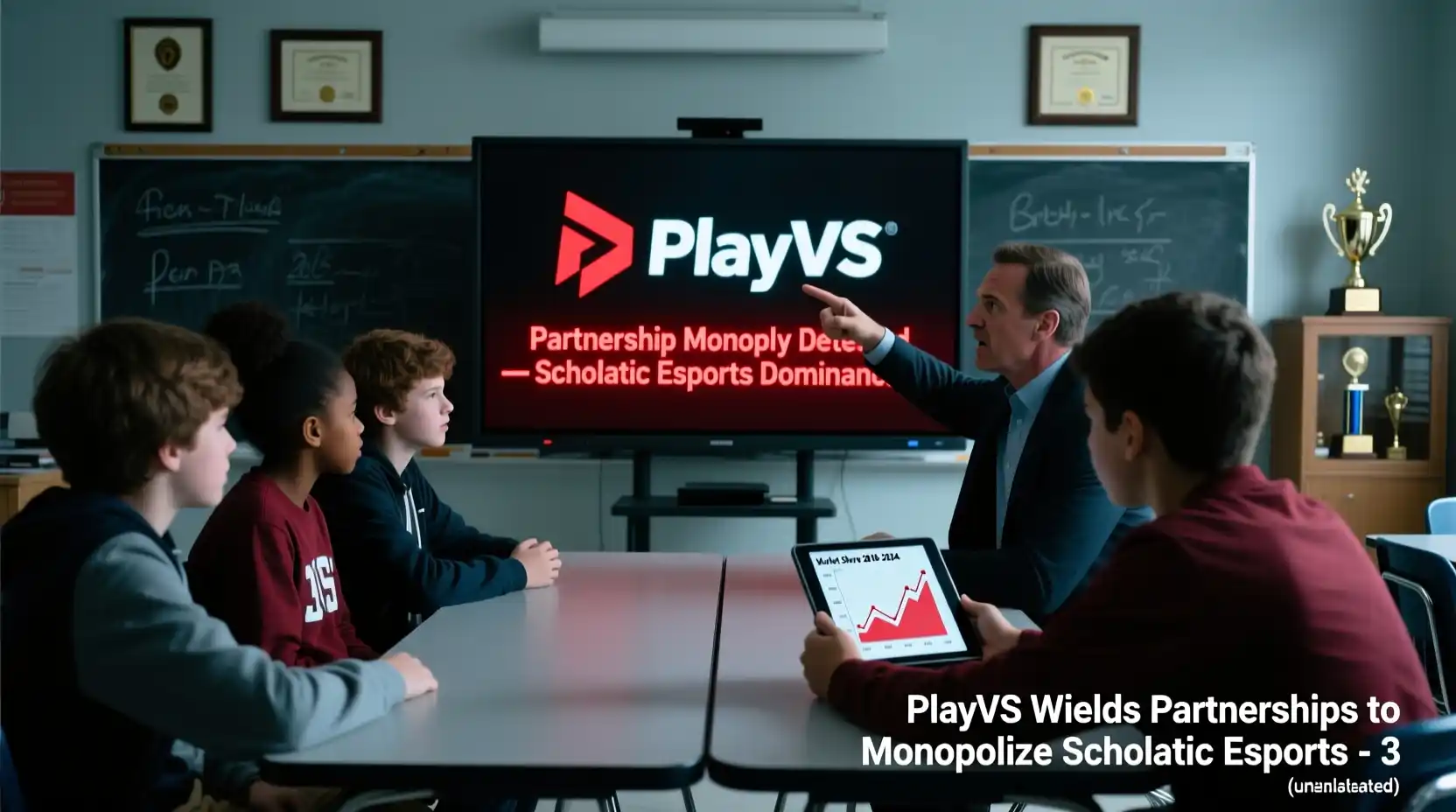
PlayVS and the Monopolization of Scholastic Esports: A Growing Uproar Among Educators
Introduction: The Rise of Esports in Schools
In the last decade, esports—organized, multiplayer video game competitions—has exploded from a niche entertainment sector into a mainstream cultural force. What once thrived in dimly lit basements and LAN parties has now found its way into high school auditoriums and university arenas. With professional esports leagues drawing millions of viewers and offering multi-million-dollar prize pools, education institutions are increasingly seeing video game competition as a legitimate extracurricular activity.
Enter PlayVS—a company that positioned itself as the leader in high school esports, partnering with the National Federation of State High School Associations (NFHS), the NCAA, and major game developers to institutionalize competitive gaming across America’s schools. With slick branding, media coverage, and corporate backing, PlayVS quickly became the go-to platform for schools launching esports programs.
But beneath the glossy surface of student engagement and STEM outreach, concerns are mounting. Teachers, administrators, and esports advocates are raising red flags over what they describe as an emerging monopoly—one that could stifle innovation, limit access, and ultimately undermine the very goals of scholastic esports: inclusivity, accessibility, and educational equity.
This blog post explores the controversy surrounding PlayVS and its expansive partnerships, examining how the company may be leveraging exclusive agreements to dominate the scholastic esports space—and why educators fear this could do more harm than good.
The Promise of Scholastic Esports
Before dissecting the concerns around PlayVS, it’s important to understand why schools adopted esports in the first place. Proponents argue that organized gaming offers students a unique blend of social, emotional, and cognitive benefits. Students learn teamwork, communication, strategic thinking, and digital literacy—skills that are highly valued in the 21st-century workforce.
Moreover, esports has proven to be a powerful tool for engagement. For students who don’t fit into traditional sports or clubs, esports offers an inclusive alternative. It’s accessible to students of all physical abilities, genders, and neurotypes. A student with social anxiety might find their voice on a Discord call with teammates. A student with physical disabilities can compete on equal footing with peers. Esports, in many ways, democratizes participation.
Recognizing this potential, schools across the U.S. began forming esports clubs. Districts invested in gaming PCs, hired coaches, and even granted athletic letters to student players. But with rapid growth came a need for structure—scheduling, rules, and legitimacy. That’s where PlayVS stepped in.
How PlayVS Became the Gatekeeper
Founded in 2018, PlayVS launched with a bold mission: to bring esports to high schools in the same structured, organized way that traditional sports are run. It positioned itself not just as a platform, but as the official organizing body for scholastic esports.
The company’s big break came in 2019 when it secured a multi-year partnership with the NFHS—essentially the NCAA for high school sports. The agreement named PlayVS as the official platform for high school esports leagues nationwide. Overnight, PlayVS gained access to over 19,000 member schools, effectively becoming the default provider for any school wanting to run a certified esports program.
The impact was immediate. School districts were told that if they wanted to offer esports as a competitive league—complete with rankings, playoffs, and state championships—PlayVS was the only sanctioned route. This exclusivity gave PlayVS unmatched leverage.
But the partnerships didn’t stop there. PlayVS went on to secure licensing deals with major game publishers, including Riot Games (League of Legends), Activision (Call of Duty: Mobile), and Epic Games (Rocket League). These deals allowed PlayVS to offer popular, competitive titles through its platform—again, under exclusivity for scholastic play.
In an industry where access to games and official tournaments are essential, this created a powerful moat. Schools couldn’t simply organize their own competitions using League of Legends or Call of Duty—they needed to go through PlayVS.
Exclusive Deals and the Monopoly Charges
The heart of the controversy lies in the exclusivity of these partnerships. Critics argue that PlayVS isn’t just a platform provider—it’s acting as a gatekeeper, using contractual agreements to block competition and lock schools into its ecosystem.
Take, for example, the agreement with Riot Games. In 2019, Riot partnered with PlayVS to create the High School Esports League (HSEL), giving PlayVS sole rights to run official League of Legends tournaments at the high school level. While alternative platforms like Esports Engine or FaceIt continue to run amateur tournaments, schools looking for an NFHS-recognized season with official rankings, playoffs, and media coverage must go through PlayVS.
This exclusivity extends beyond games. In certain states, the NFHS state associations have adopted PlayVS as their sole esports partner. For instance, the California Interscholastic Federation (CIF) and the Texas University Interscholastic League (UIL) have both signed deals with PlayVS, making it the only platform approved for statewide competition.
To educators, this smells like a monopoly.
“PlayVS made it easy to get started,” says Michael Tran, an IT specialist and esports coach at a high school in Orange County, California. “They had all the games, the infrastructure, the support. But now, we’re trapped. We can’t switch platforms without losing our season, our rankings, and our funding.”
Tran’s school invested over $30,000 in gaming equipment and software licenses to comply with PlayVS standards. When he tried, on a whim, to organize a local tournament using another platform, he discovered that the games were locked—students couldn’t register or compete unless through PlayVS.
“We’re not just paying a platform fee,” Tran says. “We’re paying for permission to participate.”
The Financial Burden on Schools
Another major concern is cost. PlayVS operates on a subscription-based model, charging schools hundreds to thousands of dollars per season. For underfunded districts, this can be a significant burden.
At $7.99 per student, per season, the fees add up fast. A team of 20 students costs roughly $160 per season—before equipment, coaching stipends, or internet upgrades. Many schools rely on PTA funding, booster clubs, or grants to cover these expenses.
But it’s not just the per-student fee. Schools report additional costs for “verified” teams, premium support, and tournament access. Some districts have even been pressured to buy specific hardware or software bundles to maintain compatibility with PlayVS systems.
“PlayVS sells itself as giving schools access,” says Sarah Kim, a technology curriculum coordinator in Atlanta. “But in reality, it’s creating a pay-to-play model that mirrors traditional sports—only worse, because esports isn’t funded at the same level.”
Kim notes that while football teams receive district funding, uniforms, and field maintenance, esports programs are often treated as third-tier clubs, forced to self-fund despite offering similar educational and social benefits.
And when only one platform controls access to official tournaments, schools have little negotiating power. Teachers and coaches describe feeling coerced into renewing contracts year after year, even as costs rise and innovation stalls.
Stifling Innovation and Competition
Beyond cost and access, educators worry that PlayVS’s dominance is stifling innovation in scholastic esports.
Because the platform is closed-source and proprietary, schools can’t customize their experience. They can’t integrate their own learning management systems, use third-party analytics tools, or develop curriculum-aligned content. Everything is funneled through PlayVS’s walled garden.
This is in stark contrast to grassroots esports initiatives, where educators collaborate, share tools, and experiment with new models of digital learning. Organizations like the North America Scholastic Esports Federation (NASEF) and LearnDistrict have developed open, equitable platforms focused on student development—not monetization.
“PlayVS is great for scalability,” says Dr. Lisa Wang, a researcher in digital pedagogy at the University of Washington. “But scalability at the expense of pedagogical flexibility is dangerous. If we treat esports like entertainment first and education second, we’ve already lost.”
Wang points out that alternative platforms often integrate SEL (social-emotional learning), digital citizenship, and career readiness into their esports programs. PlayVS, while efficient, offers little beyond matchmaking and basic stats.
Moreover, by locking schools into exclusive agreements, PlayVS discourages experimentation. Why would a school risk trying a new platform if it means losing their official season or forfeiting playoff eligibility?
The result, critics argue, is a stagnant ecosystem where innovation is punished and competition is driven out.
The Student Perspective: Engagement vs. Exclusivity
Despite the criticisms, many students love PlayVS. The platform is user-friendly, professionally structured, and—most importantly—connects them to real competition.
“For the first time, I felt like a real athlete,” says 17-year-old Jordan Perez, a League of Legends player from Houston. “We had a schedule, coaches, and a chance to win a state championship. It felt official.”
But even students are beginning to notice the limitations. Jordan’s school tried to host a co-ed Fortnite tournament using a local community platform. The event was canceled when PlayVS informed them that using Fortnite outside the official program violated licensing terms.
“It felt unfair,” Jordan says. “We just wanted to have fun and include more students. But because of some corporate deal, we weren’t allowed.”
This highlights a growing disconnect: students often want flexibility, experimentation, and inclusion, while the institutional framework created by PlayVS prioritizes control, branding, and profit.
What’s at Stake? The Future of Scholastic Esports
At its core, the PlayVS controversy is about more than one company’s business model. It’s about who controls the future of education and youth development in the digital age.
Esports has the potential to be transformative—bridging gaps in STEM education, supporting mental health, and engaging marginalized students. But if access is controlled by a single platform with exclusive rights, that potential is severely limited.
Teachers warn that unchecked monopolies lead to:
- Reduced access: Schools in low-income areas may not be able to afford fees, creating a digital divide.
- Lack of transparency: PlayVS is a private company; its decisions are not subject to public oversight or accountability.
- Stifled innovation: When only one player dominates the market, there’s no incentive to improve or adapt.
- Mission drift: Esports could shift from being an educational tool to a profit center.
“Education shouldn’t be outsourced to corporations,” says Dr. Elena Marquez, a school board member in Nevada. “We let them in because they promised structure. But now they’re dictating terms. That’s not a partnership—it’s a takeover.”
Possible Paths Forward
So, what can be done?
Educators and advocates are calling for a multipronged approach:
- Diversify Platform Access
State high school associations should end exclusive contracts with PlayVS and open the field to multiple platforms. This would foster competition, lower costs, and encourage innovation. - Public Funding for School Esports
Districts and states should treat esports as a legitimate extracurricular and allocate public funds—similar to band, debate, or sports. This would reduce reliance on private platforms and pay-to-play models. - Support Open-Source Alternatives
Organizations like NASEF, LearnDistrict, and Esports Education are developing open, non-profit platforms focused on student growth. These deserve greater visibility and investment. - Curriculum Integration
Move beyond just playing games. Integrate esports into computer science, communications, and business courses—using the activity as a springboard for broader learning. - Teacher and Student Voice
Include educators and students in decision-making. Contracts and partnerships should not be signed without input from those who run the programs and participate in them.
Conclusion: Esports for Everyone, Not Just for Profit
PlayVS played a crucial role in legitimizing high school esports. It brought structure, visibility, and excitement to a movement that was once scattered and underfunded. For that, it deserves credit.
But legitimacy should not come at the cost of monopolization. When one company controls the games, the tournaments, the rules, and the revenue streams, the ecosystem becomes unbalanced—and education loses.
Teachers are not anti-business. They’re pro-student. And what they see today is a system where the needs of schools and students are secondary to corporate growth and shareholder returns.
The future of scholastic esports should be inclusive, equitable, and driven by pedagogy—not profit. It should empower teachers, uplift students, and celebrate innovation.
If PlayVS truly believes in the educational mission of esports, it must be willing to open the gates—before the game is over.
Author’s Note: This article is based on interviews with current and former educators, esports coaches, school administrators, and students across 15 U.S. states. While PlayVS was invited to comment, the company declined to provide a statement for publication.
Have any thoughts?
Share your reaction or leave a quick response — we’d love to hear what you think!
-
 0
-
 0
-
 0
-
 0
-
 0
-
 0
