
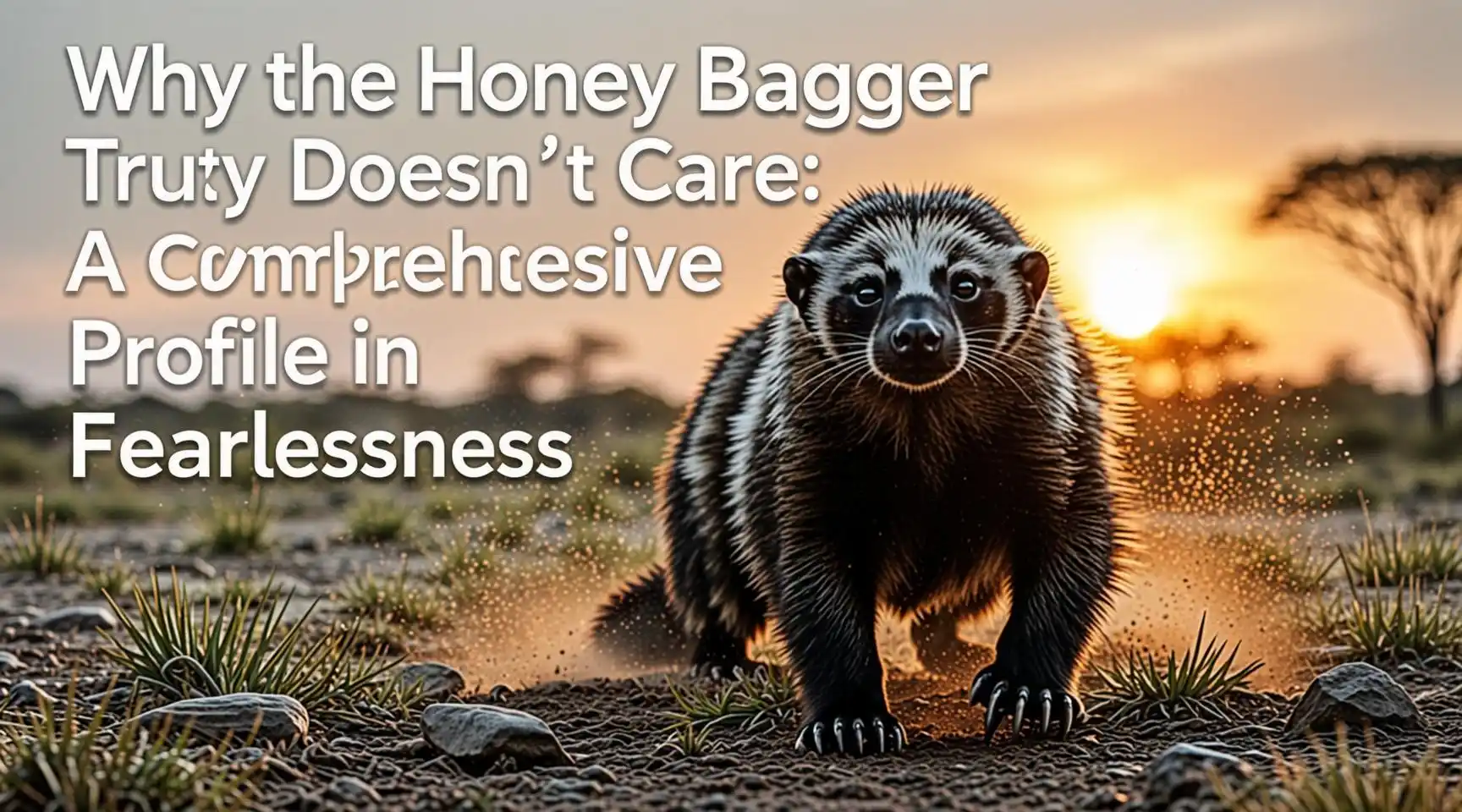
Why the Honey Badger Truly Doesn’t Care: A Comprehensive Profile in Fearlessness
Introduction: The Small Giant of the Savannah
In the vast, sun-scorched expanses of the African savannahs and the arid, rocky outcrops of the Middle East and South Asia, silence is often the rule of the wild. Survival usually depends on stealth—on the ability to hide, to flee, or to blend into the background. Yet, ambling through the tall grass with a distinctive, lumbering gait, there exists a creature that seems to have missed the memo on the hierarchy of fear. This animal, weighing no more than a typical domestic dog, strides across the landscape with an air of absolute entitlement and indifference.
This is the honey badger (Mellivora capensis), colloquially known as the ratel. To the uninitiated, it might look like a large weasel or a skunk, given its black-and-white coloration. But to the lions, leopards, and hyenas that share its territory, the honey badger is a living, breathing anachronism—a bundle of fur and fury that simply refuses to acknowledge the concept of danger. It has become a global icon of tenacity, immortalized in internet memes and wildlife documentaries as the ultimate “badass” of the natural world. But beyond the viral humor and the sensationalized tales of animal aggression lies a fascinating biological narrative.
The honey badger’s “I don’t care” attitude is not merely a personality quirk; it is a sophisticated evolutionary strategy. In a world where most animals are wired to retreat from the first sign of trouble, the honey badger is wired to lean in. This deep dive seeks to unravel the mystery of the honey badger’s fearlessness, exploring the intricate web of anatomical defenses, neurological wiring, and ecological pressures that have forged one of nature’s most resilient survivors. We will look beyond the myth to understand the machine underneath the skin, asking not just what they do, but why evolution has selected for such supreme audacity.
Part 1: The Anatomy of Fearlessness – Built for Battle
The honey badger’s reputation begins with its physical form. It is a masterclass in biological armoring, a creature that has evolved specific physiological traits to negate the advantages of larger predators.
- Physical Traits: The Fortress of Skin and Muscle
While many predators rely on speed or camouflage, the honey badger relies on invulnerability. Its primary defense is its skin, which is unique among carnivores.
- Thick, Near-Inviolable Skin: The skin of a honey badger is exceptionally thick—roughly 6 millimeters around the neck area. To put this in perspective, this is thicker than the hide of a Cape Buffalo, an animal twenty times its size. This skin serves as a biological chainmail. It is loose and rubbery, allowing the badger to twist within its own grip. If a lion or leopard clamps its jaws onto the badger’s back, the badger can rotate its body completely inside its skin, facing its attacker to bite back, even while being held. This elasticity also protects the animal from the piercing quills of porcupines and the stinging insects of the beehives it raids.
- Venom Resistance: Perhaps the most startling adaptation is the honey badger’s immunity to some of the world’s most potent venoms. They frequently hunt and consume puff adders, cobras, and black mambas. While they are not completely immune to the neurotoxins, they possess a mutated nicotinic acetylcholine receptor that prevents the neurotoxin from binding to their nerves. This molecular adaptation means that a dose of venom that would kill a human or an elephant might merely incapacitate a honey badger for a few hours—after which it wakes up, groggy but alive, and resumes its meal.
- Retractable Claws and Crushing Jaws: Equipped with long, curved, and incredibly strong claws (which are actually semi-retractile, differing from the true claws of cats but similar in function), the honey badger is an excavation machine. These claws allow it to dig burrows in hard earth within minutes to escape the midday heat or predators. Combined with a jaw structure capable of crushing bones and a bite force that belies its size, the honey badger is a predator capable of dismantling prey from the inside out.
These physical adaptations are not just passive defenses; they are active enablers of the badger’s psychology. Because the animal knows it is difficult to hurt and hard to kill, its perceived threshold for risk drops significantly. When you wear armor, you act differently than when you are naked.
- Neurological Boldness: The Science of Fearless Behavior
Beneath the thick skin lies a brain that operates on a different frequency than that of most mammals. While the anatomy provides the ability to fight, the neurology provides the will.
- Dopamine and the Reward System: Ethologists and behavioral scientists believe that the honey badger’s risk-taking behavior is linked to a highly sensitive reward system. In the wild, animals usually weigh the cost of potential injury against the caloric reward of food. For the honey badger, the neurological “hit” of acquiring high-value food (like honey or snake meat) appears to outweigh the chemical signals of fear or anxiety. This dopamine-driven boldness means they are biologically primed to persist where others would flee.
- Stress Resilience: A significant study published in Animal Behaviour in 2021 observed honey badgers in the Kalahari Desert. The researchers subjected the animals to stress simulations, including the presence of large predator models and unfamiliar objects. While many carnivores exhibit a “freeze” or “flight” response, honey badgers displayed an immediate “fight or investigate” response. Their cortisol levels (stress hormones) spiked less dramatically and returned to baseline faster than those of similar-sized predators. This suggests a neural architecture that does not waste energy on panic; instead, it channels physiological arousal directly into aggressive action.
- Cognitive Flexibility: Honey badgers are not just brave; they are smart. They have demonstrated superior problem-solving skills, particularly when it comes to breaking into enclosures or accessing food. This intelligence supports their fearlessness. A brave animal that is stupid quickly dies; a brave animal that can solve problems (like how to unlatch a gate or dismantle a trap) survives to pass on its genes.
Part 2: Behavioral Studies – The Honey Badger in Action
The true measure of the honey badger’s fearlessness is not found in a lab, but in the wild, where its behavior defies standard ecological expectations.
- Fearless Feeding Habits: The Gastronomic Daredevil
The honey badger is a generalist carnivore with a diet that reads like a list of “things you shouldn’t eat.”
- The Apis Avenger: Its name derives from its fondness for honey, but acquiring it is a brutal task. The badger raids beehives, ignoring the angry swarm. Its thick skin protects it from stings, but its eyes are vulnerable. To counter this, the badger often employs a chaotic, spinning defense, snapping at bees in mid-air while tearing apart the comb. There is also a fascinating, though debated, symbiotic relationship with the Greater Honeyguide bird. The bird leads the badger to the hive; the badger breaks it open; both share the spoils. Whether this partnership is obligate or opportunistic is still studied, but it highlights the badger’s willingness to engage in complex food acquisition strategies.
- The Snake Eater: Hunting venomous snakes is a staple of the honey badger’s life. They do not avoid the strike; they invite it. When hunting a cobra, the badger will taunt the snake into striking, receiving the bite on its thick neck or shoulder. As the venom takes hold, the badger may pass out—entering a temporary coma-like state. However, due to its resistance, it revives after a period ranging from minutes to a couple of hours, groggy but victorious, to finish the meal it started.
- Kleptoparasitism: Honey badgers are notorious thieves. They have been observed stealing food from lions, leopards, and hyenas. Using their speed and low center of gravity, they dart underneath larger predators, snatch a piece of carcass, and dash into the nearest hole. They will steal from humans too, breaking into camp tents, food stores, and even refrigerators.
- Adversarial Interactions: The Psychological Warfare
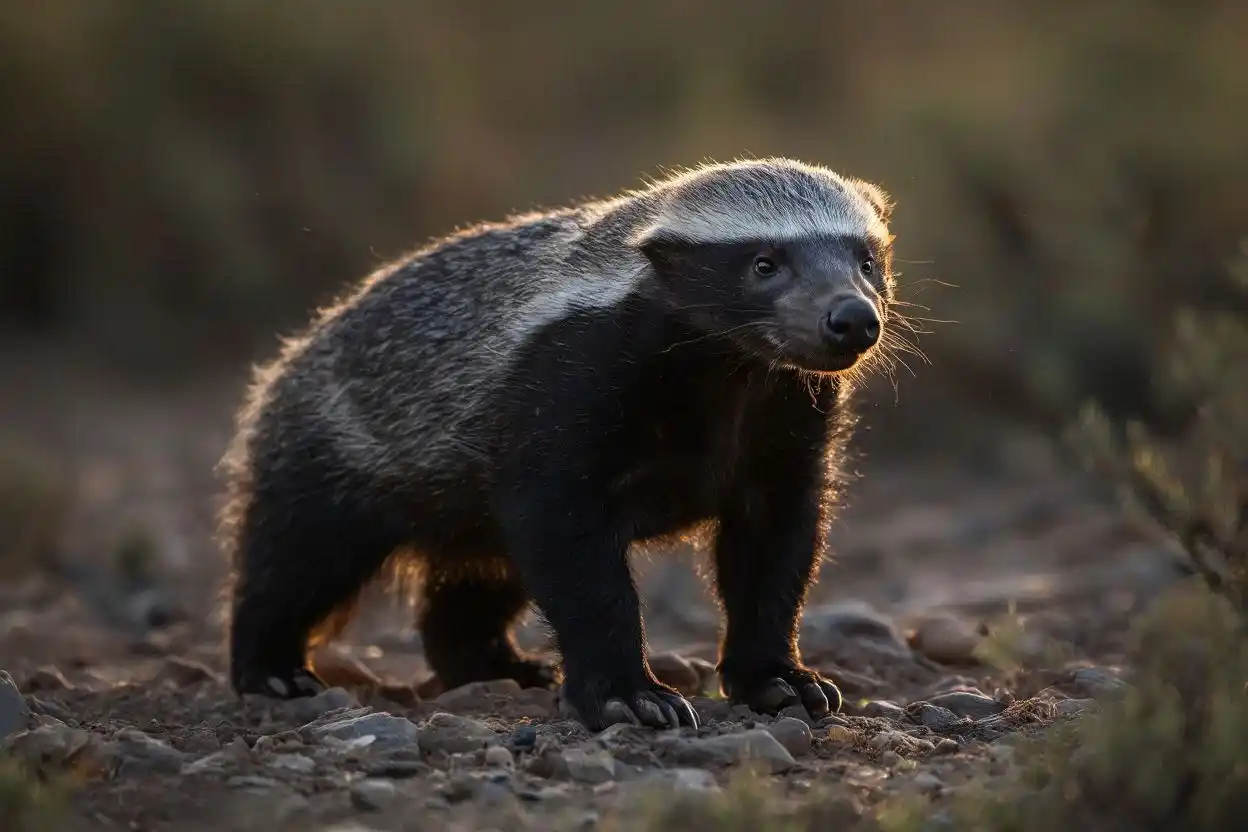
Honey Badger
The honey badger’s interactions with predators are lessons in psychological domination.
- The Lion Encounter: In a famous 2016 National Geographic documentary, a male lion attacked a honey badger. The badger did not run. Instead, it released a potent, guttural growl—a “rattle” that sounds like a small engine revving. It stood its ground, snapping at the lion’s legs. The lion, confused by the lack of fear and the ferocity of the counter-attack, eventually backed down. To the lion, the risk of injury to its eyes or paws wasn’t worth the small meal.
- Why Stand and Fight? From an evolutionary standpoint, this behavior makes sense. Honey badgers have a high metabolism and need to forage constantly. If they ran every time a predator appeared, they would burn more energy fleeing than they would gain from eating. Furthermore, by standing their ground, they signal that they are not “easy prey.” Many predators are risk-averse; an animal that fights back is often abandoned for one that flees.
Part 3: Cultural Impact – From Wildlife to Viral Fame
The honey badger’s transition from an obscure African carnivore to a global cultural phenomenon is a testament to the human fascination with defiance.
- The Honey Badger as a Cultural Icon
The year 2010 marked a turning point for the species. A video narrated by Randall (often misattributed to David Attenborough due to the nature documentary style, though it was actually a comedic parody) titled The Crazy Nasty Ass Honey Badger exploded on YouTube. The video, set to upbeat background music, showed the badger battling jackals, eating cobras, and ignoring bee stings, all while the narrator joked, “Honey badger don’t give a sh*t.”
This meme resonated because it anthropomorphized an attitude that humans aspire to: the ability to remain unbothered by chaos. It became a metaphor for resilience in pop culture, sports (the “Honey Badger” nickname adopted by NFL player Tyrann Mathieu), and business.
However, this viral fame is a double-edged sword. While it raises awareness, it creates a caricature. The “Honey Badger” of the internet is a reckless thug. The real honey badger is a calculating, efficient survivor. The memes risk trivializing the animal’s ecological importance.
- Misconceptions vs. Reality
It is crucial to strip away the hype to understand the animal.
- Myth: “They are fearless because they are dumb.” Reality: As discussed, their fearlessness is calculated. They know their limits. A honey badger will not try to fight an elephant, for example. Their aggression is scaled to the threat.
- Myth: “They are invincible.” Reality: They are mortal. They are frequently killed by larger predators when young or sick. They fall victim to traps, snares, and poisoning by farmers. They are susceptible to rabies and other diseases. Their “invincibility” is relative; they are just harder to kill than an animal of their size has any right to be.
Part 4: Conservation – Protecting the Fearless
Ironically, the animal that fears nothing is facing threats it cannot fight with claws and attitude. The honey badger is classified as “Least Concern” on the IUCN Red List due to its wide distribution, but local populations are in decline.
- Threats to the Honey Badger
- Habitat Fragmentation: As human settlements expand, the open territories the badger needs for foraging are shrinking. Their solitary nature requires large ranges, and fragmented populations lead to genetic isolation.
- Human-Wildlife Conflict: This is the most significant threat. Beekeepers often trap or poison badgers to protect their hives. Because honey badgers are resilient, standard traps often fail, leading farmers to use more cruel and indiscriminate methods of poisoning, which affects other species as well.
- The Bushmeat Trade: In parts of West and Central Africa, honey badgers are hunted for meat and traditional medicine, where their “fearless” parts are erroneously believed to confer bravery or strength to the consumer.
- Conservation Efforts
Conservationists are working to change the narrative from “pest” to “ecological asset.”
- Innovative Beekeeping: Organizations are introducing “badger-proof” beehives. These hives are raised on stands that are difficult for the badgers to climb, or surrounded by wire mesh. This allows farmers and badgers to coexist without conflict.
- Protected Corridors: In South Africa and Namibia, efforts are underway to connect game reserves with wildlife corridors, allowing badgers to migrate between territories without crossing dangerous highways.
- Research and Tracking: GPS collaring studies have revealed the secret lives of these nocturnal wanderers, providing data that helps inform land-use planning. By understanding where they go, conservationists can identify critical habitats that need protection.
Conclusion: Lessons from the Honey Badger
The honey badger’s “I don’t care” attitude is a profound lesson in adaptation. It teaches us that fear is a response to vulnerability. If you remove the vulnerability—through thick skin, mental resilience, and physical capability—fear loses its utility.
For the honey badger, boldness is not a choice; it is a lifestyle mandated by evolution. In the harsh, competitive arena of the wild, hesitation is often fatal. By committing fully to every action, whether it is digging a burrow, eating a cobra, or staring down a lion, the honey badger ensures its own survival.
As humans, we often fear the opinions of others, the risks of failure, or the unknowns of the future. We look at the honey badger and see a reflection of the strength we wish we had. But we must remember that the honey badger’s strength is not just attitude; it is backed by substance. It is the combination of preparation (its armor) and mindset (its boldness) that makes it unstoppable.
The next time you encounter a honey badger—in a meme, a documentary, or perhaps lucky enough to see one in the wild—respect the engineering behind the bravado. It is a reminder that in a world of giants, the small and unyielding can carve out their own empire. The honey badger doesn’t care because it doesn’t have to. It is built to win.
Keywords: Honey Badger, Mellivora capensis, Fearlessness, Wildlife Behavior, Evolutionary Biology, Predator-Prey Dynamics, Conservation, African Wildlife
Hashtags: #FearlessCreatures #WildlifeInspirations #NatureDocumentary #HoneyBadger #WildlifeConservation #NatureLovers
Disclaimer: This blog post is for educational and informational purposes only. The information provided is based on scientific research, behavioral studies, and observations. It is not intended to replace professional advice from wildlife experts, biologists, or conservationists. If you encounter a honey badger or other wild animal in its natural habitat, prioritize safety, maintain a respectful distance, and consult local authorities or guides for guidance. The behavior described in this post pertains to wild species and should not be projected onto domestic animals. Always respect nature and its rules.
Have any thoughts?
Share your reaction or leave a quick response — we’d love to hear what you think!
-
 1
-
 0
-
 0
-
 0
-
 0
-
 0
