
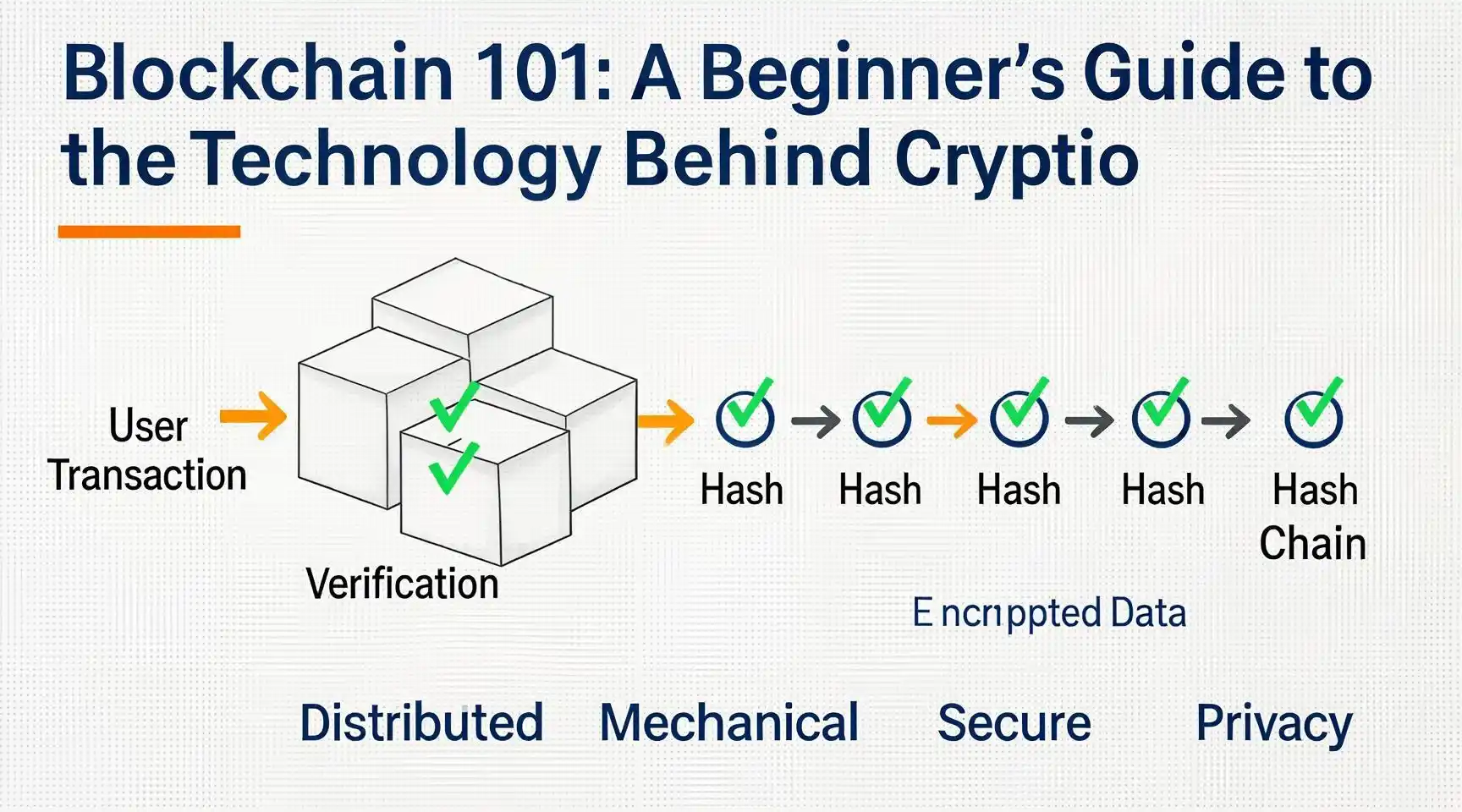
Blockchain 101: A Beginner’s Guide to the Technology Behind Crypto
Introduction: The Dawn of the Trust Revolution
We stand on the precipice of a technological shift that promises to redefine how we interact, trade, and govern ourselves. For the last two decades, the internet has been the primary driver of global connectivity, yet it has suffered from a fundamental flaw: it is an internet of information, not an internet of value. When you send an email, you are sending a copy; the recipient has it, but you also retain it. This works perfectly for messages and news, but it fails miserably for assets like money, property titles, or intellectual property. You cannot spend the same dollar twice.
Historically, solving this “double-spend problem” required a middleman—a bank, a government, or a clearinghouse—to act as the central authority verifying transactions. But what if we could remove the middleman? What if we could create a system where trust is not placed in a fallible human institution, but in mathematical code and distributed consensus?
This is the promise of blockchain. It is the technology that underpins cryptocurrencies like Bitcoin and Ethereum, yet its potential extends far beyond digital money. It is a protocol for truth in a world increasingly plagued by digital forgeries and institutional distrust. This guide will peel back the layers of this complex technology, transforming the abstract concept of “blockchain” into a tangible understanding of how it functions and why it matters.
Chapter 1: The Problem with Centralization
To understand blockchain, one must first understand the status quo: centralized databases.
Imagine a traditional bank. The bank maintains a ledger—a digital spreadsheet—that records every customer’s balance and every transaction. This ledger is stored on the bank’s private servers, housed in secure data centers.
- Single Point of Failure: If the bank’s server crashes or is hacked, the records are compromised.
- The Gatekeeper: You cannot access your money without the bank’s permission. If the bank decides to freeze your account, you are powerless.
- Opacity: You cannot see the bank’s ledger. You only see your own statement. You must trust that the bank is recording accurately and not lending out more money than it holds.
For centuries, this centralized model worked because it was the only way to ensure trust. It was inefficient and expensive—requiring armies of accountants, auditors, and security experts—but it was necessary.
Blockchain flips this model on its head. It proposes a system where the ledger is not hidden in a vault, but is public and distributed across thousands of computers around the world. It replaces the “trust us” promise of institutions with “trust the code” verification of a network.
Chapter 2: The Genesis of a New Ledger
The concept of a blockchain was outlined in 2008 by an anonymous figure or group known as Satoshi Nakamoto. In the whitepaper titled Bitcoin: A Peer-to-Peer Electronic Cash System, Satoshi described a solution to the double-spending problem using a peer-to-peer network.
The core innovation was the “chain of blocks.”
What is a Block?
Think of a block as a container, similar to a single page in a record book. Each block contains three critical elements:
- Data: This is the record of transactions (e.g., “Alice sent 1 Bitcoin to Bob”).
- The Hash: A unique, cryptographic fingerprint of the block.
- The Previous Hash: The fingerprint of the block that came before it.
This structure is the “chain” in blockchain. Block 3 contains the fingerprint of Block 2, which contains the fingerprint of Block 1. If you tried to tamper with Block 1—say, to change a transaction amount—its fingerprint would change. Because Block 2 holds the old fingerprint, the link would break. The network would see the mismatch and reject the fraudulent block. This creates an Immutable Ledger, meaning once data is recorded, it cannot be altered.
Chapter 3: Cryptography—The Art of Secret Keeping
Blockchain relies heavily on cryptography, the science of encoding information.
The Hash Function
At the heart of the system is the cryptographic hash function. In simple terms, a hash function takes an input (any amount of data) and turns it into a fixed-length string of characters (the hash).
- Deterministic: The same input will always produce the same output.
- One-Way: You cannot reverse-engineer the input from the hash.
- Avalanche Effect: Changing a single letter or number in the input completely changes the hash.
For example, if you input “Hello World” into the SHA-256 algorithm (used by Bitcoin), you get a specific code. If you change it to “Hello World!”, the resulting code looks completely different. This sensitivity ensures that if a hacker tries to change even a fraction of a cent in a blockchain record, the hash changes, alerting the entire network to the fraud.
Public and Private Keys
Blockchain also utilizes asymmetric cryptography, or public-key cryptography. This involves two keys:
- Public Key: This is like your bank account number. You can share it with anyone so they can send you funds.
- Private Key: This is like your PIN or signature. It proves ownership of the assets associated with the public key.
You must guard your private key with your life. On the blockchain, there is no “forgot password” button. If you lose your private key, your funds are lost forever. If a thief gets your private key, they can drain your assets, and the network will validate the transaction because the thief possesses the mathematical proof of ownership.
Chapter 4: Decentralization and Distributed Ledger Technology (DLT)
The magic of blockchain is not just in the cryptography, but in where the data lives. In a centralized system, the database sits in one place. In a blockchain, the database is Distributed.
Every participant (node) in the network has a copy of the entire ledger. When a new transaction occurs, it is broadcast to the network. Every node updates its copy. This brings us to the first of our core concepts.
Keyword 1: Decentralization Decentralization means that control and decision-making are transferred from a central entity (individual, organization, or group) to a distributed network. This offers several advantages:
- Fault Tolerance: If one node goes offline, the network continues to function.
- Attack Resistance: There is no central server to bomb or hack. An attacker would need to overwhelm more than half the network simultaneously to force a change, a feat that is prohibitively expensive for large networks like Bitcoin.
- Censorship Resistance: No single administrator can ban a user or block a transaction.
This architecture creates a Distributed Ledger Technology (DLT). It is a consensus of replicated, shared, and synchronized digital data geographically spread across multiple sites, countries, or institutions.
Chapter 5: Consensus Mechanisms—Finding Agreement
If everyone has a copy of the ledger, how does the network agree on which copy is correct? If one node tries to cheat, how do the honest nodes stop them? This is solved by Consensus Mechanisms.
Proof of Work (PoW)
Used by Bitcoin, this is the original consensus mechanism. In PoW, specialized computers called “miners” compete to solve a complex mathematical puzzle. This puzzle involves finding a hash that is lower than a specific target number.
- The Mining Process: Miners bundle pending transactions into a block. They then run the hashing algorithm repeatedly, adding a random number (called a “nonce”) to the block data until they find a hash that matches the network’s criteria.
- The Cost: This process requires immense amounts of computational power and electricity. This is the “Work” in Proof of Work.
- The Reward: The first miner to solve the puzzle gets to add the block to the chain and is rewarded with newly minted cryptocurrency (the block reward).
This mechanism secures the network because to attack it, a bad actor would need to control 51% of the total computing power of the network. The cost of the electricity required to do this would far outweigh the potential gains.
Proof of Stake (PoS)
Used by Ethereum (post-Merge) and many newer blockchains, PoS was created to address the energy consumption of PoW. Instead of miners solving puzzles, we have “validators.”
- Staking: Validators lock up a portion of their own cryptocurrency as “stake” (collateral).
- Selection: The network randomly selects a validator to propose the next block. The probability of being chosen often depends on the amount of stake.
- Security: If a validator acts maliciously or approves fraudulent transactions, their stake is “slashed” (confiscated by the network).
PoS is energy-efficient and allows for faster transaction processing, though critics argue it may lead to centralization where the richest holders have the most influence.
Chapter 6: The Ecosystem—Wallets, Nodes, and Gas
To interact with a blockchain, a user needs a Wallet. Despite the name, a crypto wallet does not actually store coins. It stores the user’s private keys. The assets exist on the ledger; the keys merely grant access to them.
- Hot Wallets: Connected to the internet (e.g., mobile apps, browser extensions). Convenient for frequent trading but vulnerable to hacking.
- Cold Wallets: Hardware devices (like USB drives) not connected to the internet. Highly secure for long-term storage.
Nodes
Nodes are the backbone of the network. A node is any computer that runs the blockchain’s software. Nodes validate transactions and blocks. A “Full Node” downloads the entire blockchain history, ensuring that all rules are followed. If a miner or validator tries to push an invalid block, the nodes will reject it, keeping the network honest.
Gas
“Gas” is the fee required to conduct a transaction or execute a smart contract on a blockchain like Ethereum. It pays the miners or validators for the computational energy required to process the data. When the network is congested, gas prices rise as users bid to have their transactions processed faster.
Chapter 7: Smart Contracts—Code is Law
While Bitcoin was designed primarily as a digital currency, the arrival of Ethereum in 2015 introduced a revolutionary concept: the Smart Contract.
Keyword 2: Smart Contracts A smart contract is a self-executing contract with the terms of the agreement between buyer and seller being directly written into lines of code. They exist across a distributed, decentralized blockchain network.
Imagine a vending machine. You put money in, the machine verifies the payment, and it dispenses the snack. No shopkeeper is needed to approve the sale. The machine is the contract. Smart contracts work similarly but on a global scale.
- Automation: They automatically trigger actions when conditions are met. For example, “If Flight X is delayed by more than 2 hours, pay User Y $200 in insurance.”
- Trustless: The parties do not need to trust each other; they trust the code. The code is immutable and cannot be arbitrarily changed by either party.
Smart contracts have enabled the explosion of Decentralized Finance (DeFi), allowing for loans, trading, and insurance to occur without banks.
Chapter 8: Tokens and the Token Economy
When people discuss crypto, they often use the terms “coins” and “tokens” interchangeably, but there is a distinction.
Coins
A coin is the native currency of a blockchain.
- Bitcoin (BTC): Native to the Bitcoin blockchain. Used to pay miners and transfer value.
- Ether (ETH): Native to the Ethereum blockchain. Used to pay gas fees and validators.
Tokens
Tokens are built on top of an existing blockchain using smart contracts. They do not have their own dedicated blockchain.
- ERC-20 Tokens: The technical standard for fungible tokens on Ethereum. Many Initial Coin Offerings (ICOs) utilized this standard to raise funds. Examples include USDT (Tether) and LINK (Chainlink).
- NFTs (Non-Fungible Tokens): Unlike coins (where one Bitcoin is identical to another), NFTs are unique. They represent ownership of a specific digital or physical asset, such as digital art, music, or real estate. They rely on standards like ERC-721.
Tokens can represent anything from loyalty points to shares in a company, creating a new economic layer on the internet.
Chapter 9: Beyond Money—Real-World Use Cases
The excitement surrounding blockchain extends far beyond trading digital currencies.
Supply Chain Management
Blockchain provides a transparent and unalterable record of an item’s journey.
- Provenance: Consumers can scan a QR code on a product to see exactly where the raw materials were sourced, which factory processed it, and how it was shipped. This is vital for luxury goods (to prevent counterfeits) and food safety (to track contamination sources).
- Efficiency: IBM and Maersk have utilized blockchain to digitize shipping paperwork, reducing transit times and costs by removing bureaucratic bottlenecks.
Voting and Governance
Current electronic voting systems are often closed-source and vulnerable to hacking. Blockchain offers a potential solution where:
- Votes are immutable; once cast, they cannot be deleted or altered.
- The system is transparent; anyone can verify the final count without compromising voter anonymity.
- Decentralized Autonomous Organizations (DAOs) use this model to govern projects, where token holders vote on proposals rather than a CEO making decisions.
Identity Management
Digital identity is currently fragmented across various websites and prone to theft (data breaches). Blockchain allows for “Self-Sovereign Identity,” where users control their own data. You could verify your age to enter a website without revealing your name or birthdate, simply by providing a cryptographic proof issued by a trusted authority (like a government) and stored on the blockchain.
Chapter 10: The Challenges and the Future
No technology is perfect, and blockchain faces significant hurdles.
Scalability
Blockchains face a “trilemma”: they can typically optimize for only two of three factors: Decentralization, Security, and Scalability. Bitcoin prioritizes security and decentralization but struggles with scalability, processing only about 7 transactions per second (TPS). Visa processes thousands. Solutions like the Lightning Network (Layer 2 solutions) are being built on top of Bitcoin to speed this up.
Energy Consumption
While Proof of Stake reduces the energy burden, Proof of Work blockchains like Bitcoin consume vast amounts of electricity. Critics argue this is environmentally unsustainable. Proponents counter that much of this energy comes from renewable sources or helps stabilize power grids by utilizing excess generation.
Regulation
Governments are scrambling to catch up. How do you tax a decentralized asset? How do you enforce “Know Your Customer” (KYC) laws on a protocol that doesn’t ask for ID? The clash between the decentralized ethos of crypto and the centralized nature of state regulation will define the next decade of the industry.
Chapter 11: The Road Ahead
We are currently in the “early internet” phase of blockchain. In the 1990s, the internet was slow, clunky, and difficult to use. Many dismissed it as a fad. Today, it is the infrastructure of modern life. Blockchain is following a similar trajectory.
Keyword 3: Immutable Ledger As we look forward, the concept of the Immutable Ledger will likely become as foundational to society as the double-entry bookkeeping system was to modern capitalism. It promises a world where truth is not a commodity to be bought and sold, but a mathematical certainty baked into the infrastructure of our digital lives.
From securing property rights in developing nations to automating global finance, blockchain is not just a tool for speculation; it is a tool for restructuring the very fabric of trust. It is a technology that empowers the individual, disintermediates the powerful, and opens the door to a more transparent and efficient world.
As you navigate this space, remember that the technology is still evolving. It is complex, volatile, and occasionally risky. But understanding the fundamentals—the cryptography, the decentralization, and the consensus—is the first step in preparing for the decentralized future.
Keywords: Decentralization, Smart Contracts, Immutable Ledger
Hashtags: #BlockchainEducation #CryptoForBeginners #FutureOfFinance
Disclaimer: This content is provided for educational and informational purposes only and does not constitute financial, investment, legal, or tax advice. The information contained herein is subject to change without notice. Cryptocurrency and blockchain technologies are highly volatile and speculative. You should not treat any opinion expressed in this text as a specific inducement to make a particular investment or follow a particular strategy. Before making any investment decisions, you should conduct your own research and consult with a qualified financial advisor. The author and publisher assume no liability for any losses or damages incurred as a result of the use or reliance on the information provided.
Have any thoughts?
Share your reaction or leave a quick response — we’d love to hear what you think!
-
 0
-
 0
-
 0
-
 0
-
 0
-
 0
