
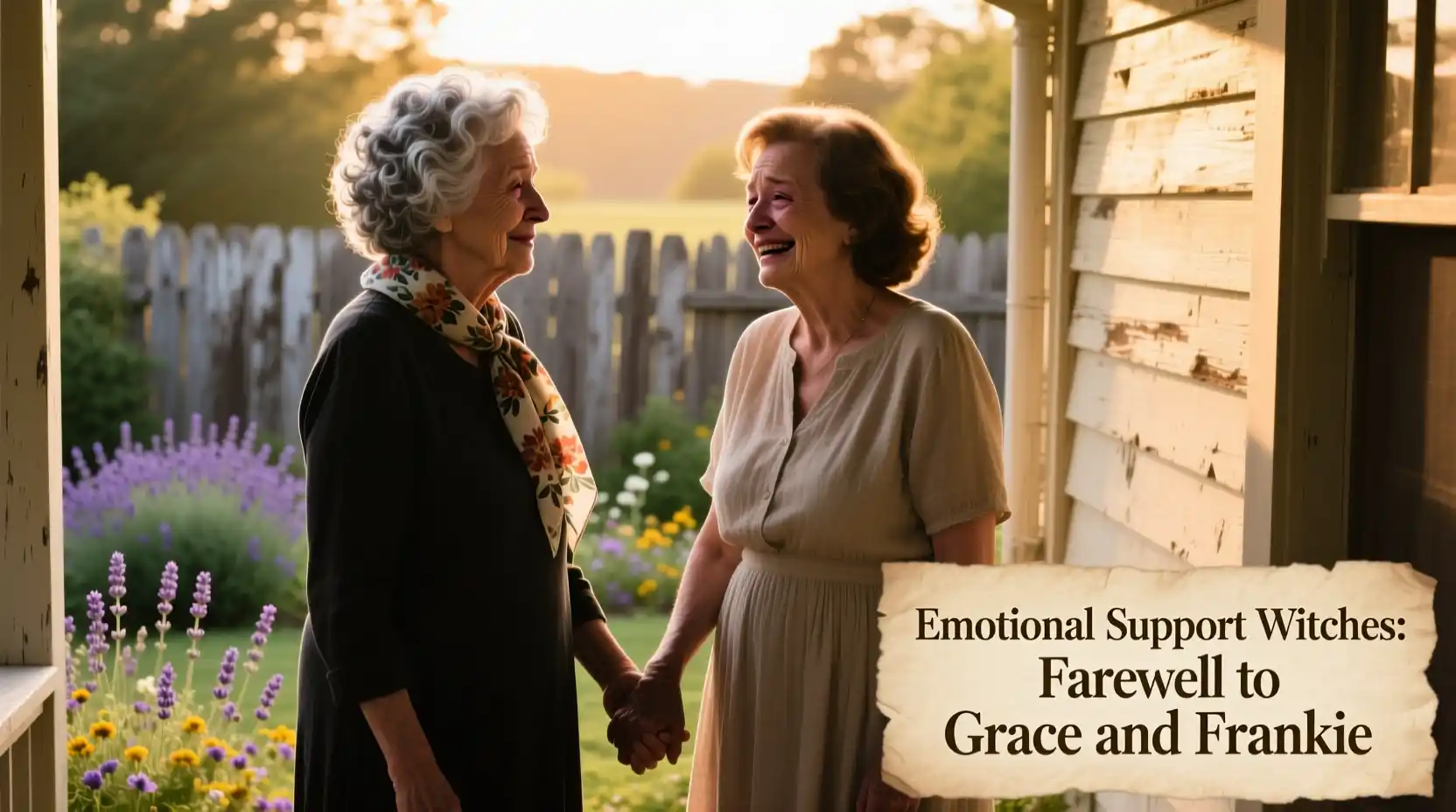
Emotional Support Witches”: Farewell to Grace and Frankie, TV’s Greatest Female Friendship
When Grace and Frankie premiered on Netflix in 2015, few predicted it would become a cultural phenomenon—one that not only challenged the norms of television representation but redefined what it means to grow old on screen with grace, humor, and radical authenticity. Seven seasons later, with the release of its final installment in April 2022, the series bowed out not with a whimper, but with the thunderous applause of an audience that had grown deeply attached to the unlikely but transformative friendship at its core: Grace (Jane Fonda) and Frankie (Lily Tomlin).
At a time when most television shows sideline or erase older women—especially older women over 70—Grace and Frankie didn’t just center them; it glorified them. It celebrated their flaws, their resilience, their enduring desire for love, purpose, and sexual fulfillment. But beyond the groundbreaking casting or the witty writing, the show’s true legacy lies in its portrayal of one of the most nuanced, layered, and revolutionary female friendships in TV history. This was not just a friendship—it was a lifeline, a revolution, and, for millions of viewers, a mirror.
The Unlikely Union That Changed Everything
The premise of Grace and Frankie is as clever as it is heartbreaking: two women—Grace, a polished, status-obsessed retired cosmetics executive, and Frankie, a free-spirited, eco-conscious hippie artist—have nothing in common except that their husbands, Robert and Sol, have been secretly in love for decades. The moment of revelation comes in the first episode, when the two men announce they’re divorcing their wives to marry each other. It’s a bombshell not only for Grace and Frankie but for the audience, who expect the ensuing narrative to be about anger, betrayal, and revenge.
Instead, it’s about something far more radical: friendship forged in the fires of shared humiliation, grief, and the quiet indignity of aging in a youth-obsessed culture.
What begins as a forced cohabitation soon evolves into one of the most authentic depictions of emotional support between women in modern television. Grace and Frankie become each other’s confidantes, co-conspirators, and caregivers—not because they always get along (they don’t), but because they choose to stay. They argue about art versus capitalism, about wine versus weed, about high heels versus sandals. They bicker over rent and chore charts. They judge each other’s choices—especially when it comes to men. And yet, through every betrayal, every health scare, every existential crisis, they remain tethered. Not by obligation, but by loyalty.
The Alchemy of Opposites: Comedy as Connection
One of the show’s great strengths is how it uses humor not to deflect pain, but to process it. The sharp, often biting banter between Grace and Frankie—crafted by Marta Kauffman, who also co-created Friends—turns their differences into both the source of conflict and the glue that binds them. In lesser hands, their dynamic might have fallen into caricature: the uptight WASP and the crunchy bohemian. But Fonda and Tomlin, both in their 70s and 80s when the show began, bring an unmatched depth and warmth to their roles.
Their friendship is not sugar-coated. It’s messy. They cancel each other’s credit cards. They sabotage each other’s romantic prospects. They hold grudges for months. But they also show up. They listen. They change. In a society that often pits women against each other—especially women of different classes, ideologies, and aesthetics—Grace and Frankie model a different path: one where differences are not erased but negotiated, where criticism coexists with care.
And their chemistry? Electric. Fonda’s poised delivery contrasts perfectly with Tomlin’s whimsical, off-kilter charm. It’s a masterclass in comedic timing, made even more powerful by the awareness that these two legendary actresses—real-life friends off-screen—were also defying Hollywood’s ageist and sexist expectations by playing complex, sexual, dynamic older women.
Reimagining Aging, One Vaginal Insert at a Time
What makes Grace and Frankie so revolutionary is its fearless interrogation of aging—not as decline, but as transformation. The show refuses to romanticize old age, nor does it treat it as something to be fixed or hidden. Instead, it stares aging in the face: the joint pain, the incontinence, the hearing loss, the mortality. But it also celebrates the freedoms that come with it: the shedding of social expectations, the rediscovery of passion, the redefinition of identity.
This is most evident in their unlikely business venture: creating an organic, all-natural line of vaginal inserts for older women dealing with sexual discomfort. It’s a farcical premise, yes, but also deeply political. By turning female sexual health—a subject often whispered about or ignored—into the centerpiece of a multimillion-dollar startup, Grace and Frankie reclaim agency over their bodies. They challenge the idea that desire and pleasure are reserved for the young. They turn menopause into a marketplace, but more importantly, into a movement.
The business becomes a metaphor for their friendship: born of necessity, built on trial and error, sustained through mutual support. It’s not just about money—it’s about purpose. In a world that discards older women professionally and emotionally, Grace and Frankie build something that matters. They become entrepreneurs, innovators, and, eventually, icons.
The Emotional Support Witches We Didn’t Know We Needed
Over the course of seven seasons, Grace and Frankie face every major life transition imaginable: the loss of spouses (to both same-sex love and death), financial instability, addiction, depression, cancer, legal battles, blended family drama, and the slow, inevitable slide toward dependency.
And through it all, they remain each other’s emotional support system. Not in the clinical, therapy-approved sense—though they could probably use some therapy—but in the everyday, gritty, real way that only deep, long-term friendships can.
They are, in the best and most affectionate sense, emotional support witches—cackling together through grief, cooking strange herbal concoctions, defying convention with their very existence. They wear caftans not because they’ve given up on fashion, but because they’ve transcended it. They smoke pot not to escape, but to engage—more fully, more joyfully—with the absurdity of life.
This term—emotional support witch—has circulated online in recent years as a tongue-in-cheek label for women who offer spiritual, emotional, and sometimes literal magic to their communities. Grace and Frankie embody this spirit. They are healers, not through formal training, but through presence. They are wise without claiming wisdom. They are flawed, forgivable, and fiercely loyal.
A Love Story Without Romance
It’s worth noting that Grace and Frankie is not a romance—not in the traditional sense. There are plenty of love interests: Sol and Robert’s relationship is tender and complex; Grace has a series of relationships with men her age, including a flirtation with a handsome ex-Navy man named Nick (played by Peter Gallagher); Frankie finds love with a Zen-like man named Jacob (Ernie Hudson). But the central love story—the beating heart of the series—is between Grace and Frankie.
It’s the kind of love that doesn’t get celebrated in pop culture: platonic, enduring, and non-transactional. They don’t live together because they have to—they stay together because they choose to. They have every opportunity to walk away, to rebuild their lives apart. But they keep showing up. They keep fighting—for each other, with each other.
In the final season, when Frankie suffers a near-fatal health crisis and Grace is forced to confront the possibility of life without her, the emotional weight is staggering. Fonda’s performance in those episodes—raw, terrified, quietly devastating—reminds us that love isn’t only found in weddings or first kisses. Sometimes, the most profound declarations are made in hospital waiting rooms, in the way one woman holds another’s hand, in the silent promise: I’m not going anywhere.
Representation That Resonates
The cultural impact of Grace and Frankie cannot be overstated. At a time when only 11% of leading roles in film and television go to women over 40—and even fewer to women over 70—the mere existence of the show is revolutionary. But it’s not just about visibility; it’s about complexity.
Grace and Frankie are not archetypes. They are not “the wise elder” or “the quirky grandmother.” They are contradictory, ambitious, vain, kind, selfish, generous. They make bad decisions. They grow. They mourn. They dance naked in the living room. They launch tech startups and write memoirs. They fall in love and fall out of love. They are, in every sense, fully human.
The show also challenges norms around sexuality and aging. Grace, in her 70s and 80s, dates, flirts, and has sex—not as a punchline, but as a natural extension of her identity. Frankie, a lesbian in real life and a queer icon for decades, continues to explore intimacy and independence on her own terms. Their openness about desire—whether for companionship, touch, or simply a good orgasm—sends a powerful message: pleasure does not expire.
Moreover, the series normalizes conversations about death. In Season 6, Robert passes away, and the show handles his death with quiet dignity, focusing not on melodrama but on the impact on those left behind. It’s one of the most honest portrayals of late-life bereavement ever seen on television. Frankie’s grief is messy; Grace’s support is imperfect. But both women model how to face mortality—not with fear, but with honesty, humor, and each other.
The Quiet Revolution of Female Friendship
At its core, Grace and Frankie is a love letter to female friendship. Not the kind glorified in glossy magazines or romanticized in rom-coms, but the real kind—the kind that survives decades of change, the kind that endures through jealousy, silence, and misunderstanding.
Their friendship feels real because it doesn’t pretend to be perfect. They don’t always understand each other. They don’t always like each other. But they see each other. In a world that renders older women invisible, Grace and Frankie refuse to let the other disappear.
This, perhaps, is the show’s greatest gift: it reminds us that friendship—deep, chosen friendship—can be as binding as marriage, as demanding as parenting, and as transformative as therapy. It’s not always easy. But it’s always worth it.
In an era when so many of us are isolated—digitally connected but emotionally adrift—Grace and Frankie offer a vision of radical companionship. They share a home, a business, a trauma, and a future. They are each other’s family. They are each other’s home.
The Legacy of Grace and Frankie
As the final credits roll and we see Grace and Frankie sitting on their beachside deck, older and wiser, still bickering over dinner plans but clearly inseparable, we are left with a quiet sense of completion. Not because every loose end is tied up (it isn’t), but because we know, deep down, that they will be okay. Together.
Grace and Frankie leaves behind a legacy that extends far beyond ratings or awards. It has paved the way for more stories about older women—not as sidekicks or punchlines, but as protagonists. It has sparked conversations about aging, sexuality, and the importance of lifelong friendship. It has shown that women’s stories don’t end at 50, or 60, or 70. In fact, they’re just getting started.
And while the show may be over, its impact is just beginning. In living rooms across the world, women are rewatching episodes, quoting lines (“I’m not aging—I’m enlivening!”), sharing memes of Grace’s one-liners and Frankie’s kale smoothies. They are starting book clubs. They are launching small businesses. They are calling their friends and saying, “Let’s do something radical.”
Because that’s the magic of Grace and Frankie—not just that they changed television, but that they changed us.
They taught us that friendship can be a revolution. That aging can be bold. That vulnerability can be strength. That two women, side by side, can face anything—even the end.
So here’s to Grace and Frankie: the emotional support witches, the unlikely soulmates, the queens of late-life reinvention.
May we all be so lucky to have, and to be, someone like them.
Farewell, and thank you.
Have any thoughts?
Share your reaction or leave a quick response — we’d love to hear what you think!
-
 0
-
 0
-
 0
-
 0
-
 0
-
 0
