
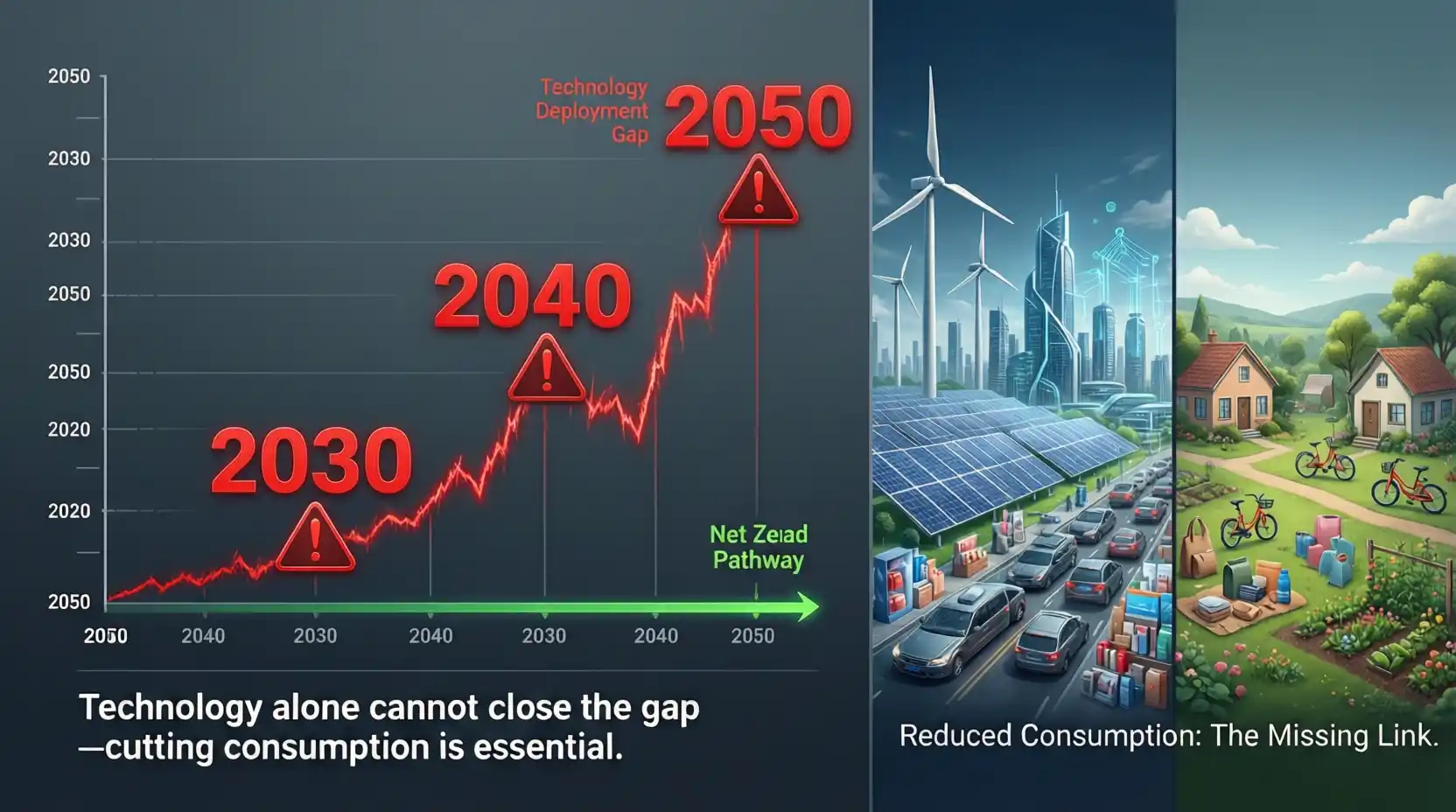
The Clock and the Calculator: Why Net Zero 2050 Faces a Timing Problem Technology Can’t Solve and Why We Must Consume Less
Introduction: The Grand Illusion of the 2050 Target
The year 2050 has become a totem in global climate policy. It is the date etched into the Paris Agreement, the finish line for corporate sustainability reports, and the beacon of hope for governments promising a “green transition.” The overarching goal of “Net Zero” by 2050 is simple in its algebraic formulation: the amount of greenhouse gases we put into the atmosphere must equal the amount we take out. It implies a balance, a restoration of equilibrium.
However, there is a profound and dangerous dissonance between the mathematical simplicity of Net Zero and the physical complexity of the global economy. The dominant narrative, championed by most developed nations and multinational corporations, relies on a specific brand of techno-optimism. It suggests that through a combination of renewable energy, electrification, hydrogen fuel, carbon capture technologies, and nature-based solutions, we can decarbonize the global economy without fundamentally altering our way of life. We can, the argument goes, keep growing, building, flying, and consuming, provided we swap the engines beneath the hood.
This narrative is not just optimistic; it is a gamble with existential stakes. When we peel back the layers of this transition strategy, we encounter a “timing problem” that is not merely logistical but physical. The scale of infrastructure required, the lag times of industrial replacement, and the sheer energy density of fossil fuels create a barrier that technology cannot leap over in the remaining 26 years.
While technology is an indispensable tool in the climate fight, it is currently being used as a shield to protect us from a more uncomfortable truth: we cannot shop our way out of the climate crisis. To bridge the gap between the 2050 target and reality, we must address the demand side of the equation. We need to talk about cutting consumption. This is not a call for poverty or a rejection of modernity, but a necessary pivot toward “sufficiency”—a structural and cultural reduction of energy and material throughput in the Global North. If we ignore the timing problem and refuse to curb consumption, Net Zero will remain a fantasy, and the climate will destabilize long before the first “carbon neutral” flight takes off.
Chapter 1: The Physics of Time and the Capital Stock Problem
To understand the timing problem, we must first understand the inertia of the global economy. The physical systems that power our civilization—power plants, steel mills, cement factories, shipping fleets, and buildings—are not software updates that can be changed instantly. They are massive, capital-intensive assets with lifespans measured in decades.
Consider the average lifespan of a coal-fired power plant: roughly 40 years. A commercial airliner can fly for 25 to 30 years. A cement plant operates for roughly 40 years. A building in New York or London might stand for a century. These assets represent “carbon lock-in.” Once built, they emit carbon dioxide for the duration of their functional lives unless they are retrofitted or scrapped early.
In 2024, we are arguably already behind the curve of the “immediate” emissions cuts required to stay within the 1.5°C target. The Intergovernmental Panel on Climate Change (IPCC) has noted that to hit Net Zero by 2050, global emissions need to peak immediately and decline by nearly half by 2030. This is not happening. Global emissions are still plateauing or rising slightly.
The timing problem arises because even if we stopped building new fossil fuel infrastructure today, the existing infrastructure would continue to pump out greenhouse gases for decades. To compensate for this “lock-in,” we would need to retire these assets early—which is financially ruinous for the companies that own them and politically destabilizing for the regions that rely on them.
Techno-optimists argue that we can overlay carbon capture and storage (CCS) onto these plants to negate their emissions. However, CCS technology is not scaling at the speed required. It is currently expensive, energy-intensive, and largely theoretical at the gigaton scale. We are betting on a technology that exists only in pilot projects to clean up a mess that is being created every second by industrial plants that are too expensive to close.
Furthermore, the sheer volume of “green” infrastructure required creates a secondary timing problem. To decarbonize the grid, we need to install thousands of gigawatts of wind and solar capacity. To electrify transport, we need to produce billions of electric vehicles (EVs). This construction boom requires a massive upfront surge of energy and materials. We must mine and process lithium, cobalt, copper, nickel, and rare earth elements. We must pour concrete (a carbon-intensive process) for foundations and smelt steel for turbine towers.
In the short term (the next 10-15 years), the energy transition itself increases demand for fossil fuels because the heavy industry powering the transition is still largely fossil-fueled. We are burning carbon to build the machines that will stop us burning carbon. This “carbon debt” must be paid off before the transition yields net benefits. If we wait for technology to mature—theoretically reaching commercial viability in the 2030s or 2040s—the cumulative emissions emitted between now and then will likely tip us past critical climate tipping points, such as the collapse of the West Antarctic Ice Sheet or the dieback of the Amazon rainforest.
Technology cannot solve this timing problem because it cannot violate the laws of physics regarding heat transfer, material strength, or chemical reaction rates. Building the new world takes time, and we have run out of time to build a replica of the old world using new materials.
Chapter 2: The Hard-to-Abate Sectors and the Limits of Electrification
The narrative of the green transition focuses heavily on the “easy” wins: generating electricity from renewables and powering passenger cars with batteries. While progress in these areas is commendable, it masks the stagnation in the “hard-to-abate” sectors. These are the areas of the economy that account for a significant portion of global emissions but cannot be easily decarbonized through batteries or renewable electricity due to physics or chemistry.
Heavy industry—steel, cement, and chemicals—accounts for roughly 25% of global CO2 emissions. Steelmaking requires coal to strip oxygen from iron ore in blast furnaces. Cement production involves a chemical reaction (calcination) that releases CO2 from limestone regardless of the energy source used. These processes require immense heat, often exceeding 1,500°C. While hydrogen and electrolysis are proposed solutions, they are currently nowhere near the scale or cost-efficiency required.
Then there is aviation and shipping. Aviation relies on liquid fuels with high energy density to keep heavy planes in the air. Batteries are too heavy; hydrogen requires too much volume. Biofuels compete with food crops and land use. Synthetic fuels (e-fuels), made by combining hydrogen and captured carbon, are incredibly energy-inefficient, requiring massive amounts of renewable electricity to produce a small amount of fuel.
If we assume technology will solve these problems by 2050, we run into the “valley of death” for innovation. The time lag between a lab breakthrough, a pilot plant, a commercial demonstration, and finally, global market saturation is historically 20 to 30 years. We simply do not have three decades to wait for a green steel breakthrough. We need the solution now.
The timing problem here is exacerbated by the growth of these sectors. Global demand for steel and cement is rising, driven by infrastructure development in the Global South. If the rich world plans to solve its emissions problem by outsourcing heavy industry to developing nations and buying green steel later, we are simply shifting the carbon burden, not reducing it.
Technology is struggling to find replacements for the material density of fossil fuels in these sectors. Consequently, the only viable mechanism to ensure emissions drop fast enough is to reduce the need for these materials. We need to design economies that require less cement, less steel, and fewer flights. This implies a shift from expansionism to maintenance—fixing what we have rather than building anew.
Chapter 3: The Efficiency Paradox and the Rebound Effect
When technology is touted as the savior, the primary mechanism cited is “energy efficiency.” The logic is straightforward: if we make cars lighter, engines more efficient, and buildings better insulated, we will use less energy to achieve the same output. Historically, however, this has not happened.
This phenomenon is known as the Jevons Paradox or the Rebound Effect. It observes that as technological progress increases the efficiency with which a resource is used, the total consumption of that resource increases rather than decreases. Why? Because efficiency lowers the cost of using the resource.
Consider the history of lighting. Over the last two centuries, the efficiency of lighting has increased by a factor of roughly 1,000 (from candles to LEDs). Has the amount of energy used for lighting decreased? No. We have simply lit up more of the world for longer hours. Efficiency made light cheap, so we consumed more of it.
Apply this to modern transport. If we switch to a fleet of highly efficient electric vehicles, the cost per mile of driving drops significantly (electricity is generally cheaper and maintenance is lower than gas cars). According to basic economics, when the price of a good drops, demand rises. If driving becomes cheaper, people may drive longer distances, live further from work, or opt for heavier, more powerful vehicles (which is already happening with the rise of massive electric SUVs).
Similarly, in the digital realm, making data centers more energy-efficient has not reduced global energy consumption from IT; it has enabled the explosion of crypto-currency mining, AI processing, and streaming services.
If we rely solely on technology to make consumption “greener,” we risk making consumption cheaper, thereby accelerating the depletion of resources and increasing the pressure on the biosphere. Efficiency is a necessary part of the puzzle, but it is not a substitute for absolute reduction.
The timing problem intersects with the rebound effect in a dangerous way. If we implement efficiency gains to lower emissions, but economic growth drives up consumption volume faster than efficiency gains, emissions continue to rise. We are trying to run up a down escalator that is accelerating. Technology gives us better shoes, but it doesn’t stop the escalator. The only way to get to the top is to address the speed of the escalator—the rate of material and energy throughput.
Chapter 4: The Resource Trap of Renewable Energy
There is a pervasive myth that renewable energy is “free” and infinite. While the sun and wind are indeed infinite, the infrastructure required to harness them is not. Solar panels, wind turbines, and batteries are physical artifacts made of finite materials extracted from the earth.
To reach Net Zero by 2050, the International Energy Agency (IEA) estimates that the demand for critical minerals could increase six-fold by 2040. We need massive amounts of lithium, cobalt, nickel, manganese, graphite, and copper. An EV requires roughly six times the mineral inputs of a conventional car. An offshore wind plant requires thirteen times more mineral resources than a gas-fired plant of the same capacity.
This leads to the resource trap. Mining and processing these materials are environmentally destructive and energy-intensive. Lithium mining consumes vast quantities of water in arid regions. Cobalt mining often involves human rights abuses and severe pollution. Copper mining requires moving entire mountains.
If we try to replace the entire global fossil fuel system with a renewable system of equivalent scale, we risk triggering an environmental collapse of a different kind—mineral exhaustion and toxic waste pollution. Furthermore, the Energy Return on Investment (EROI) for renewable energy is generally lower than for fossil fuels during their heyday. This means a larger portion of the energy we generate must be reinvested into the energy system (mining, building, maintaining) just to keep it running.
The timeline for opening new mines is often 10 to 15 years, just for the permitting and construction. If the demand for minerals is skyrocketing, supply constraints will drive up prices, slowing down the deployment of green tech. This creates a vicious cycle: we need green tech to stop climate change, but we need fossil fuels to build the green tech, and the materials to build the green tech are running out.
Technology cannot circumvent the finiteness of the Earth’s crust. We cannot technologically innovate our way out of a shortage of copper or lithium without finding substitutes, which takes decades of research. Therefore, the only way to make the renewable transition feasible within the resource constraints is to reduce the size of the energy system we are trying to build. A smaller economy requires fewer solar panels and fewer batteries. Cutting consumption is the only way to relieve the pressure on the mineral supply chain and ensure the energy transition is physically possible.
Chapter 5: The Carbon Budget and the Equity Gap
Perhaps the most damning aspect of the timing problem is the “carbon budget.” This is the estimated amount of carbon dioxide the world can emit while still having a 50% or 66% chance of limiting warming to 1.5°C. As of 2024, that budget is nearly exhausted. At current emission rates, we will blow the 1.5°C budget before the end of this decade.
If we distribute this remaining budget equally among the global population (equity), the wealthy nations—the Global North—have effectively already used up their allocation. They are now running on “carbon debt” borrowed from the Global South and future generations.
The Net Zero 2050 narrative often obscures this equity gap. It assumes a global convergence where developing nations leapfrog fossil fuels. However, developing nations require energy to alleviate poverty and build infrastructure. If they are to follow a green path, the Global North must leave the remaining carbon budget for them, or provide the finance and technology for a green leapfrog.
But the Global North is not reducing its emissions fast enough. Instead, we rely on the narrative that future technologies (like Direct Air Capture) will remove excess carbon from the atmosphere, allowing us to overshoot the budget today and clean it up tomorrow. This is a classic moral hazard. It allows wealthy consumers to continue their high-consumption lifestyles under the guise that “scientists will fix it later.”
Direct Air Capture (DAC) is currently prohibitively expensive and energy-intensive. To capture the billions of tons of CO2 we emit would require an industrial infrastructure larger than the current global oil industry. It is highly unlikely that DAC will be operational at a meaningful scale within the critical next decade.
Therefore, the responsibility to cut consumption falls disproportionately on the wealthy. The top 10% of global emitters (roughly anyone earning over $38,000 a year, though this varies by region) are responsible for nearly half of global consumption emissions. The bottom 50% contribute only about 10-12%.
Technology is often applied uniformly, but the equity of emissions is not uniform. Improving the efficiency of a private jet matters less than billions of people gaining access to clean cooking. The timing problem dictates that we have no time for a trickle-down transition. We need an immediate contraction of emissions from the top emitters. This is not a technological fix; it is a political and ethical choice to consume less.
Chapter 6: Redefining the Solution—The Case for Sufficiency
If technology cannot solve the timing problem, what can? We must turn to the concept of “Sufficiency.” While Efficiency is about doing the same with less (better technology), Sufficiency is about doing well with enough (enough technology, better lifestyle). Sufficiency involves setting limits on consumption to ensure it stays within planetary boundaries.
Sufficiency is not a return to the Stone Age. It does not mean we must live in caves or forego modern medicine. Instead, it means a radical reorganization of our societal priorities. It involves distinguishing between “needs” and “wants.” It requires a shift from an economy predicated on infinite growth to one focused on human well-being, ecological stability, and leisure.
Transportation: Techno-optimism bets on EVs. Sufficiency bets on public transit, walkable cities, and the 15-minute city. It means reducing the need for travel by bringing work, school, and services closer to home. It means high-speed rail for long distances instead of short-haul flights. It means a cultural shift where car ownership is seen as a utility, not a status symbol.
Housing: Techno-optimism bets on heat pumps and smart grids. Sufficiency bets on retrofits and insulation (passive houses), but also on shared living spaces and smaller homes per capita. It challenges the trend of larger houses occupied by fewer people. It emphasizes “radical retrofitting” of existing stock rather than demolition and new construction.
Food: Techno-optimism bets on lab-grown meat and vertical farming. Sufficiency bets on a shift to plant-based diets, reducing food waste (which accounts for roughly 8-10% of global emissions), and supporting local, regenerative agriculture. It recognizes that eating industrially produced meat is a luxury the planet can no longer afford.
Economy: Techno-optimism bets on “Green Growth.” Sufficiency aligns with “Degrowth” or “Post-Growth” theories. This suggests that we can decarbonize the economy, but perhaps not grow it indefinitely in material terms. It proposes a reduction in working hours to share employment and increase leisure time (which typically has a lower carbon footprint than labor). It involves shifting GDP focus from manufacturing to care, arts, and education—sectors that provide high social value with low material throughput.
By adopting sufficiency, we relax the timing problem. If we reduce energy demand by 30-40% through efficiency and behavioral change, we don’t need to build renewable energy quite as fast. We don’t need to mine as many metals. The pressure on the remaining carbon budget eases, giving us more time to roll out the necessary technology for the hard-to-abate sectors.
Chapter 7: The Political and Psychological Barriers
If sufficiency is such a logical solution to the timing problem, why is it absent from mainstream political discourse? The answer lies in the power of vested interests and the psychological hold of consumerism.
Politicians are allergic to the idea of “less.” Electoral cycles are short, and promises of austerity or reduced consumption do not win votes. The dominant economic model (Neoclassical Capitalism) relies on constant consumption to drive profit. Corporations spend billions on advertising to manufacture desires for products we do not need. The concept of “planned obsolescence” ensures that goods break quickly, necessitating replacement and keeping the wheel of consumption spinning.
Furthermore, the “hedonic treadmill” of consumer psychology means that we quickly adapt to new levels of wealth. A new car or phone brings joy only briefly, after which we return to our baseline happiness and desire the next upgrade. Breaking this cycle requires a cultural shift that values experiences, community, and nature over material possessions.
There is also the fear that “cutting consumption” implies a loss of freedom. In the individualistic West, consumption is equated with liberty. The idea of the state or society dictating “how much is enough” feels authoritarian. However, the alternative—a world ravaged by climate chaos, where supply chains collapse and resources become scarce—is a far greater imposition on freedom. Voluntary sufficiency is a choice; involuntary scarcity is a catastrophe.
Overcoming these barriers requires reframing the narrative. We must stop viewing climate action as a sacrifice and start viewing it as a gain. Less traffic means less stress and more time. Smaller houses mean less cleaning and maintenance. A slower food culture means better health and connection. The transition to sufficiency is an opportunity to improve the quality of life for the majority while reducing the ecological footprint of the wealthy.
Chapter 8: Implementing Sufficiency—Policy Pathways
Talking about cutting consumption is abstract; implementing it requires concrete policy levers. Here are a few strategies that governments could employ immediately:
- Ecological Tax Reform: Shift taxation from labor (income tax) to resources (carbon tax, extraction tax, luxury consumption tax). This makes labor cheaper (encouraging employment) and resources expensive (discouraging waste). The revenue can be recycled as a dividend to citizens to protect low-income earners.
- Advertising Bans: Just as we banned tobacco advertising, we can restrict advertising for high-carbon goods like SUVs, airline tickets, and fast fashion. This reduces the social pressure to consume and “status anxiety.”
- Right to Repair: Enforce legislation that mandates manufacturers to design products that are repairable and long-lasting. This kills the business model of planned obsolescence and reduces the throughput of materials.
- Urban Planning: Zoning laws must prioritize mixed-use development over suburban sprawl. Investing in public transit makes car ownership unnecessary for millions.
- Caps on Luxury Emissions: Implement a “carbon card” or frequent flyer levy that restricts the amount of carbon an individual can use for non-essential travel. Those who wish to fly more must buy the quota from those who fly less, creating a market that redistributes wealth while capping total emissions.
- Work-Time Reduction: Moving to a four-day work week without loss of pay. This has been shown to reduce carbon footprints (less commuting, less office energy use) while improving worker well-being.
These policies face fierce opposition from entrenched interests, but they are essential to addressing the timing problem. We cannot wait for a technological silver bullet; we must use the regulatory tools at our disposal to lower demand now.
Chapter 9: The Role of Technology in a Sufficiency World
It is important to clarify that arguing for consumption cuts does not mean rejecting technology. Technology is vital, but its role changes. Instead of technology being an “enabler” of endless growth, it becomes a “tool” for sustainability.
In a sufficiency world, technology is used to:
- Optimize grids: Smart software to manage intermittent renewables.
- Decarbonize essential services: Green steel and cement for necessary infrastructure (hospitals, public transit).
- Improve quality of life: Medical advances, educational tools, and connectivity that do not require massive material throughput.
We need to stop asking “Can technology replace fossil fuels to keep the GDP growing?” and start asking “How can technology help us live well within ecological limits?” The former is a distraction; the latter is a survival strategy.
The timing problem dictates that we must prioritize technologies that are available, scalable, and low-resource now. This means insulation, heat pumps, public transit, solar panels, wind turbines, and behavioral nudges. It means deprioritizing sci-fi solutions like fusion power, space-based solar, or planetary-scale geoengineering, which consume valuable time, capital, and mental bandwidth.
Conclusion: The Moral Imperative of Less
Net Zero by 2050 is a laudable goal, but as a strategy, it is currently built on a foundation of sand. The reliance on technology to solve the climate crisis while ignoring the need to reduce consumption is a mathematically impossible equation. The timing problem—defined by the inertia of fossil infrastructure, the slow scale-up of renewables, and the depletion of critical minerals—means we do not have the luxury of waiting for a green tech revolution to mature while maintaining the status quo.
We have entered an era of consequences. The climate impacts we are witnessing—wildfires, floods, heatwaves—are the result of emissions from decades ago. The emissions we produce today will lock in suffering for decades to come. We are in a race between physics and politics, and physics is not negotiating.
To have any chance of stabilizing the climate, the wealthy nations and individuals of the world must rapidly reduce their consumption of energy, materials, and land. This is not a call for misery, but a call for maturity. It is a recognition that the Earth is finite, and that infinite growth on a finite planet is a fairy tale.
By embracing sufficiency, we can alleviate the pressure on the energy transition, allow technology time to mature where it is truly needed, and build a society that is more resilient, equitable, and ultimately, happier. Technology can light the path, but we must be the ones to choose to walk it. And to reach the destination in time, we must learn to travel lighter. The clock is ticking, and the solution is not just a better machine—it is a better way of life.
Disclaimer: This article is for informational purposes only. The views expressed regarding climate policy, economic theory, and technological timelines are based on current analysis and modeling. They do not constitute professional financial, investment, or legal advice. Readers are encouraged to conduct their own research and consult with qualified professionals regarding specific decisions.
Have any thoughts?
Share your reaction or leave a quick response — we’d love to hear what you think!
-
 0
-
 0
-
 0
-
 0
-
 0
-
 0
