
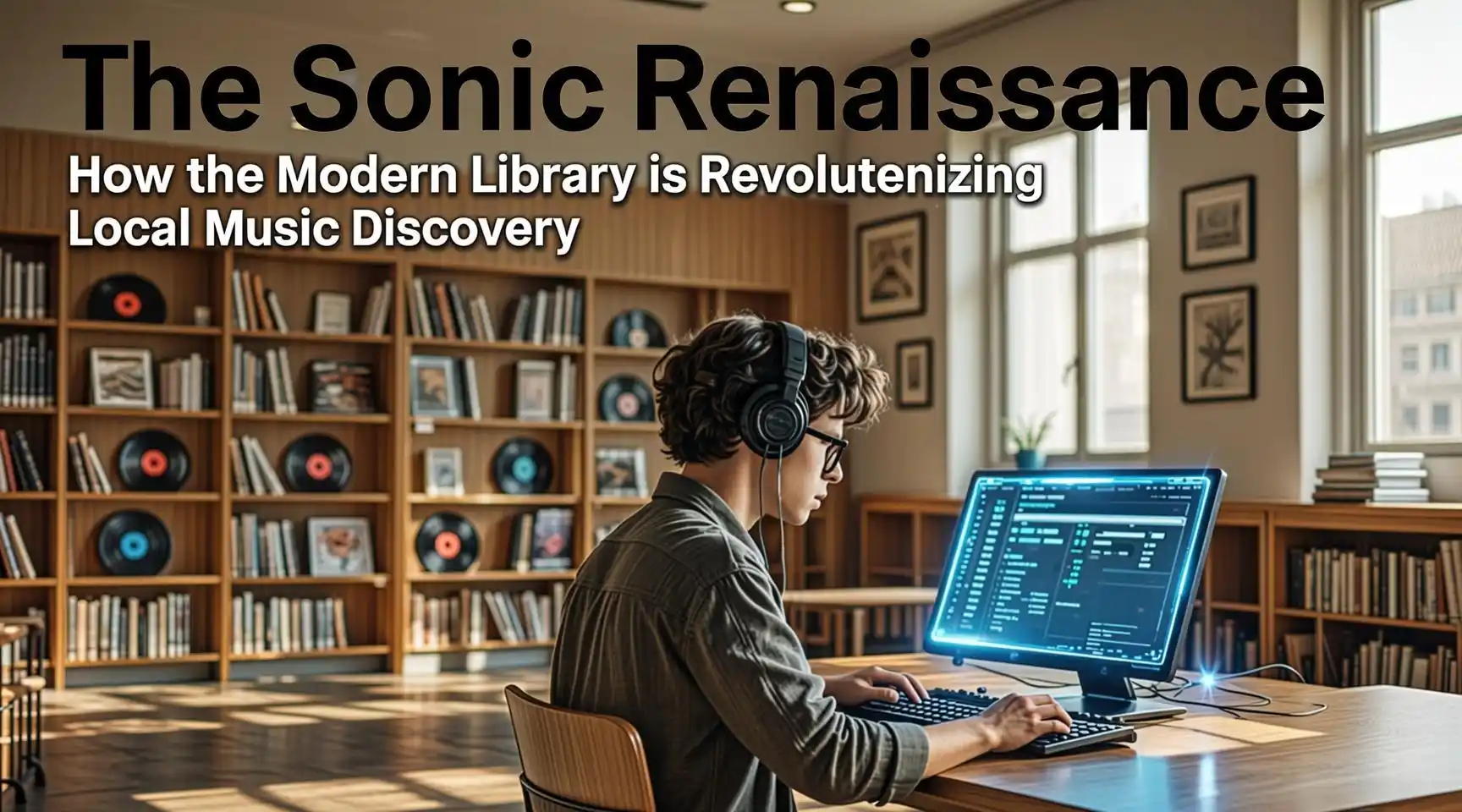
The Sonic Renaissance: How the Modern Library is Revolutionizing Local Music Discovery
Introduction: Beyond the Quiet Stacks
For generations, the public library has been symbolized by the hush of study rooms, the smell of aging paper, and the rigid rows of Dewey Decimal classifications. It was a repository of the recorded past—a place where knowledge was stored, preserved, and occasionally retrieved. However, as the twenty-first century progresses, the identity of the library is shifting from a static warehouse of books to a dynamic hub of community creation and digital access. In an era where the algorithmic gatekeepers of Spotify, Apple Music, and YouTube dictate the global soundscape, a quiet revolution is taking place within the municipal walls of your local library. This revolution is not about silence; it is about amplification. It is the launch of a new, library-based streaming service dedicated exclusively to the up-and-coming artists who live, breathe, and create within our own neighborhoods.
This initiative represents a radical reimagining of the library’s role in cultural preservation. No longer content merely to archive the dead composers of centuries past, libraries are now stepping up to become the patrons of the living. By offering a streaming service that shares the work of local, independent musicians, libraries are bridging the dangerous gap between the creator and the consumer, democratizing an industry that has become increasingly opaque and monopolized. This text explores the multifaceted implications of this service, examining the technological infrastructure, the economic impact on local artists, the benefits for patrons, and the profound cultural shift required to bring the stacks into the streaming age.
Chapter 1: The Crisis of Discoverability in the Digital Age
To understand why a library streaming service is necessary, one must first understand the current landscape of the music industry. We live in an age of paradoxical abundance. There has never been more music available to the human race than there is right now. Over 100,000 new songs are uploaded to streaming platforms every single day. For the listener, this creates a paradox of choice: paralyzed by the sheer volume of options, most retreat into the safety of algorithmic recommendations, listening to the same top 40 hits or “mood playlists” curated by faceless data engines.
For the independent artist, this landscape is often desolate. The “democratization” promised by the internet has morphed into a “pay-to-play” nightmare. To be heard, an artist often needs substantial marketing budgets, playlisting connections, or the luck of going viral on TikTok. The algorithm favors those who already have momentum, creating a feedback loop where the rich get richer and the independent artist remains shouting into a hurricane. The radio waves, once a bastion of local diversity, have been consolidated into corporate conglomerates playing identical playlists across state lines.
Consequently, local music scenes are suffering. Talented musicians who lack the resources to compete with major label marketing campaigns are finding it increasingly difficult to find a local audience. The barrier to entry for recording may have lowered (home studios are more accessible), but the barrier to being heard has never been higher. This is where the library steps in. Unburdened by the profit motive, the library does not care about “clicks” or “ad revenue.” Its mandate is service, education, and community enrichment. By creating a streaming platform, the library cuts through the noise, offering a curated, trusted space where the signal of local talent can finally be found.
Chapter 2: The Library as the New Patron of the Arts
Historically, art thrived under the system of patronage. Composers like Mozart and Beethoven survived because wealthy nobles or the church commissioned their work. In the twentieth century, this role shifted briefly to record labels, who acted as investors and bankers for artists. Today, that system has eroded. Labels are risk-averse, signing only acts that guarantee a return on investment based on data-driven formulas.
The library is uniquely positioned to fill this void as a “public patron.” Funded by taxpayers and grants, the library’s bottom line is the cultural health of the community, not stock prices. The introduction of a streaming service is an extension of the library’s existing mission of “collection development.” Just as a librarian curates a selection of books on local history or gardening, they can now curate a selection of local music.
This shift changes the relationship between the artist and the institution. In the commercial model, the artist is a product to be exploited. In the library model, the artist is a community asset to be nurtured. The streaming service offers legitimacy. Being selected for the library’s catalog serves as a badge of quality, a seal of approval that tells the patron: “This music is worth your time.” It validates the artist’s work in a way that a random upload to Bandcamp or SoundCloud cannot. Furthermore, the library can offer physical support alongside digital streaming—recording equipment in makerspaces, practice rooms, and workshops on music business literacy—creating a holistic support system for the local creative class.
Chapter 3: Mechanics of the Service – “LocalTones”
Let us conceptualize this service, which we will call “LocalTones” for the sake of this exploration. The technical architecture of LibraryTones must be robust yet user-friendly, designed to compete with the UX (user experience) standards set by major commercial platforms while adhering to the strict accessibility standards required of public institutions.
The User Interface (UI): Patrons would access LibraryTones through a web browser or a dedicated mobile app, authenticated using their existing library card credentials. The interface would be clean and intuitive, featuring sections such as “New Releases,” “Staff Picks,” “Genre Explorer,” and “History of Our Scene.” A unique feature could be “The Sounds of the City,” a playlist that updates weekly to showcase the diversity of the region’s output.
The Metadata and Curation: Unlike commercial algorithms that recommend music based on what sells, LibraryTones would rely on librarian curation and rich metadata. Each track would be tagged not just by genre (e.g., Rock, Jazz), but by mood, instrumentation, and cultural relevance. Librarians could write liner notes and biographies for the artists, adding an educational layer that is absent from Spotify. This transforms listening from a passive activity into an active learning experience.
Streaming Quality and Accessibility: High-fidelity audio streaming would be a priority, appealing to audiophiles who are frustrated by the compressed bitrates of commercial services. Crucially, the platform would adhere to WCAG (Web Content Accessibility Guidelines), ensuring that the visually or hearing impaired can fully navigate the service. This might include high-contrast modes, transcripts of lyrics, and integration with screen readers.
Integration with Physical Collections: The service would bridge the digital and physical divide. If a user streams a local jazz trio and falls in love with them, the library catalog could show that the library also holds the band’s physical CD or vinyl records, or books on the history of jazz. The streaming service becomes a discovery tool that drives circulation of all library materials.
Chapter 4: The Artist Onboarding Process
A critical component of this initiative is the submission and onboarding process. It must be equitable, accessible, and fair. Unlike the opaque submission processes of commercial playlists, the library’s process would be transparent and community-focused.
Eligibility and Verification: To qualify for the LibraryTones platform, artists must verify their local status. This could be done by providing a proof of residence within the library’s service area. This ensures that the service remains dedicated to local music, fulfilling its mandate to support the immediate community.
Rights and Licensing: This is the most complex legal aspect. The library must negotiate a licensing agreement with the artists. A standard “Non-Exclusive Digital Distribution Agreement” would be drafted. This agreement grants the library the right to host and stream the music to its cardholders. Importantly, the artist retains 100% of their copyright and ownership. The library is not “stealing” the music; they are hosting it with permission.
The Royalty Question: Will artists be paid? In a commercial model, royalties are paid per stream, often amounting to fractions of a cent. A library model might operate differently. Since the service is “free” at the point of use (funded by taxes), the library might offer a modest honorarium or a grant-based payment for accepted submissions. Alternatively, the service could operate on a “lending” model similar to physical books, where a fixed fee is paid to the artist for the inclusion of their work in the catalog for a set period (e.g., one year). This provides predictable income to the artist, unlike the unpredictable volatility of streaming royalties.
The Review Panel: To maintain quality control, a panel of diverse community members—librarians, local music teachers, scene veterans, and teen volunteers—would review submissions. This prevents the platform from becoming a “dumping ground” for low-quality recordings and ensures that the music featured represents the best of the region.
Chapter 5: Benefits for the Community Patron
Why would the average library user bother switching from Spotify to a library streaming service? The value proposition for the patron is rooted in connection, discovery, and ethics.
Hyper-Local Discovery: For the listener who wants to feel connected to their town, LibraryTones offers a map of the community’s soul. It allows them to discover the jazz trio playing at the downtown bistro, the punk band practicing in the garage next door, or the folk singer-songwriter performing at the farmer’s market. It fosters a sense of pride in local culture.
Ethical Consumption: Many listeners are becoming uncomfortable with the labor practices of major streaming platforms. They want to know that their support is actually helping the artist. Listening via LibraryTones is an act of civic engagement. It supports the library’s funding models and ensures that local artists are getting visibility and potential stipends.
Educational Value: Students of music can use the platform to study the works of their peers. It can serve as a resource for music classes, allowing teachers to showcase local examples of specific genres or techniques. The library can also host “Listen and Learn” sessions where tracks are played and dissected.
Event Integration: The streaming service becomes a promotional tool for library events. If the library is hosting a “Battle of the Bands” or a summer concert series, the streaming service can host a “Pre-Show Playlist” featuring the competing artists. This drives attendance and engagement with physical library programming.
Chapter 6: Economic Impact and Urban Planning
The ripple effects of this service extend beyond the headphones of the listeners and the bank accounts of the musicians; they touch the very economic vitality of the region.
The “Music City” Multiplier: Cities that foster vibrant music scenes see significant economic boosts. Fans of local music go out to shows, they buy drinks, they purchase merchandise, and they pay for parking. By amplifying the local scene, LibraryTones acts as a marketing engine for the local nightlife and hospitality economy. It helps retain creative talent in the city; artists are less likely to move to New York, Los Angeles, or Nashville if they feel they have a supportive platform and an appreciative audience at home.
Tourism: A curated, accessible local music archive is a unique cultural asset that can attract tourists. Visitors to the city could access the app (perhaps with a “guest pass” feature) to listen to the “Sounds of [City Name]” while they explore. It creates a unique sense of place that differentiates the city from every other generic metropolis.
Real Estate and Development: Areas with strong cultural amenities often see increased property values and community cohesion. A library that actively promotes local culture becomes a “third place”—a home away from home—that anchors the neighborhood. This service reinforces the library as a modern, relevant institution, making it easier for municipalities to advocate for funding and expansion projects.
Chapter 7: Challenges and Mitigation Strategies
No ambitious project is without its hurdles. The implementation of a library streaming service faces significant challenges regarding funding, technology, and copyright.
Funding the Infrastructure: Streaming requires servers, bandwidth, and software development. This is expensive. Libraries can mitigate this by applying for specific technology and arts grants (e.g., from the National Endowment for the Arts or the Institute of Museum and Library Services). Partnerships with local tech companies can also provide in-kind sponsorship or server space.
Copyright Complexity: Navigating the rights to cover songs, samples, and mashups is difficult. The library must employ or consult with copyright lawyers to draft clear guidelines for artists. A strict policy stating that the artist warrants they own all rights to the recording (and any samples used) will protect the library from litigation.
Digital Divide: Streaming is high-bandwidth. If the library serves a population with poor internet access, the service may be exclusionary. The library must address this by improving Wi-Fi access in its branches and loaning out hotspots or mobile devices to patrons who lack them. The app must also have an “offline mode” where users can download playlists while in the library to listen to later at home.
Sustainability: The initial hype may fade. To ensure long-term sustainability, the library must integrate the service into its core operations, not treat it as a one-time grant project. Regular marketing, continuous artist recruitment, and fresh content are essential. Engaging “Digital Ambassadors”—young patrons who help promote the service on social media—can keep the momentum going.
Chapter 8: The Future of the Archive
Perhaps the most profound aspect of the LibraryTones initiative is its archival potential. Commercial streaming services are fickle; they remove content constantly due to licensing disputes or lack of plays. Music uploaded to the internet today can disappear tomorrow.
The library, by its very nature, is a forever institution. When a library uploads a local artist’s album to its streaming server, it is archiving that piece of cultural history. In one hundred years, historians and musicologists will be able to look back at the LibraryTones archive to understand what life sounded like in our town in the 2020s.
This creates a “Living Archive.” It is not a dusty box of reel-to-reel tapes that no one can touch; it is a breathing, streaming collection that preserves the now for the future. This fulfills the highest calling of the library: the preservation of human culture. By treating local music with the same reverence as a rare manuscript or a historical photograph, the library elevates popular art to the status of heritage.
Chapter 9: Case Studies and Hypothetical Scenarios
To visualize the impact, let us look at a few hypothetical scenarios involving LibraryTones.
Scenario A: The Teen Prodigy Sarah, a 16-year-old electronic music producer, makes beats in her bedroom using free software. She has no money for distribution and no following. She uploads her tracks to LibraryTones. A local librarian hears them and adds them to the “Electronic Futures” playlist. A promoter for a local festival sees the playlist, books Sarah for an opening slot, and her career is launched. The library provided the first stage.
Scenario B: The Retired Hobbyist Mr. Hernandez, a retired teacher, has been writing folk songs about the city’s history for 30 years. He never released them. His daughter encourages him to digitize them and submit to the archive. Now, students researching local history can listen to his songs as primary source documents, learning about the city’s past through melody and verse.
Scenario C: The Community Healer After a tragedy strikes the community, the library curates a “Healing Frequencies” playlist featuring soothing local instrumental music. It becomes a shared resource for the town, a way to process grief through the shared comfort of local sound.
Chapter 10: Implementation Roadmap
For a library system wishing to launch this service, a phased approach is recommended.
Phase 1: The Pilot (Months 1-6): Select a small group of 10-20 diverse local artists. Build a basic, functional web-prototype. Focus on ironing out legal kinks and testing the user experience with a small group of patrons.
Phase 2: The Public Beta (Months 7-12): Launch to the general public but with limited marketing. Focus on gathering feedback. What genres are missing? Is the app crashing? Use this time to secure more funding.
Phase 3: The Full Rollout (Year 1+): Full marketing blitz. Integration with the library’s main website. Launch of the mobile app. Partnership events with local music venues. Expansion of the catalog to hundreds of artists.
Conclusion: A Symphony of Community
The launch of a library streaming service for local up-and-coming artists is more than just a tech upgrade; it is a declaration of values. It asserts that local culture matters, that the arts are for everyone, and that the library is the beating heart of the community. In a world where digital platforms often isolate us, feeding us content designed to keep us scrolling and spending, the library offers a alternative: a platform designed to connect us, to teach us, and to lift us up.
By providing the infrastructure for local music to thrive, libraries are ensuring that the soundtrack of our lives is not written by a corporate algorithm in a distant server farm, but by the neighbors we see on the street. This is the future of the library: loud, proud, and unmistakably local. It is an investment in the creative economy, a gift to the patrons, and a lifeline for the artists. As we move forward into an increasingly digital future, let us look to the library—not just to borrow books, but to borrow a listen to the soul of our city.
Keywords:
- Local Music Discovery
- Community Archive
- Independent Artist Streaming
Hashtags: #LibraryMusic #SupportLocalArtists #SonicArchive
Disclaimer: The text provided above is a conceptual expansion and for informational purposes only. The specific details regarding the “LibraryTones” service, including its name, features, and implementation strategies, are hypothetical and designed to illustrate the potential of such a program. Actual library streaming services may vary in structure, legal compliance, and availability depending on the institution’s resources and local copyright laws. Readers interested in implementing such a service should consult with legal professionals regarding licensing and intellectual property rights.
Top of Form
Have any thoughts?
Share your reaction or leave a quick response — we’d love to hear what you think!
-
 0
-
 0
-
 0
-
 0
-
 0
-
 0
