
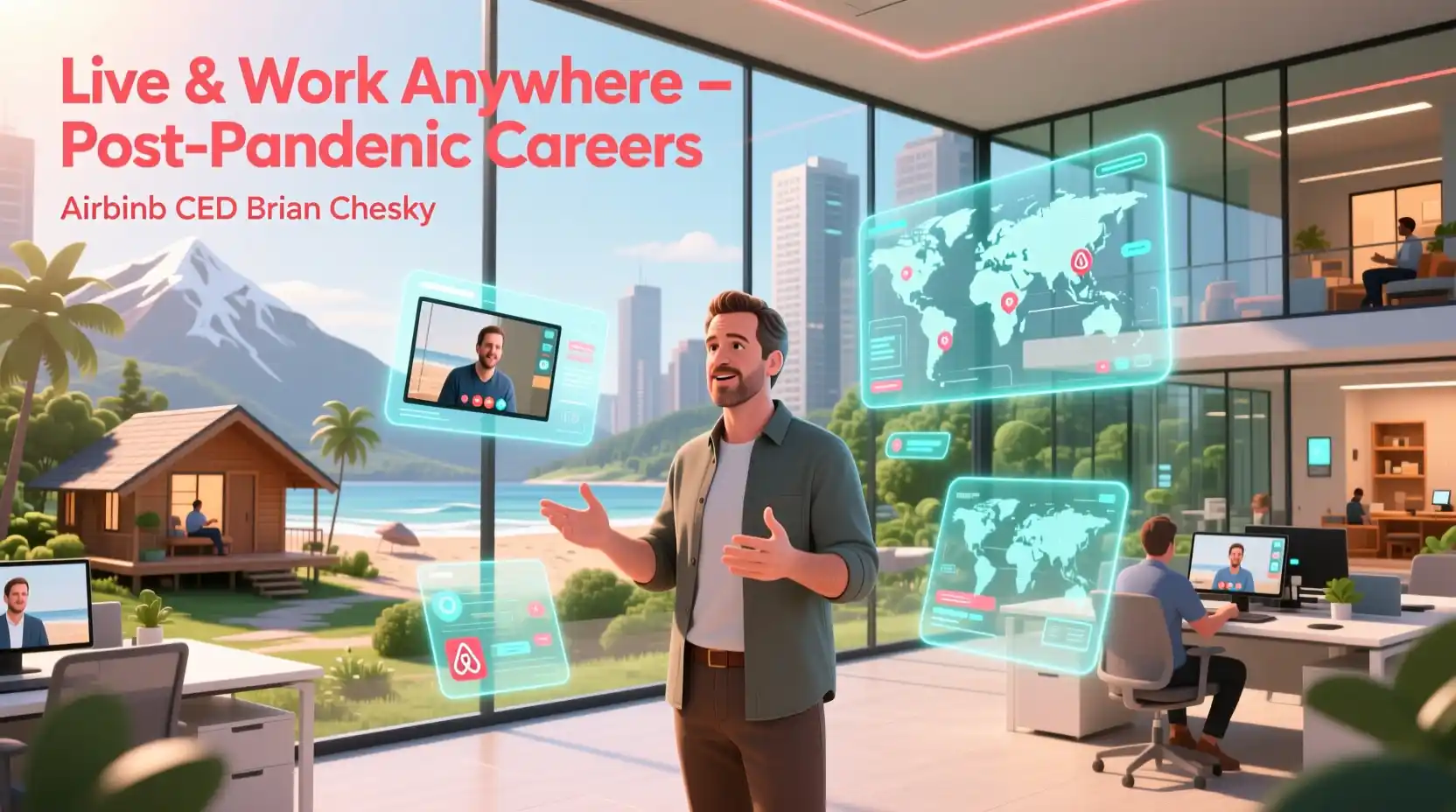
The End of the Office as We Know It: Deconstructing Airbnb’s “Live and Work Anywhere” Revolution and the New World of Work
In the spring of 2022, as the world tentatively emerged from the throes of a global pandemic, a memo circulated within Airbnb that would send shockwaves through the corporate world. It wasn’t about quarterly earnings or a new product launch. It was a declaration of a new philosophy of work, authored by CEO Brian Chesky. The message was seismic in its simplicity and profound in its implications: Airbnb employees could now “live and work anywhere.”
This wasn’t just another incremental step towards flexible work; it was a full-throated embrace of a borderless, office-less future. Chesky’s announcement was the loudest signal yet that the great, forced experiment of the pandemic had permanently altered our relationship with work, the office, and the very concept of a career. It was a bet on human freedom, a strategic masterstroke in talent acquisition, and a perfect piece of marketing for a company whose entire business is built on the idea of belonging anywhere.
To understand the true weight of this decision, we must look beyond the headline. We must trace the path that led us here, dissect the intricate mechanics and hidden brilliance of Airbnb’s model, and explore the vast, turbulent ripple effects it is creating across industries, cities, and the lives of millions. This is the story of the end of the office-centric era and the dawn of a new, more flexible, and infinitely more complex world of work.
Part 1: The Genesis of a Revolution – From Gray Cubicles to Global Wi-Fi
The idea that an entire workforce could be untethered from a central office was, for decades, a fringe fantasy. To appreciate the revolutionary nature of Chesky’s announcement, we must first understand the rigid, geography-bound world it seeks to dismantle.
The Pre-Pandemic Office: A Cathedral of Commute and Clock-In
For the better part of a century, work was a place. It was a physical destination you traveled to, five days a week, roughly between the hours of nine and five. This model, forged in the industrial revolution and perfected in the post-war economic boom, was built on the pillars of presenteeism and direct supervision. Productivity was often visually measured: who was at their desk first, who stayed latest, who looked busiest.
The office was a social ecosystem, complete with its own rituals, hierarchies, and tribal territories. The corner office was the ultimate symbol of status. The cubicle farm was the great equalizer. The coffee machine was the watering hole for gossip and collaboration. The commute, a soul-crushing daily pilgrimage for millions, was the necessary price of admission to this world. This structure dictated not just our workdays, but our lives. It determined where we lived, how we spent our mornings and evenings, and, by extension, who we became. Corporate culture was transmitted through osmosis—in-person meetings, team lunches, and the subtle, non-verbal cues that are lost in a digital translation. To question this model was to question the very foundation of modern capitalism.
The Tectonic Shift: The Pandemic as an Unwitting Catalyst
Then, in March 2020, the world stopped. A microscopic virus accomplished what decades of lobbying and negotiation could not: it emptied the world’s offices overnight. The shift to remote work was not a planned, strategic evolution; it was a chaotic, desperate scramble. Companies that had long resisted remote work were forced to embrace it out of necessity. Kitchen tables became desks. Living rooms became boardrooms. Zoom became a verb.
The initial consensus among many executives was one of deep skepticism. They feared a catastrophic collapse in productivity, a loss of control, and the disintegration of their carefully curated company cultures. But a funny thing happened on the way to the apocalypse. For many knowledge-based industries, productivity didn’t just hold steady; in some cases, it actually increased. Freed from commutes and office distractions, many employees found they could focus more deeply. The rigid 9-to-5 schedule began to soften, replaced by a focus on results rather than hours logged.
This global, involuntary experiment proved a powerful thesis: for a vast segment of the workforce, physical presence was not a prerequisite for high performance. The technological infrastructure—high-speed internet, cloud computing, collaborative software like Slack and Teams—had been quietly maturing for years, ready to underpin this new reality. The pandemic simply provided the catalyst that forced its mass adoption. It shattered the long-held assumption that work and place were inextricably linked.
The Early Adopters: The Digital Nomads of the 2010s
Of course, the concept of working remotely wasn’t born in 2020. For years, a small but growing tribe of “digital nomads” had been living the future that was suddenly thrust upon the mainstream. These were the freelancers, the entrepreneurs, the developers, and the writers who had traded their stationary desks for a life of perpetual travel.
In the early 2010s, hubs like Chiang Mai, Thailand; Bali, Indonesia; and Medellín, Colombia became legendary in these circles. They offered a potent combination of low cost of living, reliable internet, vibrant expat communities, and an enviable quality of life. For these pioneers, remote work was not a perk; it was a lifestyle choice. They were the beta testers for the “work from anywhere” model, ironing out the kinks, building the tools, and evangelizing the philosophy on blogs and forums. They were a niche movement, often viewed with a mixture of envy and suspicion by the corporate world. But they proved that it was possible to build a successful career and a fulfilling life without a fixed address. They were the canaries in the coal mine, and when the pandemic hit, the rest of the world finally had to listen to what they had been saying all along.
Part 2: Deconstructing Airbnb’s Manifesto – A Masterclass in Modern Strategy
Brian Chesky’s “live and work anywhere” memo was more than a generous HR policy. It was a multi-layered strategic document that reflected a deep understanding of the new post-pandemic reality. To truly grasp its significance, we must dissect its components, from the official rules to the brilliant business synergy it creates.
The Policy in Practice: Freedom Within a Framework
On the surface, Airbnb’s policy is the gold standard of flexibility. It allows employees to work from over 170 countries for up to 90 days a year in each location, without any change to their compensation. They can also move freely within their country of employment. This is a significant step beyond the “work from home” policies adopted by many companies, which still tether employees to a specific geographic location, often within commuting distance of a now-underutilized office.
However, this freedom is not anarchy. It operates within a carefully constructed framework designed to manage the immense legal and logistical complexities of a globally distributed workforce. The 90-day limit per country is a crucial detail, designed to prevent employees from inadvertently establishing tax residency in a foreign nation, a legal minefield that could have severe financial implications for both the employee and the company. Airbnb has had to build a sophisticated internal infrastructure to support this, providing employees with tools and resources to understand visa requirements, local laws, and tax obligations in their chosen destinations.
The policy is also a testament to trust. It operates on the assumption that employees are responsible adults who can manage their own time and productivity without direct supervision. This is a radical departure from the traditional management mindset and requires a fundamental shift in how performance is measured and evaluated. The focus moves inexorably from “hours worked” to “outcomes achieved.”
The Strategic Brilliance: A Four-Dimensional Chess Move
From a business perspective, Airbnb’s policy is a masterstroke that serves several strategic goals simultaneously.
- Talent Acquisition and Retention in a War for Talent: The “Great Resignation” was not just about people quitting their jobs; it was about people re-evaluating their lives and demanding more from their employers. Flexibility is no longer a nice-to-have perk; it is a non-negotiable requirement for a huge segment of the workforce. By offering the ultimate form of flexibility, Airbnb positions itself as an employer of choice, able to attract and retain top talent from a global pool, not just from the cities where it has offices. A brilliant engineer in rural Portugal or a marketing genius in a small town in Japan is now a potential hire, something that was unthinkable just a few years ago.
- The Ultimate Marketing Synergy: This is perhaps the most ingenious aspect of the policy. Airbnb is a company that facilitates travel and long-term stays. By empowering its own employees to live and work anywhere, it is turning its workforce into its most authentic and powerful marketing campaign. Every employee who shares their experience of working from a cottage in the English countryside or an apartment in Tokyo is a living, breathing testimonial for the Airbnb platform. It blurs the line between employee and brand ambassador, reinforcing the core brand message of “belonging anywhere” in the most credible way possible.
- Cost Savings and Operational Efficiency: While the company has not focused on this publicly, a globally distributed workforce inevitably leads to a reduced need for expensive, prime-location commercial real estate. By allowing employees to work from home or wherever they choose, Airbnb can downsize its physical footprint, leading to significant long-term savings on rent, utilities, and other overheads. This capital can be reinvested into technology, talent, and growth initiatives.
- Fostering Innovation and a Global Perspective: A workforce that is truly global, not just in name but in location, brings a wealth of diverse perspectives and experiences to the table. An employee working in South America will have a different understanding of the travel market there than one based in San Francisco. This distributed intelligence can fuel innovation, leading to products and services that are more finely tuned to a global customer base.
The Human Element: The Promise and the Peril for the Individual
For the individual Airbnb employee, this policy opens up a world of possibility. It offers the chance to design a life that aligns with personal values, not just professional obligations. An employee can be closer to aging parents, spend a year exploring their ancestral homeland, or simply escape the high cost of living and stress of a major city. It promises a better work-life integration, where work is something you do, not a place you go.
However, this freedom comes with its own set of challenges. The onus of structuring the day, maintaining productivity, and avoiding burnout falls squarely on the individual. The social fabric of the office—the casual chats, the after-work drinks, the camaraderie—is gone, replaced by a potentially isolating digital existence. Navigating different time zones can be a logistical nightmare, leading to early morning or late-night meetings that encroach on personal time. The policy, while generous, also requires a high degree of self-discipline, proactivity, and comfort with ambiguity. It is a lifestyle that will be liberating for some and overwhelming for others.
Part 3: The Ripple Effect – How One Policy is Reshaping Our World
Airbnb’s announcement did not happen in a vacuum. It was both a reflection of and a catalyst for a much broader societal shift. The “live and work anywhere” model is sending powerful shockwaves through the labor market, urban planning, and the very geography of our lives.
The Great Resignation and the Power Shift to Employees
The pandemic triggered a mass existential crisis. Stuck at home, people had time to reflect on their lives, their careers, and what truly mattered to them. This reflection fueled the “Great Resignation,” a phenomenon where millions of workers voluntarily left their jobs, not necessarily to stop working, but to find better work.
At the heart of this movement was a demand for flexibility, autonomy, and a greater sense of purpose. Companies that clung to the old, rigid, office-first model found themselves hemorrhaging talent. Airbnb’s policy was a direct response to this new reality. It was a signal that the company understood the new power dynamic. In a competitive labor market, employers are no longer just selling a salary; they are selling a lifestyle. The ability to “live and work anywhere” has become one of the most powerful recruitment and retention tools in the modern corporate arsenal. Companies that fail to offer some form of meaningful flexibility risk being left behind, relegated to the dustbin of pre-pandemic thinking.
The Urban Exodus and the Rise of the “Zoom Towns”
One of the most tangible consequences of the remote work revolution has been a significant migration out of major, expensive urban centers like San Francisco, New York, and London. Freed from the need to live near the office, many workers have sought more space, a lower cost of living, and a better quality of life in smaller cities, suburbs, and rural areas.
This mass migration has given rise to the so-called “Zoom Towns”—places that have seen an influx of remote workers, driving up demand for housing and straining local infrastructure. Towns like Boise, Idaho; Bend, Oregon; and Asheville, North Carolina became poster children for this trend. The influx of high-earning tech workers brought economic benefits, but also significant challenges. Housing prices skyrocketed, pricing out long-term residents. Local services, from grocery stores to internet providers, struggled to keep up with the demand. The character of these towns began to change, leading to tensions between newcomers and the established community.
This urban exodus has had a devastating impact on the economies of major cities. The commercial real estate market in central business districts is in crisis, with office vacancy rates soaring. The ecosystem of small businesses that relied on the daily influx of office workers—coffee shops, restaurants, dry cleaners, lunch spots—has been decimated. Public transportation systems are facing massive budget shortfalls as ridership remains far below pre-pandemic levels. The very identity of the “downtown” is being called into question.
The Future of Commercial Real Estate: From Skyscrapers to Stumblebums
The traditional office, a towering symbol of corporate power for over a century, is facing an existential threat. With employees working from home or adopting hybrid models, companies are realizing they need far less physical space. This has led to a crisis in the commercial real estate market.
Massive office towers, once prime assets, are now becoming liabilities. The value of these buildings is plummeting, and owners are struggling to find tenants. This has led to a growing conversation about adaptive reuse: converting these empty office buildings into other uses, such as residential apartments, hotels, or vertical farms. However, such conversions are technically complex, incredibly expensive, and often face significant zoning and regulatory hurdles.
The long-term future of the central business district is uncertain. Some experts predict a “hollowing out” of city centers, while others believe they will be reinvented as hubs for culture, entertainment, and social connection, rather than just work. The office may not disappear entirely, but its role is set to change dramatically. It is likely to evolve from a daily, mandatory destination into a more occasional, purpose-driven space for collaboration, innovation, and team-building—a “clubhouse” for the distributed workforce.
Part 4: The Dark Side of “Anywhere” – Unpacking the Hidden Costs
While the “live and work anywhere” dream is alluring, it is not a utopia. Beneath the surface of freedom and flexibility lie a host of complex challenges, legal nightmares, and potential social costs that must be carefully navigated.
The Practical Minefield: Taxes, Visas, and Time Zones
The logistical hurdles of a globally distributed workforce are immense and often underestimated.
- Tax and Legal Complexity: This is the single biggest challenge. When an employee works from a different country, even for a short period, it can trigger a host of tax and legal obligations for both the employee and the employer. The employee could become a tax resident in the new country, subject to local income tax. The employer might be required to register as a business entity in that country, comply with local labor laws, and make social security contributions. Navigating the web of international tax treaties and employment laws is a complex and expensive endeavor that requires specialized legal and accounting expertise. Airbnb’s 90-day rule is an attempt to manage this, but it doesn’t eliminate the complexity entirely.
- The Time Zone Tango: Collaboration across multiple time zones is a constant challenge. Scheduling a meeting between employees in California, London, and Tokyo means someone is waking up very early or staying up very late. This can lead to burnout and a feeling of being “always on.” It forces a shift towards asynchronous communication—relying more on email, project management tools, and recorded messages—which can be less efficient for brainstorming and complex problem-solving than a real-time conversation.
- The Digital Divide: The “work from anywhere” model is predicated on one crucial assumption: reliable, high-speed internet. But this is not a reality for everyone. In many parts of the world, even in developed countries, high-speed internet is unavailable or unaffordable. This creates a new form of inequality, where only those with access to the necessary digital infrastructure can participate in the new world of work. This risks leaving behind rural communities and lower-income individuals, exacerbating the digital divide.
The Social and Psychological Toll: Isolation, Inequality, and Erosion of Culture
The human cost of the remote work revolution is just as significant as the logistical one.
- Isolation and Loneliness: The office, for all its faults, provides a vital sense of community and social connection. It’s where friendships are formed, mentors are found, and a sense of belonging is cultivated. Remote work can be incredibly isolating. The lack of spontaneous social interaction can lead to feelings of loneliness and disconnection. While virtual happy hours and online team-building activities can help, they are often poor substitutes for genuine, in-person connection. This isolation can be a major contributor to burnout and mental health issues.
- The Erosion of Company Culture: Building a strong, cohesive culture is one of the biggest challenges for a distributed team. Culture is not something that can be dictated in a memo; it is built through shared experiences, informal interactions, and the daily observation of “how things are done around here.” When employees are scattered across the globe, it is much harder to transmit these unwritten rules and values. It requires a much more intentional and structured approach to communication, onboarding, and team-building. There is also a real risk of an “out of sight, out of mind” bias, where employees who are not physically present in the office may be overlooked for promotions and high-profile projects.
- Equity and Inclusion Concerns: The “live and work anywhere” model is not equally accessible to everyone. It tends to favor those who have the financial means, the right type of job, and the personal support system to take advantage of it. An employee with young children, for example, may find it difficult to work without the structure and support of an office. An employee living in a small apartment may not have the space for a dedicated home office. Furthermore, the benefits of remote work can be unequally distributed. While some employees thrive with the autonomy, others—particularly those early in their careers—may suffer from a lack of mentorship and hands-on guidance that is more readily available in an office environment. This can inadvertently widen existing inequality gaps within the workforce.
Part 5: The Future of Work – A Hybrid Horizon and a New Management Philosophy
The “live and work anywhere” model, as championed by Airbnb, represents one extreme of the new work spectrum. For most companies, the future is likely to be a more nuanced and hybrid reality.
The Hybrid Model: The Search for a Middle Ground
The hybrid model, which combines remote work with some time in the office, has emerged as the most popular compromise. A typical arrangement might be two or three days in the office and the rest of the week working from home. This model is seen as a way to get the “best of both worlds”: the flexibility and focus of remote work combined with the collaboration and social connection of the office.
However, implementing a successful hybrid model is fraught with difficulty. It requires a complete rethinking of the office’s purpose. It can no longer be a place for individual, heads-down work; it must be a destination for collaboration, innovation, and team-building. Companies must also grapple with the potential for a two-tiered system, where in-office employees receive preferential treatment over their remote colleagues, creating resentment and division. The success of hybrid work depends entirely on strong leadership, clear communication, and a deep commitment to fairness and inclusion.
Redefining Productivity and the Role of Leadership
The shift to remote and hybrid work is forcing a fundamental re-evaluation of what “productivity” means. In the old world, productivity was often equated with presence. In the new world, it must be measured by output, impact, and results. This requires a dramatic shift in management philosophy, away from micromanagement and towards trust, autonomy, and empowerment.
Leaders must become more like coaches than supervisors. Their role is to set a clear vision, define measurable goals, provide the necessary resources and support, and then get out of the way. They must be masters of asynchronous communication, experts in building community in a digital environment, and champions of employee well-being. This new style of leadership is more difficult and requires more skill than the old command-and-control approach, but it is essential for success in the new world of work.
The Next Frontier: AI, the Four-Day Week, and the Quest for Balance
The conversation about the future of work is rapidly expanding to include other transformative ideas. The four-day work week, for example, is gaining traction around the world, with trials showing that it can lead to increased productivity, improved employee well-being, and a better work-life balance. This trend is closely linked to the rise of remote work, as both are predicated on a shift from measuring hours to measuring results.
Meanwhile, the rapid advancement of artificial intelligence (AI) is set to further revolutionize the nature of work. AI has the potential to automate many routine tasks, freeing up human workers to focus on more creative, strategic, and interpersonal activities. This could make remote work even more feasible and efficient, but it also raises profound questions about the future of jobs and the skills that will be needed in the AI-powered economy.
Conclusion: The End of an Era and the Dawn of a New Work Order
Brian Chesky’s declaration that Airbnb employees can “live and work anywhere” was far more than a simple HR policy update. It was a bold statement about the future, a recognition that the world of work has been irrevocably transformed. It symbolizes the death of the rigid, office-centric, 9-to-5 model that dominated the 20th century.
The revolution we are witnessing is not just about where we work, but about why and how we work. It is a shift towards a more human-centric model that values flexibility, autonomy, and trust. It promises greater freedom and a better integration of our professional and personal lives. But this new frontier is not without its perils. It presents immense logistical, legal, and social challenges, from the complexities of international tax law to the risk of isolation and inequality.
The future of work will not be a single, monolithic model. It will be a spectrum of options, from the fully remote, globe-trotting digital nomad to the hybrid employee who splits their time between a home office and a company “clubhouse.” The companies that thrive in this new era will be those that embrace flexibility, invest in the right technology and leadership training, and place a genuine focus on the well-being and equitable treatment of their employees.
The office is not dead, but its purpose has changed forever. It is no longer the center of the work universe, but rather one of many possible nodes in a distributed network. The pandemic was the catalyst, but the desire for a better, more balanced way of living and working was the fuel. Airbnb’s bold move was simply the spark that lit the fire, illuminating a path toward a new world of work—one that is more flexible, more global, and, ultimately, more human.
Disclaimer: This article is an expanded analysis and commentary based on publicly available information and news reports regarding Airbnb’s remote work policy and the broader trends in the future of work. The information contained herein is for informational purposes only and does not constitute legal, financial, tax, or professional advice. The landscape of remote work is complex and constantly evolving. Readers should not act upon the information provided without seeking independent professional advice tailored to their specific circumstances. The author and publisher are not responsible for any actions taken based on the content of this article.
Have any thoughts?
Share your reaction or leave a quick response — we’d love to hear what you think!
-
 0
-
 0
-
 0
-
 0
-
 0
-
 0
