
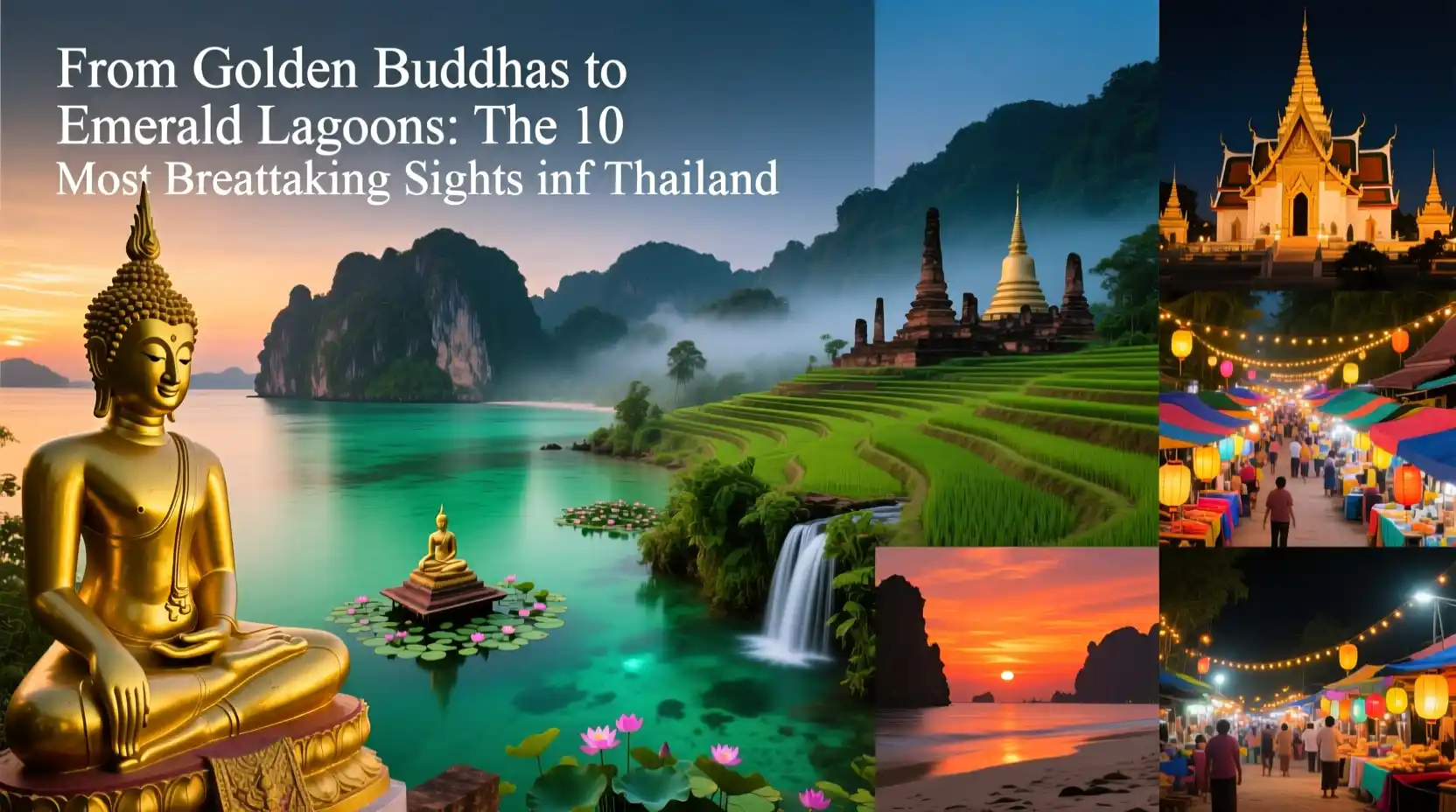
From Golden Buddhas to Emerald Lagoons The 10 Most Breathtaking Sights in Thailand
From Golden Buddhas to Emerald Lagoons: The 10 Most Breathtaking Sights in Thailand
An In-Depth Journey Through the Land of Smiles
There is a certain alchemy to Thailand, a magical fusion of the sacred and the sensual, the ancient and the vibrant. It’s a land where the air hangs thick with the scent of lemongrass and incense, where the gentle chime of a temple bell mingles with the sizzle of street food woks, and where the glint of gold on a Buddha’s spire is mirrored by the glimmer of sun on a turquoise sea. To visit Thailand is to step into a living painting, a tapestry woven with threads of profound spirituality, rich history, and staggering natural beauty.
For the first-time visitor, the sheer abundance of wonders can be overwhelming. Where do you even begin to unpack the treasures of a nation that offers everything from the opulent grandeur of royal palaces to the primal serenity of ancient rainforests? How do you choose between a thousand temples, a thousand beaches, a thousand moments that could define your trip?
This guide is your answer. We have journeyed from the bustling heart of Bangkok to the tranquil peaks of the north, from the iconic limestone karsts of the Andaman Coast to the emerald depths of its southern lakes, to curate a definitive list of the ten most breathtaking sights Thailand has to offer. This is not merely a checklist. This is a deep dive. For each entry, we will explore not just what you will see, but why it matters. We’ll delve into the history, the mythology, and the cultural soul of each place. We’ll provide you with the practical, on-the-ground knowledge you need to experience it like a seasoned traveler, not just a tourist.
So, prepare to be enchanted. Prepare to be inspired. This is your ultimate guide to the ten experiences that will capture your heart and define your understanding of the Land of Smiles. This is a journey from the divine grace of Golden Buddhas to the sublime beauty of Emerald Lagoons.
- The Grand Palace & Wat Phra Kaew: The Beating Heart of a Kingdom
The Story: In the heart of Bangkok, a city of gleaming skyscrapers and chaotic energy, lies a sanctuary of unparalleled splendor: The Grand Palace. For over 150 years, this was the official residence of the Kings of Siam, the spiritual and political center of the Thai kingdom. While the current monarch no longer resides here, the complex remains the pinnacle of Thai architecture, craftsmanship, and royal reverence. At its core, like a sacred jewel in a golden box, is Wat Phra Kaew, the Temple of the Emerald Buddha, the most sacred Buddhist site in all of Thailand.
To walk through the gates of the Grand Palace is to step back into a world of myth and majesty. It was built in 1782 by King Rama I, the founder of the Chakri Dynasty, when he moved the capital across the river from Thonburi to Bangkok. The complex was designed to be a self-contained city, with royal residences, government offices, and the most revered of all temples. Every building, every statue, every inch of this sprawling 218,400-square-meter estate is steeped in symbolism and history, a testament to the devotion of the Thai people to their monarchy and their faith.
What You’ll See: The sheer scale and detail of the Grand Palace can be overwhelming, so it’s best to approach it with a sense of wonder and a willingness to get a little lost.
- Wat Phra Kaew (The Temple of the Emerald Buddha): This is the main event. Unlike other temples that house a community of monks, Wat Phra Kaew is a private royal chapel. The central attraction is the Phra Kaew Morakot, the Emerald Buddha. Carved from a single piece of jade, this diminutive statue stands only 66 centimeters tall but holds immense spiritual weight. According to legend, it originated in India, was enshrined in Cambodia, and later captured by the Siamese. The king himself is the only person permitted to change the Buddha’s elaborate gold costume, which he does three times a year to mark the change of seasons. Photography inside the chapel housing the Buddha is strictly forbidden, a rule that adds to its mystical aura. Surrounding the main building are a series of stunning structures: golden chedis, ornate pavilions, and a gallery of murals depicting the entire Ramakien, Thailand’s national epic.
- The Outer Court: As you enter, you’ll find the Outer Court, which once housed government departments. Today, it features several impressive buildings, including the model of Angkor Wat, a gift from France to King Rama V. The surrounding walls are adorned with exquisite murals depicting scenes from the Ramakien, a Thai epic based on the Hindu Ramayana. These are not just paintings; they are a vibrant, violent, and beautiful storybook, with demons, gods, and heroes locked in cosmic battles.
- The Central Court: This area includes the Phra Maha Monthien group of buildings, which were used for important royal ceremonies. The most striking is the Chakri Maha Prasat Hall, a brilliant fusion of European neoclassical architecture and traditional Thai roof spires. This architectural blend was a deliberate statement by King Rama V, symbolizing Siam’s modernization while retaining its unique cultural identity.
- The Inner Court: This section was once the exclusive domain of the king’s royal consorts and daughters. It is now largely closed to the public, but its mystique adds to the palace’s allure.
- The Guardian Statues: Throughout the complex, you’ll be greeted by a host of mythical guardians. Look for the towering, fierce-looking yaksha (giants) who stand guard at the gates, each with a unique backstory from the Ramakien. Also, spot the half-bird, half-human Kinnari, graceful celestial beings who are said to be harbingers of good fortune.
The Visitor’s Guide:
- Getting There: The Grand Palace is located on Na Phra Lan Road, Phra Nakhon district. The easiest way to get there is via the Chao Phraya Express Boat. Take the boat to the Tha Chang (No. 9) or Tha Tien (No. 8) pier. From there, it’s a short walk. Taking a taxi or tuk-tuk is an option, but be aware of the infamous Bangkok traffic. The MRT subway’s Sanam Chai station is also a short walk away.
- Best Time to Visit: Go as early as humanly possible. The palace opens at 8:30 AM. Arriving by 8:15 AM puts you at the front of the line. By 10:00 AM, tour groups descend in droves, and the heat becomes intense. Avoid weekends and Thai public holidays if you can.
- Tickets & Practicalities: As of late 2023, admission is 500 Thai Baht. This ticket includes entry to the Queen Sirikit Museum of Textiles within the palace grounds, which is well worth a visit. The palace is open daily from 8:30 AM to 3:30 PM. Note that ticket sales stop at 3:15 PM.
- The Dress Code (This is Non-Negotiable): This is the strictest dress code in all of Thailand. You will be denied entry if you do not comply.
- No shorts, short skirts, or capri pants. Your legs and shoulders must be covered.
- No sleeveless shirts, tank tops, or transparent clothing.
- No tight-fitting or revealing clothing.
- Trousers and long-sleeved or short-sleeved t-shirts/blouses are your safest bet. If you forget, you can rent appropriate clothing for a modest fee at the entrance near the ticket booth.
- Insider Tips:
- Hire a Guide: For your first visit, a licensed guide (available for a fee at the entrance) is invaluable. They will bring the murals and statues to life with stories you would otherwise miss.
- Beware of Scams: Outside the palace, you will inevitably be approached by friendly locals who will tell you the palace is “closed for a special Buddhist ceremony” and offer to take you on a tuk-tuk tour to a “lucky” gem store. This is a classic scam. The palace is only closed on state ceremonial days. Politely decline and walk towards the entrance.
- Wat Pho is Next Door: After the Grand Palace, walk to the adjacent Wat Pho (Temple of the Reclining Buddha). It’s a completely different but equally spectacular experience. You can buy a combined ticket or a separate one. It’s a perfect way to continue your morning of temple exploration.
- Wat Arun (Temple of Dawn): A Mosaic of Light on the River
The Story: Across the Chao Phraya River from the Grand Palace, Wat Arun stands as a majestic symbol of Bangkok, its prang (tower) piercing the sky like a shard of ancient porcelain. Known as the Temple of Dawn, it derives its name from the Hindu god Aruna, who is often personified as the radiations of the rising sun. Legend has it that King Taksin, the founder of the Thonburi Kingdom, arrived at this temple at dawn. He later renamed it Wat Chaeng, and it became his royal chapel. After King Rama I ascended the throne and moved the capital to the other side of the river, the temple was renamed Wat Arun Rajwararam and enshrined with an important Buddha image from the Grand Palace.
While its name suggests the best time to visit is sunrise, Wat Arun is arguably at its most breathtaking at sunset, when the fading light illuminates its intricate mosaics, making them glow with an ethereal fire. It is a monument not just to faith, but to the artistic genius of the Thai people, a testament to what can be created with humble materials like broken porcelain and seashells.
What You’ll See: Wat Arun’s architectural style is unique in Bangkok, heavily influenced by the Khmer temples of Angkor. Its central feature is the towering 82-meter-high central prang, surrounded by four smaller prangs at the corners.
- The Central Prang: This is the heart of the temple. The structure is said to represent Mount Meru, the center of the Buddhist universe. Climbing the steep, narrow steps of the prang is an adventure in itself. As you ascend, you’ll pass by niches containing statues of the guardian giants of the four cardinal directions. The views from the top are absolutely spectacular, offering a panoramic vista of the Chao Phraya River, the Grand Palace, and the modern Bangkok skyline. Be warned: the descent is steep and can be nerve-wracking for those with a fear of heights.
- The Porcelain Mosaics: This is Wat Arun’s most defining feature. The entire surface of the prangs is covered in a complex and beautiful mosaic made from millions of pieces of colorful, broken Chinese porcelain. These were not just random shards; they were ballast from the trading ships that sailed up the river from China in the early 19th century. The artisans of King Rama II and III transformed this waste into art, creating intricate floral patterns and mythical figures. Look closely, and you can see the individual pieces of bowls, plates, and vases that make up this stunning facade.
- The Ordination Hall (Ubosot): At the river’s edge stands the main ordination hall. Inside, you’ll find two impressive Buddha images: one enshrined by King Rama II and a larger, green one commissioned by King Rama IV. The walls of the hall are adorned with stunning murals depicting the life of the Buddha. The entrance is guarded by two large stone demons from the Ramakien epic. The mother-of-pearl inlay work on the doors is exquisite.
- The Grounds: The spacious temple grounds are a peaceful escape from the city’s hustle. You’ll find several smaller pavilions, beautiful gardens, and rows of elegant, bell-shaped chedis. The riverside location provides a constant, cooling breeze and a fantastic perspective for photos.
The Visitor’s Guide:
- Getting There: The most scenic and fun way to get to Wat Arun is by taking the cross-river ferry from the Tha Tien pier (which is right next to Wat Pho). The ferry runs frequently and costs only a few baht. You can also take the Chao Phraya Express Boat to the Wat Arun (No. 8) pier.
- Best Time to Visit: For the best light for photography, aim for the late afternoon, about an hour or two before sunset. This allows you to see the temple in daylight, watch the colors change as the sun sets, and see it illuminated after dark. The temple is beautifully lit up at night. If you go early in the morning, you’ll have fewer crowds but the light will be harsher.
- Tickets & Practicalities: Admission is 100 Thai Baht. The temple is open daily from 8:00 AM to 6:00 PM. Note that you can no longer climb the central prang after 6:00 PM, even though the grounds may be open later.
- Dress Code: While not as strict as the Grand Palace, a respectful dress code is still enforced. Shoulders and knees must be covered. Scarves and sarongs are available for rent if needed.
- Insider Tips:
- The Best Photo Spot: The classic, postcard-perfect shot of Wat Arun is actually from the opposite side of the river. After your visit, take the ferry back to the Tha Tien pier and walk along the riverbank. There are several restaurants and piers there that offer stunning, unobstructed views of the temple, especially at sunset.
- Wear Good Shoes: The steps of the prang are very steep and uneven. Sturdy, closed-toe shoes with good grip are highly recommended.
- Explore the Riverside: The area around Wat Arun is full of charm. Take a walk along the river, explore the small local shops, and consider having dinner at one of the riverside restaurants for a magical view of the illuminated temple.
- Ayutthaya Historical Park: Whispers of a Fallen Empire
The Story: An hour’s drive north of modern Bangkok lies the ghost of a magnificent city. Ayutthaya was once the glittering capital of Siam, one of the wealthiest and most cosmopolitan cities in the world. Founded in 1350, it grew into a global powerhouse, a bustling trading hub that welcomed merchants from China, Japan, Persia, France, and England. Its streets were said to be paved in gold, and its palaces and temples were adorned with priceless treasures.
But this golden age was not to last. In 1767, the Burmese army invaded after a long siege. They conquered, sacked, and burned the city to the ground, leaving it in ruins. The city was so thoroughly destroyed that the king abandoned the site and moved the capital to Thonburi, and later to Bangkok. Today, the Ayutthaya Historical Park, a UNESCO World Heritage Site, is a sprawling, atmospheric landscape of crumbling brick, toppled Buddha statues, and hauntingly beautiful temple ruins. To walk among its ruins is to feel the palpable weight of history, to hear the whispers of a fallen empire.
What You’ll See: The park is vast, covering the ruins of the former capital’s island city. It’s best explored by bicycle, motorbike, or tuk-tuk. The main sites are concentrated in the northwest corner of the island.
- Wat Mahathat (The Temple of the Great Relic): This is perhaps the most famous and photographed site in Ayutthaya. It was the royal monastery and housed the Buddha’s holy relic. Today, its most iconic feature is the head of a stone Buddha statue that is mysteriously and beautifully entwined within the roots of a banyan tree. It’s a powerful, serene, and slightly eerie image that has become a symbol of the park. The temple complex itself is a fascinating labyrinth of ruined chedis, prayer halls, and columns, all being slowly reclaimed by nature.
- Wat Phra Si Sanphet (The Royal Monastery): Located within the grounds of the old Royal Palace, this was the most important temple in Ayutthaya. It was used exclusively for royal ceremonies. Its three massive, bell-shaped chedis, which contained the ashes of three Ayutthayan kings, dominate the skyline. They are remarkably well-preserved and are the architectural centerpiece of the park. The sheer scale of the structures gives you a sense of the grandeur that once was.
- Wat Chaiwatthanaram (The Temple of the Long Reign): Situated on the riverbank, west of the main island, this is arguably the most visually stunning of all Ayutthaya’s temples. Its design is heavily influenced by the Khmer style of Angkor Wat. A central prang is surrounded by a gallery and four smaller prangs, all perfectly symmetrical. The temple is particularly beautiful at sunset when the light hits the stone, casting long shadows and bathing the entire complex in a warm, golden glow. It’s a photographer’s dream.
- Wat Lokayasutharam: This site is home to a massive, reclining Buddha image. Unlike the golden, ornate ones you see elsewhere, this one is made of brick and covered in white plaster. It’s over 42 meters long and 8 meters high. Its serene, enigmatic smile is incredibly peaceful, especially when viewed in the quiet of the early morning or late afternoon.
- Viharn Phra Mongkol Bopit: This modern building houses one of Thailand’s largest bronze Buddha images. The original viharn was destroyed in the Burmese invasion, but the Buddha image survived. It’s a beautiful, gilded statue that offers a stark contrast to the ruins outside.
The Visitor’s Guide:
- Getting There: Ayutthaya is easily accessible from Bangkok. You can take a train from Hua Lamphong Station (a slow but scenic journey), a minivan from Mo Chit or Victory Monument, or hire a private taxi. Once in Ayutthaya, you can get around the park by renting a bicycle (the most popular and enjoyable option), hiring a tuk-tuk for a few hours, or renting a motor scooter if you are confident.
- Best Time to Visit: The best time to visit is during the cool, dry season from November to February. The weather is pleasant for cycling around. Aim to start early in the morning to avoid the midday heat and the biggest tour groups. Staying overnight allows you to experience the temples at sunrise and sunset, when they are at their most magical and least crowded.
- Tickets & Practicalities: The park is divided into different zones. You can buy a single ticket for 220 Thai Baht that covers the main sites (Wat Mahathat, Wat Ratchaburana, Wat Phra Si Sanphet, Wat Phra Ram, and Wiharn Phra Mongkol Bopit). Alternatively, you can pay a small entry fee (around 50 Baht) at each individual site. The park is open daily from 8:00 AM to 6:00 PM.
- Insider Tips:
- Hire a Local Guide: A guide for half a day is a great investment. They can take you to the best spots, tell you the stories behind the ruins, and help you navigate the sprawling park.
- The River Cruise: A popular day trip from Bangkok is a combined river cruise and Ayutthaya tour. You cruise up the river in the morning, explore the sites, and then have a lavish lunch buffet on the boat as you cruise back down in the afternoon. It’s a relaxing and scenic way to see the area.
- Stay Overnight: The town of Ayutthaya has a great selection of guesthouses and hotels. Staying overnight allows you to visit the sites at the best times of day and enjoy a more relaxed pace. You can also visit the local night market for some fantastic food.
- Respect the Ruins: Do not climb on the ancient structures, and be respectful, especially at the sites with Buddha images.
- Sukhothai Historical Park: The Serene Cradle of Thai Civilization
The Story: Before Ayutthaya’s glory, there was Sukhothai. This UNESCO World Heritage Site was the first capital of Siam, founded in 1238. The name Sukhothai translates to “Dawn of Happiness,” and it was here that the core elements of Thai culture and identity were forged. It was in Sukhothai that the Thai script was invented, Theravada Buddhism was established as the state religion, and the first Thai-style art and architecture were developed.
While Ayutthaya is grand and dramatic, Sukhothai is serene, elegant, and more intimate. The ruins are spread across a large, beautifully manicured park, with lush lawns, lotus-filled ponds, and large, shady trees. The atmosphere is peaceful and contemplative, a stark contrast to the bustling city that once stood here. Exploring Sukhothai feels like cycling through a beautiful, open-air museum, a journey back to the very beginnings of the Thai nation.
What You’ll See: The park is divided into five zones, with the Central Zone being the most important and well-preserved. Bicycles are the perfect way to explore, allowing you to cover the ground at a leisurely pace.
- Wat Mahathat (The Temple of the Great Relic): The spiritual and administrative center of the old capital, this is the largest and most impressive temple in Sukhothai. Its main chedi, a lotus-bud spire, is the classic symbol of Sukhothai architecture. Surrounded by smaller chedis, the ruins of viharns (assembly halls), and a gallery of 168 standing Buddha images, the complex is majestic and deeply spiritual. The sight of the central chedi reflected in the large pond in front of it is one of the most iconic images of Thailand.
- Wat Si Chum (The Temple of the Bodhi Tree): Located just outside the main walls of the Central Zone, Wat Si Chum is home to a truly awe-inspiring sight. A massive, seated brick Buddha image, known as Phra Achana, fills a tight, square mandapa (shrine). At 15 meters tall and 11 meters wide, it’s an overwhelming presence. The most fascinating part is the narrow, slanted staircase hidden within the walls of the mandapa, which leads to a small opening at the top. From here, you can peer down at the Buddha’s serene face and imagine the ancient kings who did the same. The ceiling of the passageway is inscribed with over 50 stone slabs depicting scenes from the Jataka tales (stories of the Buddha’s previous lives).
- Wat Saphan Hin (The Temple of the Stone Bridge): For the best view in Sukhothai, you must make the pilgrimage to Wat Saphan Hin. Located on a hill west of the city, its name comes from the slate pathway and bridge that leads up to it. The climb is gentle and rewarding. At the top, you’ll find a 12.5-meter-tall standing Buddha image, known as Phra Attharot, offering a blessing to the city below. The view over the entire park and the surrounding countryside is breathtaking, especially at sunrise.
- Wat Trapang Ngoen (The Silver Lake Monastery): This small, picturesque temple is built on an island in the middle of a large, rectangular pond. It’s especially beautiful in the late afternoon when the sun sets behind its classic lotus-bud chedi. It’s a perfect spot for a quiet moment of reflection.
- The Ramkhamhaeng National Museum: Before or after exploring the park, a visit to this museum is highly recommended. It provides excellent context for what you are about to see (or have just seen), with a superb collection of Sukhothai-era Buddha images, pottery, and artifacts. It’s named after King Ramkhamhaeng the Great, Sukhothai’s most famous ruler.
The Visitor’s Guide:
- Getting There: Sukhothai is a bit more off the beaten path than Ayutthaya. The nearest airport is in Phitsanulok (PHS), about a 50-minute drive away. From Bangkok, you can take a bus from Mo Chit bus terminal to the “new” city of Sukhothai, and then a local songthaew (shared taxi) to the historical park, which is about 12km away in the “old” city.
- Best Time to Visit: Like Ayutthaya, the cool, dry season (November-February) is ideal. The park is beautiful year-round, but can be very hot during the day from March to May.
- Tickets & Practicalities: The Central Zone has an entrance fee of 100 Thai Baht. The other zones are free. The park is open daily from 6:30 AM to 7:30 PM. The best time to explore is early morning or late afternoon when the light is soft and the temperature is comfortable.
- Insider Tips:
- Stay in the Old City: There are several charming guesthouses and small hotels right next to the historical park. Staying here allows you to easily access the park at sunrise and sunset, when it’s at its most beautiful and you can have it almost to yourself.
- Rent a Bicycle: Bicycles are available for rent everywhere in the old city for around 50 Baht a day. It’s the best way to experience the park’s serene atmosphere. For those who don’t want to pedal, electric bikes are also available.
- Don’t Miss the Food: Sukhothai is famous for its own style of noodles, “Guay Tiew Sukhothai.” It’s a delicious, unique dish that you must try. You’ll find it served at small stalls and restaurants all over the old city.
- Combine with Si Satchanalai: For the true history buff, consider a day trip to the Si Satchanalai Historical Park, a satellite capital of Sukhothai. It’s less restored and more “ruined,” but its jungle-covered setting is incredibly atmospheric. It’s about a one-hour drive from Sukhothai.
- Wat Phra That Doi Suthep: A Sacred Mountain Peak
The Story: Rising majestically above the cultural capital of Chiang Mai is the mountain of Doi Suthep. Perched on its summit, like a golden crown, is one of Thailand’s most sacred and beloved pilgrimage sites: Wat Phra That Doi Suthep. The legend of its founding is as magical as the temple itself. In the 14th century, a monk named Sumanathera had a dream that told him to find a relic of the Buddha in the ruins of a stupa in Pi Cha. The king of the Lanna Kingdom, Ku Na, invited the monk to bring the relic to Chiang Mai. When the relic was placed on the back of a white elephant to be enshrined, the elephant trumpeted, ran up the mountain, and then died at the very spot where the temple now stands. This was taken as a divine sign, and the king ordered a chedi to be built on that spot to house the sacred relic.
Today, Doi Suthep is a place of profound spiritual importance for Thai people and a must-see for any visitor to Northern Thailand. The journey up the mountain, the climb up the Naga serpent staircase, and the panoramic views from the top all contribute to an unforgettable and deeply moving experience.
What You’ll See: The temple complex is a beautiful blend of Lanna and Thai architectural styles, gleaming with gold and offering spectacular views.
- The Naga Staircase: The traditional way to enter the temple is by climbing the 306-step staircase flanked by two enormous, mythical Naga serpents. Their bodies form the banisters, and their seven heads meet at the top. The climb is a physical act of devotion, and as you ascend, the forest opens up, and the first glimpses of the golden chedi appear. For those who cannot or do not wish to climb, there is a funicular tram for a small fee.
- The Golden Chedi: The centerpiece of the temple is the stunning golden chedi that enshrines the Buddha relic. Its bell-shaped shape is typical of Lanna architecture, and it is covered in gold plates that glitter brilliantly in the sun. Devotees walk around the chedi in a clockwise direction, a practice known as circumambulation, as a form of meditation and merit-making.
- The Viharn and Courtyard: The courtyard surrounding the chedi is a bustling, yet peaceful, space. You’ll find shrines, bells, and smaller chedis. The main viharn (assembly hall) contains a beautiful Buddha image, and its walls are decorated with modern murals depicting the history of the temple and the legend of the white elephant. The atmosphere is filled with the scent of incense and the sound of chanting and ringing bells.
- The Viewing Platform: On the edge of the courtyard, a viewing platform offers one of the most breathtaking panoramic views in all of Thailand. On a clear day, you can see the entire city of Chiang Mai laid out below you, a patchwork of buildings and greenery surrounded by misty mountains. It’s the perfect spot to watch the sunset, as the city lights begin to twinkle below.
- The Monk’s Chat: Doi Suthep is one of the places in Chiang Mai where you can participate in “Monk Chat.” This is a program where you can sit down with young Buddhist monks to ask questions about Buddhism, Thai culture, or monastic life. It’s a wonderful opportunity for a genuine cultural exchange.
The Visitor’s Guide:
- Getting There: Doi Suthep is about 15 km from the center of Chiang Mai. The most popular way to get there is by hiring a red songthaew (shared taxi) from the base of the mountain near Chiang Mai University or the zoo. You can charter the whole vehicle for a round trip, or you can share with others. Taxis and Grab are also available.
- Best Time to Visit: Go early in the morning to avoid the crowds and the heat, or go in the late afternoon to see the sunset and stay for the evening chanting. The temple can get very crowded, especially on weekends and Buddhist holidays.
- Tickets & Practicalities: There is a 30 Thai Baht entrance fee for foreign nationals at the base of the staircase. The temple is open daily from 6:00 AM to 6:00 PM.
- Dress Code: As a sacred religious site, a respectful dress code is required. Shoulders and knees must be covered. Shawls and sarongs are available for rent at the entrance if you are not appropriately dressed.
- Insider Tips:
- Listen for the Bells: As you walk around the chedi, you will see rows of bells. Pilgrims ring them as they pass to bring good fortune and to announce their presence to the Buddha. The collective sound is a beautiful, meditative hum.
- Explore the Mountain: Doi Suthep is part of a national park. If you have your own transport, you can continue driving up the mountain to other attractions like the Bhubing Palace (the royal winter residence) and the Hmong hill tribe village of Doi Pui.
- Combine with a Trip: Many tour operators combine a trip to Doi Suthep with a visit to a local village or a waterfall. However, going independently is easy and gives you more flexibility.
- Wat Rong Khun (The White Temple): A Surreal Vision of the Modern Age
The Story: In the northern city of Chiang Rai, a temple unlike any other in Thailand shimmers in the sunlight. Wat Rong Khun, better known as the White Temple, is not an ancient ruin. It is a contemporary masterpiece, a breathtaking and thought-provoking work of art created by the renowned Thai artist Chalermchai Kositpipat. He began the project in 1997, funding it himself, with the intention of creating a new kind of temple for the modern world.
The White Temple is a deeply symbolic interpretation of Buddhist teachings. Its dazzling white color represents the purity of the Buddha, while the thousands of embedded mirrors symbolize the wisdom of the Dharma (the teachings of the Buddha) that will shine brightly throughout the universe. But this is no simple, serene temple. It is a surreal, fantastical, and at times shocking vision that blends traditional Buddhist iconography with modern pop culture and social commentary. It is a journey from the darkness of worldly desire to the light of enlightenment.
What You’ll See: A visit to the White Temple is a multi-sensory experience that is both beautiful and unsettling.
- The Bridge of “The Cycle of Rebirth”: The approach to the main ubosot (ordination hall) is a key part of the experience. You cross a small bridge over a pond of writhing, outstretched hands. These are the hands of souls reaching out from hell, representing desire, greed, and attachment. Crossing the bridge symbolizes leaving behind worldly temptations to reach the gates of heaven.
- The Main Ubosot (The Ordination Hall): The exterior of the ubosot is a dazzling spectacle of white plaster and glass. It is adorned with intricate carvings of mythical creatures like kinnaree and nagas. But look closer, and you’ll find modern, unexpected figures embedded in the facade, from superheroes like Superman and Iron Man to characters from The Matrix and even Michael Jackson. Chalermchai uses these figures to represent the gods and demons of our modern world.
- The Interior Murals: The interior of the ubosot is where the social commentary is most explicit. The walls are covered in stunning, vibrant murals painted by Chalermchai himself. Unlike traditional temple murals depicting the life of the Buddha, these are a modern interpretation of samsara (the cycle of birth, death, and rebirth). You’ll see scenes of 9/11, oil rigs, spaceships, and a wall of celebrity faces, from Harry Potter to Neo. It’s a chaotic, controversial, and utterly fascinating depiction of the challenges of the modern world and the path to overcoming them.
- The Golden Building (The Toilet): In stark contrast to the white temple is a separate, ornately designed golden building. Many assume it’s a treasury or another shrine, but it is, in fact, the public restroom. Its golden color symbolizes worldly desire and materialism, a stark contrast to the pure white of the temple. It’s a clever and powerful artistic statement.
- The Gallery and Grounds: The complex also includes an art gallery where you can see more of Chalermchai’s paintings, and beautifully landscaped grounds with other smaller, creative structures.
The Visitor’s Guide:
- Getting There: Wat Rong Khun is located about 13 km south of Chiang Rai city center. The easiest way to get there is by hiring a songthaew or a tuk-tuk for a round trip. Most drivers will wait for you. You can also rent a motorbike or join a shared tour.
- Best Time to Visit: The temple is open daily. The best time to visit is on a sunny day, as the sun makes the white and mirrored surfaces sparkle brilliantly. It gets very busy, especially with tour groups from China, so try to go early in the morning (it opens at 8:00 AM) or later in the afternoon.
- Tickets & Practicalities: Admission is 100 Thai Baht for foreign visitors. This fee helps to fund the ongoing construction and maintenance of the temple complex. The temple is open from 8:00 AM to 6:00 PM.
- Dress Code: A respectful dress code is enforced. Shoulders and knees must be covered. No shorts, short skirts, or sleeveless tops.
- Insider Tips:
- Photography Rules: Photography is allowed everywhere on the grounds, but it is strictly forbidden inside the main ubosot. This is to protect the delicate murals and to maintain the sanctity of the space.
- Be Respectful: Despite its modern, pop-culture elements, this is a functioning, sacred religious site. Be quiet and respectful, especially inside the buildings.
- It’s a Work in Progress: The White Temple is still under construction. Chalermchai Kositpipat has a team of artists working on it, and he plans to continue adding to it for the rest of his life. Don’t be surprised to see areas under renovation or new structures being built.
- Combine with a Tour: Wat Rong Khun is often combined on tours with the Blue Temple (Wat Rong Suea Ten) and the Black House (Baan Dam), two other unique and fascinating artistic attractions in the Chiang Rai area.
- Phi Phi Islands & Maya Bay: The Iconic Tropical Paradise
The Story: For many, the image of Thailand is inextricably linked to the Phi Phi Islands. These six islands in the Andaman Sea, located between Phuket and the mainland Krabi province, are the epitome of tropical paradise. With their sheer limestone cliffs rising vertically from turquoise waters, their powdery white-sand beaches, and their vibrant coral reefs, they are breathtakingly beautiful. Their fame skyrocketed after the 2000 film The Beach, starring Leonardo DiCaprio, was filmed at Maya Bay on the smaller Phi Phi Leh island.
The main island, Koh Phi Phi Don, is the only one with permanent inhabitants and a tourist infrastructure. It’s a bustling, energetic hub of activity. The smaller, uninhabited Phi Phi Leh is a protected national park, home to stunning lagoons, caves, and the world-famous Maya Bay. While overtourism has taken its toll, recent conservation efforts have made a visit here a more sustainable and, in some ways, more rewarding experience. The Phi Phi Islands remain a must-see, a place where the sheer power and beauty of nature are on full display.
What You’ll See: A trip to the Phi Phi Islands is all about the seascapes, the marine life, and the vibrant atmosphere.
- Maya Bay: The star of the show. After being closed for several years to allow its coral reefs and ecosystem to recover, Maya Bay has reopened with new, stricter rules designed to protect it. You can no longer swim in the bay itself. Instead, boats must moor at a new pier on the other side of the island, and visitors walk along a designated wooden path to the beach. While you can’t lounge in the water like in the movie, the view is still as stunning as ever. The crescent of white sand framed by towering limestone cliffs is a truly iconic sight. The focus has shifted from “being in the movie” to appreciating the bay’s natural beauty from a respectful distance.
- Pileh Lagoon: Often called “the Blue Lagoon,” this stunning emerald-green lagoon is hidden away on Phi Phi Leh. It’s a nearly enclosed body of water surrounded by sheer, 100-meter-high cliffs. The water is incredibly calm and clear, and it’s a popular spot for swimming and snorkeling. Boats anchor in the middle, and you can jump into the pristine water for a refreshing dip. It feels like a secret, hidden world.
- Viking Cave: Also on Phi Phi Leh, this cave is famous for two things. First, it’s a site where ancient paintings resembling Viking ships were found (hence the name). Second, and more practically, it’s a location where locals harvest the valuable swiftlet’s nests, used to make bird’s nest soup. You can’t go inside the cave, but boats will stop outside for you to take photos.
- Monkey Beach: As the name suggests, this small, pretty beach on the northern tip of Koh Phi Phi Don is home to a large troop of macaque monkeys. They are incredibly bold and accustomed to tourists. You can watch them play and forage, but be very careful. They are wild animals and can be aggressive if they think you have food. Do not feed them under any circumstances.
- Viewpoint 1 & 2: For the best panoramic views of Koh Phi Phi Don, you must hike up to the viewpoint. The trail starts in Ton Sai village. Viewpoint 1 is about a 20-30 minute climb, and Viewpoint 2 is a little further. The effort is rewarded with a spectacular, postcard-perfect view of the two curved bays of Ton Sai and Loh Dalum, separated by a thin strip of land. It’s especially beautiful at sunrise or sunset.
The Visitor’s Guide:
- Getting There: The vast majority of visitors visit the Phi Phi Islands on a day trip speedboat tour from either Phuket or Krabi. These tours typically include hotel pickup, lunch, and stops at all the main spots. If you want to stay overnight, you can take a ferry from Phuket (Rassada Pier) or Krabi (Klong Jilad Pier) to Tonsai Pier on Koh Phi Phi Don.
- Best Time to Visit: The high season, from November to April, offers the best weather and calmest seas. The monsoon season from May to October brings rougher seas and heavy rain, and many boat tours may be cancelled. For a less crowded experience, try to visit during the “shoulder” months of November or April.
- Tickets & Practicalities: Day tours cost between 1,500-3,000 Thai Baht per person, depending on the operator and inclusions. The national park fee for Phi Phi Leh is an additional 400 Baht for adults and 200 Baht for children (as of late 2023). This is usually collected by your tour guide.
- Insider Tips:
- Stay Overnight: To truly experience the magic of the islands and escape the day-trip crowds, stay for at least one night on Koh Phi Phi Don. After the day-trippers leave (around 4 PM), the island takes on a much more relaxed vibe. You can enjoy the sunset viewpoints and have the beaches more to yourself the next morning before the first boats arrive.
- Choose Your Tour Wisely: Not all boat tours are created equal. Cheaper tours can be overcrowded. Look for a smaller group tour or consider hiring a private longtail boat for a more personalized experience.
- Sea Sickness: The Andaman Sea can be choppy. If you are prone to seasickness, take medication before you get on the boat.
- Respect the Rules: The new rules at Maya Bay are there for a reason. Follow the instructions of the park rangers, stay on the designated paths, and do not touch the coral or take any shells.
- Railay Beach: A World of Secluded Beauty
The Story: Just a short boat ride from the bustling town of Ao Nang in Krabi lies a place that feels like a different world. Railay is not an island, but a peninsula that is cut off from the mainland by towering limestone cliffs, making it accessible only by boat. This geographical isolation is its greatest asset. With no roads, no cars, and no motorbikes, Railay is a sanctuary of tranquility and breathtaking natural beauty.
The peninsula is divided into four main areas: West Railay, East Railay, Phra Nang Beach, and Tonsai. West Railay boasts the classic, long stretch of white sand and turquoise water. East Railay faces a mangrove swamp and is the main arrival point for boats. Phra Nang Beach, arguably the most stunning beach in the world, is a crescent of perfect sand at the base of dramatic cliffs. Tonsai, accessible only by a short walk or boat at low tide, is a rustic, laid-back backpacker and rock-climbing hub. Railay is a place for relaxation, adventure, and sheer, unadulterated awe.
What You’ll See: Railay’s beauty is defined by its dramatic geology and its laid-back atmosphere.
- Phra Nang Cave Beach (Princess Cave Beach): This is the jewel in Railay’s crown. Frequently voted one of the most beautiful beaches in the world, Phra Nang is a vision of paradise. The sand is impossibly fine and white, the water is crystal clear and calm, and it is framed by colossal limestone karsts. At one end of the beach is a famous cave, the Princess Cave, which is a sacred shrine dedicated to the spirit of a drowned princess. Fishermen leave offerings, including carved wooden phalluses, in the hope of a safe and bountiful catch. The cave itself is an intriguing, spiritual site.
- The Limestone Karsts: The sheer, vertical cliffs that define Railay are a sight in themselves. They jut out of the sea and the land like ancient giants, covered in lush greenery. At sunrise and sunset, the light hits them, creating a spectacular display of colors and shadows. They are not just for looking at; they are a world-class destination for rock climbing, and you will often see climbers scaling their faces.
- The Viewpoint & Lagoon: A moderately challenging, but well-marked, trail starts near the Diamond Cave Resort on East Railay. A short, steep climb takes you to a viewpoint with a stunning panorama of both East and West Railay beaches. For the more adventurous, a slightly more difficult and muddy trail from the viewpoint leads down to a hidden, emerald-green lagoon, surrounded by cliffs. It’s a challenging scramble, but the reward of swimming in this secret spot is immense.
- Sunset at West Railay: West Railay is the place to be at sunset. As the sun dips below the horizon, it paints the sky and the iconic karsts in brilliant shades of orange, pink, and purple. The beach comes alive with people, bars set out mats and cushions, and fire dancers perform their mesmerizing routines. It’s a magical, communal experience.
- Kayaking and Paddleboarding: The calm waters around Railay are perfect for exploring by kayak or stand-up paddleboard. You can paddle over to the nearby islands, explore the mangroves on East Railay, or just float and admire the incredible scenery from a different perspective.
The Visitor’s Guide:
- Getting There: There are no direct roads to Railay. You must take a longtail boat. The most common departure points are Ao Nang Beach and Ao Nam Mao Pier, both of which are a short tuk-tuk ride from Krabi town. The boats run frequently during daylight hours. The journey takes about 10-15 minutes. You’ll have to wade through the water to get on and off the boat, so wear appropriate clothing.
- Best Time to Visit: The best time to visit is during the dry season, from November to April. The seas are calm, and the weather is sunny. During the monsoon season (May-October), sea conditions can be rough, and some boat services may be disrupted.
- Tickets & Practicalities: The longtail boat from Ao Nang costs around 100-300 Baht per person, depending on the time of day and demand. You pay at the ticket booth at the pier. There is no entrance fee to Railay itself.
- Insider Tips:
- Where to Stay: Your choice of base depends on your budget and style. West Railay has the most high-end resorts. East Railay is cheaper and more of a backpacker scene. Tonsai is for serious climbers and those seeking a rustic, party vibe. Phra Nang has no accommodation.
- Footwear is Key: The terrain is a mix of sand, mud, and rocky paths. A good pair of sandals or walking shoes that you can get wet is essential, especially if you plan on doing the viewpoint hike.
- The “Tsunami Warning” Sirens: You will hear a siren being tested every day at 1 PM. This is just a test, so don’t be alarmed.
- Book in Advance: Railay is a popular destination, especially during peak season. Book your accommodation well in advance, particularly for the resorts on West Railay.
- Erawan National Park: A Seven-Tiered Emerald Dream
The Story: Deep in the jungles of Western Thailand, near the town of Kanchanaburi, lies a place of mythical beauty. Erawan National Park is named after the three-headed white elephant from Hindu mythology, the mount of the god Indra. The park’s main attraction, the Erawan Waterfall, is said to resemble this divine creature, with its seven tiers of cascading water forming the body and its top tier representing the heads.
This is not just one waterfall, but a series of seven, each with its own unique character and charm. The water flows over limestone cliffs, creating a series of stunning pools and gorges. The mineral-rich water gives the pools a stunning, vibrant emerald-green color. The journey to the top tier is a pilgrimage through a pristine, steamy jungle, with the constant sound of rushing water as your companion. Erawan is a place for swimming, hiking, and connecting with the raw, untamed beauty of Thailand’s interior.
What You’ll See: The experience of Erawan is climbing the seven tiers. You can swim at most of the levels, making it a perfect activity for a hot day.
- Tiers 1 & 2: The first two tiers are easily accessible, just a short walk from the visitor center. Tier 1 is a wide, powerful cascade that tumbles into a large, shallow pool perfect for wading. Tier 2 features a curtain-like waterfall that flows into a beautiful, deep pool ideal for swimming. These tiers can get crowded, but for good reason.
- Tier 3: This tier is a bit of a climb, but it’s worth it. The waterfall here cascades over a series of limestone steps, creating a series of smaller, picturesque pools. It’s a great place for photos.
- Tiers 4 & 5: As you climb higher, the jungle gets thicker and the crowds thin out. Tier 4 is a scenic spot with a large pool and a backdrop of lush greenery. Tier 5 is a highlight for many. The waterfall here is more powerful, and the pool is deep and incredibly inviting for a swim amidst the jungle.
- Tier 6: This tier is a steep climb, but the reward is a stunning, secluded grotto. The water slides down a smooth, chiseled rock face into a deep, clear pool. It feels like a secret, hidden sanctuary.
- Tier 7 (The Elephant’s Head): The final and most challenging tier to reach. The climb is steep and can be slippery, but the view at the top is breathtaking. The water splits into multiple streams as it flows over the rocks, resembling the trunk and tusks of an elephant, hence the name. Swimming here is not always permitted, depending on the water level, but the view alone is worth the trek.
- The Wildlife: Keep your eyes peeled for the park’s inhabitants. You might see monkeys, monitor lizards, and a huge variety of colorful birds and butterflies. The park is a thriving ecosystem.
The Visitor’s Guide:
- Getting There: Erawan National Park is about 65 km from Kanchanaburi town. The easiest way to get there is by hiring a private taxi or songthaew for the day. There are also public buses that run from Kanchanaburi’s bus station, but they are infrequent. Many people visit Erawan as part of a larger trip to Kanchanaburi, which is also home to the famous Bridge on the River Kwai.
- Best Time to Visit: The best time to visit is during the cool, dry season (November-February). The water flow is good, and the weather is pleasant for hiking. The rainy season (June-October) means the waterfall is at its most powerful, but the trails can be very slippery and dangerous.
- Tickets & Practicalities: The park entrance fee is 300 Baht for adults and 200 Baht for children. The park is open daily from 8:00 AM to 4:30 PM. You should start your hike early to avoid the biggest crowds and the midday heat.
- Insider Tips:
- Wear Proper Footwear: The trails can be steep, rocky, and slippery. Sturdy shoes with good grip, like trainers or hiking sandals, are essential. Flip-flops are not recommended.
- Bring a Dry Bag: If you want to swim, you’ll need to carry your belongings with you. A waterproof dry bag is a very good investment to keep your phone, camera, and valuables safe.
- Food and Drink: There are several small food stalls and restaurants at the base of the waterfall, near Tier 1. They serve simple but delicious Thai food and drinks. It’s a great place for a meal after your hike.
- Don’t Rush: Don’t just race to the top. The beauty of Erawan is in taking your time, swimming in the different pools, and enjoying the journey through the jungle. Plan for at least 3-4 hours to do the full climb and enjoy the falls.
- Cheow Lan Lake (Khao Sok National Park): The Ultimate Emerald Lagoon
The Story: If there is one place in Thailand that truly embodies the title “Emerald Lagoon,” it is Cheow Lan Lake in Khao Sok National Park. This is not just a lake; it is a vast, man-made reservoir created in the 1980s when the Ratchaprapha Dam was built, flooding a vast valley of pristine rainforest. What was left behind is a landscape of unparalleled, almost surreal beauty. Hundreds of towering, sheer-sided limestone karsts, draped in ancient rainforest, rise dramatically from the calm, emerald-green waters of the lake. It is often compared to Ha Long Bay in Vietnam, but with a wilder, more primordial feel.
Khao Sok National Park itself is one of the oldest and most biodiverse rainforests in the world, older even than the Amazon. The lake is its centerpiece, a place where you can truly disconnect from the world and immerse yourself in nature. Spending a night on one of the floating raft houses, listening to the sounds of the jungle under a canopy of stars, is one of the most profound and unforgettable experiences you can have in Thailand.
What You’ll See: A visit to Cheow Lan Lake is a multi-day adventure of boating, hiking, caving, and wildlife spotting.
- The Landscape: The main attraction is the view itself. As your longtail boat cruises across the lake, you are surrounded by a breathtaking panorama of limestone karsts jutting out of the water. The sheer scale of it is awe-inspiring. The color of the water, a deep, vibrant emerald green, is simply stunning. Every turn in the lake reveals a new, more spectacular vista.
- The Floating Raft Houses: These are the unique accommodations on the lake. Simple, rustic bamboo and wooden rafts float on the water, anchored in quiet coves. They offer basic but comfortable rooms and a restaurant. Waking up in the morning to the mist rising off the water and the sounds of the jungle is an experience that will stay with you forever. It’s the perfect base for exploring the lake.
- The Great Coral Cave (Tham Nam Thalu): This is a popular excursion from the raft houses. You take a boat and then a short hike through the jungle to reach the entrance of a large cave system. Inside, you’ll find impressive stalactites and stalagmites and a cool underground stream that you have to wade through. A guide and a headlamp are essential. It’s a real adventure.
- Wildlife Spotting: Khao Sok is home to an incredible array of wildlife. While sightings are never guaranteed, you have a chance of seeing wild elephants, gibbons, hornbills, and a huge variety of other birds and reptiles. The best time for wildlife viewing is early in the morning or late in the afternoon. Your boat guide will be an expert at spotting things.
- Kayaking and Swimming: The calm waters of the lake are perfect for kayaking. You can paddle at your own pace, exploring hidden coves and getting a closer look at the dramatic cliffs. The water is clean and refreshing, and a swim in the middle of the vast, silent lake is an incredible feeling.
The Visitor’s Guide:
- Getting There: Cheow Lan Lake is located within Khao Sok National Park. The main gateway town is also called Khao Sok, which is on the main highway between Surat Thani and Krabi. You can take a bus or minivan to Khao Sok town. From there, you must arrange your trip to the lake. Most people book a 2-day/1-night or 3-day/2-night package tour, which includes transfers from the town, accommodation on a raft house, all meals, and activities like boat trips, kayaking, and caving. It is very difficult and expensive to arrange independently.
- Best Time to Visit: The best time to visit is during the dry season, from December to April. During this time, the water levels are lower, revealing more of the dramatic limestone cliffs and the beautiful “beaches” at the base of the karsts. The rainy season (May-November) sees higher water levels, which can be beautiful but may limit access to some hiking trails and caves.
- Tickets & Practicalities: A 2D1N package tour typically costs between 4,000-6,000 Thai Baht per person, depending on the level of luxury of the raft house. This price usually includes the national park entrance fee (300 Baht for adults), all transport, food, accommodation, and guided activities.
- Insider Tips:
- Book a Package: As mentioned, booking a package is the most practical and cost-effective way to experience Cheow Lan Lake. It takes all the logistics out of your hands.
- Bring Insect Repellent: You are in the middle of a rainforest. Mosquitoes will be present, especially in the early morning and evening. A good insect repellent is a must.
- Pack Light: You only need a small bag for your overnight trip on the lake. Pack essentials like swimwear, a change of clothes, a flashlight/headlamp, a good book, and a power bank.
- Disconnect and Embrace It: There is very limited or no Wi-Fi or mobile signal on the lake. This is a feature, not a bug. Embrace the opportunity to disconnect from the digital world and fully immerse yourself in the incredible natural beauty around you.
Beyond the Top 10: Honorable Mentions
Thailand’s beauty is so abundant that a list of ten can only scratch the surface. Here are a few more breathtaking sights that could have easily made the list:
- The Similan Islands: A group of nine islands in the Andaman Sea, famous for having some of the best scuba diving and snorkeling in the world, with crystal-clear water, vibrant coral, and abundant marine life.
- Wat Rong Suea Ten (The Blue Temple): Another stunning modern temple in Chiang Rai, known for its brilliant sapphire blue interior and a magnificent white Buddha statue.
- The Bridge on the River Kwai, Kanchanaburi: A poignant and historically significant site, this bridge is a reminder of the horrors of WWII and the Death Railway. The JEATH War Museum and the Kanchanaburi War Cemetery are essential visits nearby.
- Doi Inthanon National Park: Known as “The Roof of Thailand,” this park is home to the country’s highest peak. It features cool weather, stunning waterfalls, the Royal Twin Pagodas, and excellent birdwatching.
- Lopburi: A city famous for its hundreds of macaque monkeys that have taken over the ancient Khmer-era temples, creating a unique and chaotic spectacle.
Essential Thailand Travel Tips
To ensure your journey is as smooth as possible, here are some practical tips:
- Visas: Check the visa requirements for your nationality well in advance. Many nationalities receive a 30-day visa exemption on arrival, but this can change.
- Currency: The currency is the Thai Baht (THB). ATMs are widely available, and credit cards are accepted in hotels and larger restaurants and shops. However, cash is king, especially in markets and for small purchases.
- Health & Safety: Drink only bottled water. Be cautious with street food at first; choose stalls that are busy with locals, as the turnover is high. Travel insurance is highly recommended.
- Culture & Etiquette: The Thai people are incredibly friendly and respectful. The “wai” (a prayer-like gesture) is the traditional greeting. Always show respect for the monarchy and religion. Dress modestly when visiting temples. Don’t touch someone’s head, and don’t point your feet at people or religious images.
- Getting Around: Domestic flights are cheap and efficient for covering long distances. Trains and buses are great alternatives. Tuk-tuks are fun for short rides, but always agree on a price beforehand. Grab (the Southeast Asian equivalent of Uber) is a reliable and affordable option for taxis in cities.
Conclusion: Your Thai Awaits
From the sacred, golden spires of Bangkok’s most revered temples to the silent, emerald waters of a rainforest lake, Thailand offers a journey for the soul. It is a land of contrasts, where ancient traditions and modern life exist in a vibrant, harmonious dance. This list of ten breathtaking sights is not an end point, but a beginning. It is a doorway into a world of wonder, a catalyst for your own adventure.
The true magic of Thailand lies not just in the places you see, but in the moments you experience. It’s the taste of your first perfect Pad Thai, the kindness of a stranger’s smile, the awe-inspiring silence of a jungle dawn, and the profound peace you feel watching the sun set over a limestone karst. So, take this guide, let it inspire you, and then create your own path. The Land of Smiles is waiting to welcome you.
Disclaimer
Please Read Carefully Before Planning Your Trip
The information provided in this blog post, “From Golden Buddhas to Emerald Lagoons: The 10 Most Breathtaking Sights in Thailand,” is intended for general informational and entertainment purposes only. While we have made every effort to ensure the accuracy of the details contained herein at the time of writing, the world of travel is constantly changing.
Accuracy and Timeliness: All information, including but not limited to, prices, opening hours, dress codes, transportation options, and tour availability, is subject to change without notice. We strongly advise all readers to conduct their own thorough research and to verify all critical information directly with official sources (e.g., official park websites, temple offices, tour operators, and government tourism boards) before making any travel bookings or decisions.
Safety and Personal Responsibility: Travel, especially to remote or natural areas, carries inherent risks. Activities such as hiking, swimming, rock climbing, and boat travel can be dangerous. The author and publisher of this blog post are not responsible for any injury, loss, or damage to persons or property that may occur as a result of following the advice or suggestions herein. All travelers are responsible for their own safety and should assess their own physical abilities and health conditions before participating in any activity. Always follow local safety guidelines, heed the advice of local guides and officials, and use common sense.
Cultural Respect: Thailand is a country with deep-rooted cultural and religious traditions. It is the responsibility of every visitor to be respectful of local customs, laws, and etiquette. This includes dressing appropriately at religious sites, behaving respectfully, and being mindful of local sensibilities. Failure to do so can cause offense and may have legal consequences.
No Affiliation: This blog post is an independent guide. We do not have any direct affiliation, sponsorship, or commercial relationship with any of the hotels, restaurants, tour operators, or attractions mentioned within the text. Any recommendations are based on subjective experience and research and should not be considered a guarantee of quality or service.
Travel Insurance: We strongly recommend that all travelers purchase comprehensive travel insurance that covers medical emergencies, trip cancellations, lost luggage, and other unforeseen circumstances before embarking on their journey to Thailand.
By reading and using this guide, you acknowledge and agree that you assume all risks associated with travel and that the author and publisher cannot be held liable for any issues that may arise during your trip. Travel wisely, travel safely, and enjoy the incredible beauty that Thailand has to offer.
Have any thoughts?
Share your reaction or leave a quick response — we’d love to hear what you think!
-
 0
-
 0
-
 0
-
 0
-
 0
-
 0
