
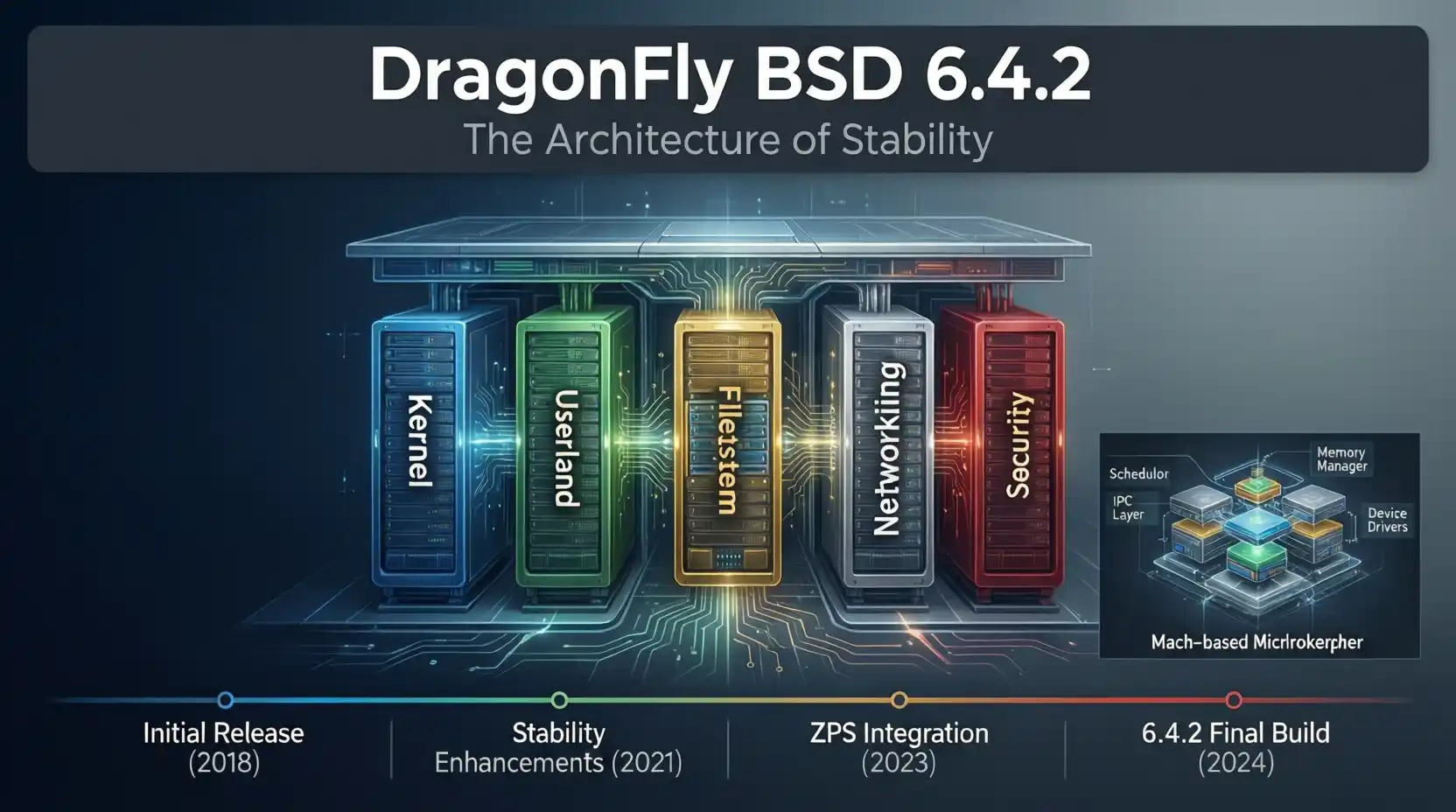
The Architecture of Stability: A Comprehensive Exploration of DragonFly BSD 6.4.2
Abstract
DragonFly BSD 6.4.2 represents a pivotal point in the evolution of this unique Unix-like operating system. As a descendant of the FreeBSD 4.8 lineage, DragonFly has carved a distinct path through the operating system landscape, prioritizing single-system image clustering, advanced virtualization, and the revolutionary HAMMER2 file system. This analysis provides an extensive expansion of the DragonFly 6.4.2 release, exploring its architectural foundations, the specific technical nuances of the 6.4.2 update, the underlying philosophy of its kernel design, and practical applications in modern computing environments.

Chapter 1: The DragonFly Philosophy and Historical Context
To understand the significance of DragonFly BSD 6.4.2, one must first appreciate the unconventional history that birthed it. In the early 2000s, the FreeBSD project underwent a massive architectural shift with the introduction of FreeBSD 5.0, specifically focusing on a new threading model and SMP (Symmetric Multi-Processing) architecture. This shift was controversial within the developer community. Matthew Dillon, a principal FreeBSD developer at the time, foresaw performance bottlenecks and complexity issues in the chosen direction. Consequently, in 2003, he forked the project to create DragonFly BSD.
The philosophy of DragonFly is not merely to be “another BSD,” but to explore alternative solutions to core operating system problems. While Linux and the other BSDs (FreeBSD, OpenBSD, NetBSD) often converge on similar solutions, DragonFly diverges.
1.1 The Single System Image Concept
The ultimate “Moonshot” goal of DragonFly BSD is the Single System Image (SSI). In a traditional cluster, multiple distinct computers work together via network messages. In an SSI, the cluster behaves as a single computer. Resources from one node are accessible on another as if they were local. DragonFly 6.4.2 continues to build the infrastructure for this, particularly through the HAMMER2 file system, which allows for transparent block and inode replication across cluster nodes.
1.2 Evolution through the 6.x Series
The 6.x series marked the stabilization of HAMMER2 as the default file system. While previous versions experimented with the format, 6.0 onward solidified it. Release 6.4.2 is a refinement release. It is not a radical overhaul but a polishing of the architecture introduced in the 6.0 and 6.2 releases, focusing on driver updates, security patches (specifically regarding OpenSSL), and kernel subsystem robustness.
Chapter 2: The Kernel – LWKT and the Scheduling Algorithm
DragonFly BSD 6.4.2 retains the unique Light Weight Kernel Threads (LWKT) scheduling model. This is the “secret sauce” that differentiates DragonFly from Linux and other BSDs.
2.1 LWKT vs. Traditional Kernel Threads
In traditional operating systems (like Linux), the kernel often relies heavily on the “giant lock” or complex fine-grained locking to manage concurrent access to kernel resources. While modern Linux uses fine-grained locking efficiently, the logic is deeply embedded in the subsystems.
DragonFly utilizes LWKTs, which are scheduled independently of user processes. This creates a separation between the scheduling of user applications and the scheduling of kernel tasks. In DragonFly 6.4.2, this results in superior performance under specific asynchronous loads, such as heavy interrupt handling or network routing, because kernel threads can migrate between CPUs to balance load without waking up the associated user processes.
2.2 The Message Passing Paradigm
DragonFly’s kernel subsystems communicate via a message passing infrastructure. Rather than manipulating shared data structures directly (which requires locks), one kernel thread sends a message to another. This is conceptually similar to microkernel designs (like Minix or Mach), but DragonFly implements it within a monolithic kernel for performance reasons.
In 6.4.2, the messaging subsystem has been tuned to reduce latency in I/O operations. When a disk interrupt occurs, a message is instantly dispatched to the appropriate filesystem thread. This deterministic latency is crucial for real-time applications and high-frequency trading environments where DragonFly is sometimes utilized.
Chapter 3: Deep Dive into HAMMER2 in Version 6.4.2
The crown jewel of DragonFly BSD is HAMMER2, a file system designed from the ground up for clustering and massive storage capabilities. While HAMMER1 (available in older versions) was impressive for its snapshots and deduplication, HAMMER2 is a complete rewrite designed for modern hardware, including NVMe SSDs.
3.1 HAMMER2 Architecture
HAMMER2 is a copy-on-write (CoW) file system. Every write operation modifies data in a new location rather than overwriting the old data. This provides inherent safety: a power failure during a write does not corrupt the file system; it simply leaves an unwritten transaction that the system ignores upon reboot.
However, HAMMER2 in DragonFly 6.4.2 goes further. It supports directory compression (LZ4 and ZSTD), allowing users to transparently compress directories to save space. It utilizes a 64-bit address space, meaning that in theory, it can handle exabytes of data without blinking.
3.2 PFS (Pseudo-File Systems) and Snapshots
One of the most powerful features in 6.4.2 is the implementation of PFSs. A HAMMER2 volume can contain multiple independent PFSs. These behave like partitions but are managed logically within the file system.
- Snapshots: Creating a snapshot in 6.4.2 is virtually instantaneous and costs nearly zero space initially (since it shares data blocks with the live filesystem until they are changed).
- Cluster Resilience: PFSs can be mirrored across different physical drives or even different network nodes.
3.3 Improvements in 6.4.2
Specific to the 6.4.2 update, the HAMMER2 code saw significant stabilization.
- Quota Management: Improvements were made to how the file system handles user and group quotas, fixing potential race conditions where space usage might be miscalculated during heavy file deletion.
- Memory Management: The buffer cache (Bcache) interaction with HAMMER2 was tuned. In previous versions, massive metadata operations (like find /) could cause unnecessary cache thrashing. 6.4.2 optimizes the retention of metadata in RAM, speeding up filesystem traversal.
Chapter 4: Specific Updates in the 6.4.2 Release
While the 6.4 series is mature, the 6.4.2 point release focuses on security, hardware support, and bug fixes. It is the culmination of several months of commits to the master branch, backported for stability.
4.1 OpenSSL and Security
Security in an OS is paramount. DragonFly 6.4.2 includes updated versions of OpenSSL to address vulnerabilities discovered in the cryptographic ecosystem. By integrating these patches, the system ensures that secure connections (HTTPS, SSH) remain resistant to known side-channel attacks and decryption exploits. The base system’s reliance on LibreSSL or OpenSSL is a constant balancing act; DragonFly generally maintains a tight integration with the base utilities, ensuring that sshd and other critical daemons are built against the latest secure libraries.
4.2 Graphics and DRM (Direct Rendering Manager)
One of the challenges for BSD systems is supporting modern graphics cards. DragonFly 6.4.2 incorporates an updated DRM/KMS stack from the Linux kernel (via a synchronization layer). This allows DragonFly to support newer Intel and AMD graphics chipsets.
- Intel Graphics: The i915 driver updates in 6.4.2 improve support for Kaby Lake and Coffee Lake architectures, providing better hardware acceleration for the desktop environments (like Mate or XFCE) often run on DragonFly.
- AMDGPU: Continued refinements to the amdgpu driver allow users with modern Radeon cards to utilize hardware acceleration without resorting to the older, slower radeon drivers.
4.3 Network Stack Enhancements
DragonFly BSD is historically famous for its network stack, particularly for its implementation of pf (Packet Filter) and ipfw. In 6.4.2, improvements were made to the ipfilter and network buffer handling (mbufs).
- WiFi Stack: The iwm and iwn (Intel Wireless) drivers received firmware updates. This is crucial for laptop users, as WiFi support is often a pain point in BSD operating systems. These updates fix connection drops and improve throughput on 5GHz bands.
4.4 Userland Utilities
The userland refers to the programs and libraries that users interact with directly (shells, text editors, compilers). 6.4.2 updates the compiler base (GCC) and the standard C library. This ensures that software compiled on DragonFly 6.4.2 benefits from the latest optimization flags and C standards compliance (C11, C17 support).
Chapter 5: Package Management – pkgsrc and DPorts
DragonFly BSD has a unique relationship with package management. It utilizes two primary systems, though DPorts is the default for binary packages.
5.1 DPorts (DragonFly Ports)
DPorts is a fork of the FreeBSD Ports system. It uses the same build infrastructure—Makefiles that download source code, patch it, and compile it locally. However, it is adapted for DragonFly’s specific system calls and library versions. In the context of 6.4.2, DPorts ensures that thousands of applications (from web servers like Nginx to desktop apps like Firefox) are available. The 6.4.2 release ensures that the base system libraries (like libc) remain compatible with the latest software available in DPorts.
5.2 pkgsrc
Originally from NetBSD, pkgsrc is a cross-platform package manager. DragonFly maintains support for pkgsrc as a fallback or alternative. Many developers prefer pkgsrc for its rigorous dependency management and clean separation of build-time versus run-time dependencies.
- Binary Packages: DragonFly offers binary packages for both DPorts and pkgsrc, though DPorts is the primary focus for the official “release engineering” builds. This allows users of 6.4.2 to install software quickly without compiling from source, which can take hours on slower hardware.
Chapter 6: Installation and Practical Usage of 6.4.2
For the system administrator or the curious hobbyist, installing DragonFly 6.4.2 is a straightforward process, though it differs significantly from Linux distributions.
6.1 The Installer
The installer is text-based (ncurses). It requires a fundamental understanding of disk partitions. Unlike Ubuntu, which automates everything, DragonFly asks the user to create a “Hammer2” volume. The user must decide how much space to allocate for PFSs (like ROOT, HOME, VAR).
- Encryption: 6.4.2 supports full-disk encryption (FDE) via GBDE or GELI. During installation, users can choose to encrypt their HAMMER2 volumes, ensuring data privacy if the hardware is stolen.
6.2 System Configuration
Once installed, configuration happens primarily through /etc/rc.conf. This file controls which services start at boot, network interfaces, and firewall settings.
- Booting: DragonFly uses a simplified boot process. The bootloader config (/boot/loader.conf) allows tuning kernel parameters (e.g., setting hw.physmem to limit memory usage for testing).
6.3 Daily Maintenance
DragonFly includes several periodic maintenance scripts (similar to cron jobs) located in /etc/periodic.
- HAMMER2 Maintenance: Unlike traditional file systems that require fsck after a crash, HAMMER2 does not need a traditional check. However, it does require “pruning” and “reblocking.” These operations clean up old snapshots and defragment the data. In 6.4.2, the periodic scripts automatically handle basic reclamation, though administrators may wish to tune hammer2 cleanup scripts manually for aggressive snapshot retention policies.
Chapter 7: Performance Benchmarking and Analysis
How does DragonFly 6.4.2 stack up against the competition?
7.1 Context Switching and Forking
Due to the LWKT system and the optimized vm_map code, DragonFly has historically performed exceptionally well in benchmarks involving massive context switching or forking processes (e.g., creating thousands of processes in a shell script loop). 6.4.2 continues this trend, often outperforming Linux 5.x kernels in synthetic benchmarks like “buildworld” (compiling the operating system source code).
7.2 NVMe Performance
With the optimizations in the CAM (Common Access Method) layer and block I/O subsystem in the 6.4 series, NVMe drive performance has reached parity with other major BSDs. The removal of bottlenecks in the BIO (Block I/O) translation layer allows modern SSDs to saturate the PCIe bus. 6.4.2 includes specific fixes for certain NVMe controllers that caused hangs under high queue depth, ensuring stability for database workloads.
7.3 Network Throughput
Thanks to the netisr (network interrupt service routine) processing, DragonFly can handle high packet-per-second rates efficiently. It is often used in routing applications. 6.4.2 refines the threading of network packets, ensuring that a single heavy flow does not starve other connections.
Chapter 8: The Development Model and Community
The development of DragonFly BSD is highly centralized compared to the sprawling Linux kernel. Matthew Dillon acts as the Benevolent Dictator for Life (BDFL), reviewing nearly all code commits.
8.1 The “Cold” Approach
The DragonFly community is small, tight-knit, and technically focused. Discussions on the mailing lists are deep and technical. There is less corporate sponsorship than Linux; most development is driven by personal interest and the desire to solve complex engineering problems. Release 6.4.2 is a testament to this community’s dedication. It represents thousands of hours of unpaid labor to polish a system that prioritizes correctness over trends.
8.2 Contribution
Contributing to DragonFly is different from contributing to Linux. There is no “maintainer hierarchy” in the same way. A contributor submits a diff to the mailing list, and if Matthew or a trusted deputy approves it, it goes in. This streamlined process allows for rapid iteration, as seen in the fast transition of HAMMER2 features from experimental to stable in the 6.x series.
Chapter 9: Use Cases for DragonFly BSD 6.4.2
Who should use this operating system?
9.1 Storage Appliances
Thanks to HAMMER2, DragonFly is an excellent candidate for a NAS (Network Attached Storage) solution. The built-in snapshotting, deduplication (in HAMMER1, available in limited capacity or legacy modes in HAMMER2 context), and replication capabilities rival ZFS (OpenZFS) but with a simpler command structure and distinct performance characteristics.
9.2 Embedded Systems and Appliances
Because the base system is cohesive and the build system (buildworld) allows for easy cross-compilation, DragonFly is used in various embedded appliances. The licensing (BSD license) allows vendors to use the code without releasing their modifications, which is attractive for proprietary hardware.
9.3 Software Development
For C developers, DragonFly offers a pristine Unix environment. The toolchain is mature, and the system supports a wide range of POSIX standards. The make infrastructure in the base system is powerful and consistent, making the entire OS feel like a unified product rather than a collection of disparate packages.
Chapter 10: Future Roadmap
Looking past 6.4.2, what lies ahead?
10.1 The Transition to 64-bit Time_t
A major challenge facing all Unix-like operating systems is the “Year 2038” problem, where 32-bit time variables will overflow. DragonFly is actively working on a 64-bit time_t implementation. This is a massive undertaking that touches almost every line of code in the kernel and userland. While 6.4.2 is not yet fully 64-bit time_t compliant (it still uses 32-bit time for much of the ABI to maintain compatibility), it lays the groundwork for future updates.
10.2 Userland VFS
A long-term goal is to allow file system operations to be handled in user-space, increasing security. If a file system driver crashes, it wouldn’t take down the kernel. The work on the VFS layer in the 6.x series inches closer to this goal.
10.3 HAMMER2 Deduplication
Deduplication (removing duplicate data blocks to save space) is a flagship feature of HAMMER1 but is currently re-architected in HAMMER2. Future updates beyond 6.4.2 aim to reintroduce a more efficient form of deduplication that does not cripple performance with heavy RAM requirements, a common complaint with ZFS deduplication.
Conclusion
DragonFly BSD 6.4.2 is a masterpiece of independent engineering. It is not merely a clone of FreeBSD or a Linux alternative; it is a distinct operating system with a unique vision of what a modern Unix should look like. Through its LWKT kernel, the revolutionary HAMMER2 file system, and a no-nonsense approach to system design, it offers stability and performance that is often overlooked in the broader tech community.
For the system administrator willing to learn a new paradigm, or the developer interested in operating system internals, 6.4.2 provides a robust, secure, and intellectually stimulating platform. It stands as proof that the “big” projects do not have a monopoly on innovation. In the world of DragonFly, the code is clean, the architecture is sound, and the dragon is still flying.
Disclaimer
General Information Use: The information provided in this article regarding DragonFly BSD 6.4.2 is for educational and informational purposes only. While every effort has been made to ensure the accuracy of the technical details, version specifications, and historical context presented, software and operating systems are subject to constant change. The author and publishers make no representations or warranties of any kind, express or implied, about the completeness, accuracy, reliability, suitability, or availability with respect to the article or the information contained in the article.
Technical Advice: Any technical advice, configuration examples, or code snippets provided herein are based on general best practices at the time of writing. Readers should be aware that applying configurations or modifications to an operating system, including but not limited to kernel parameters, file system setups, and firewall rules, carries inherent risks. It is the responsibility of the reader to test these configurations in a non-production environment before deploying them to critical systems.
Warranty and Liability: In no event will the author, the platform hosting this content, or any affiliated parties be liable for any loss or damage including without limitation, indirect or consequential loss or damage, or any loss or damage whatsoever arising from loss of data or profits arising out of, or in connection with, the use of this document.
Software Endorsement: This document references DragonFly BSD, a specific open-source software product. Reference to this software does not imply an endorsement of the product by the author or platform, nor does it imply a guarantee of fitness for any particular purpose. Users should evaluate the software’s suitability for their specific needs.
Security: While DragonFly BSD 6.4.2 includes security patches, no operating system is completely immune to security vulnerabilities. Users are responsible for maintaining their own security posture, applying patches promptly, and following security best practices.
Trademarks: All trademarks, service marks, and company names mentioned are the property of their respective owners. DragonFly BSD is a trademark of Matthew Dillon and the DragonFly Project.
Keywords
Primary Keywords: DragonFly BSD 6.4.2, DragonFly BSD, BSD Operating System, Open Source OS, HAMMER2 Filesystem, LWKT, Light Weight Kernel Threads, UNIX, System Administration, 6.4.2 Release Notes.
Secondary Keywords: Clustering, Single System Image, Virtual Memory, File System Architecture, Copy-on-Write, Data Deduplication, BSD License, Kernel Development, Matthew Dillon, FreeBSD Fork, Operating System Security, Network Stack, pkgsrc, DPorts, SSL/TLS, NVMe Support, Open Source Software, Kernel Tuning, Snapshot Technology, Data Integrity, ZFS Alternative, Command Line Interface, System Performance, Source Code Compilation.
Have any thoughts?
Share your reaction or leave a quick response — we’d love to hear what you think!
-
 0
-
 0
-
 0
-
 0
-
 0
-
 0
