
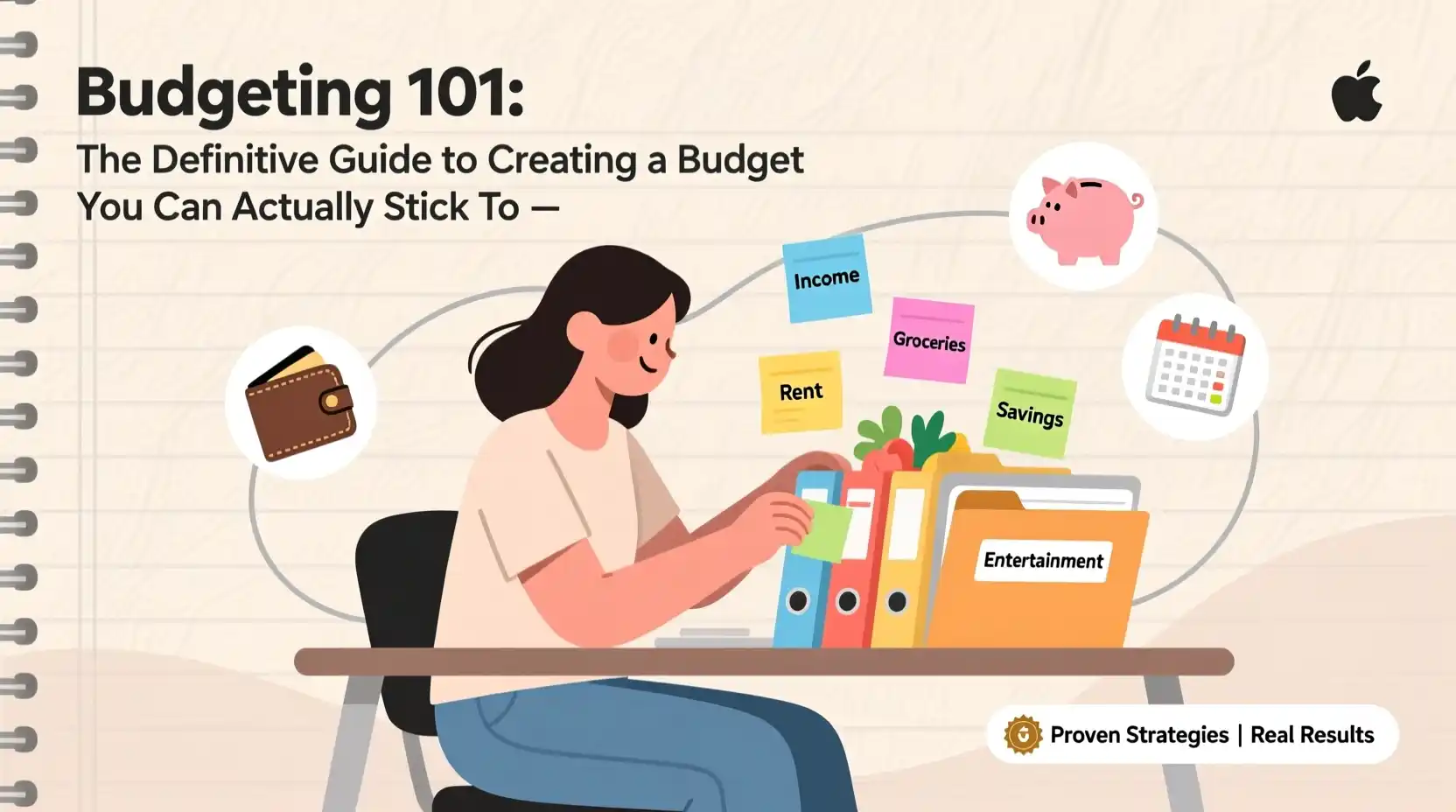
Introduction: More Than Just Numbers—Your Blueprint for Financial Freedom
Budgeting 101: How to Create a Budget You Can Actually Stick To
Does the word “budget” make you cringe?
If so, you’re not alone. For many, the word conjures images of restriction, spreadsheets, and saying “no” to everything fun. It feels like a financial diet, destined to be started on a Monday and abandoned by Friday, leaving a trail of guilt and frustration in its wake.
But what if we’ve been thinking about it all wrong?
What if a budget wasn’t about restriction, but about empowerment? What if it wasn’t a cage, but a key? A key that unlocks the door to financial freedom, reduced stress, and the ability to spend on the things you genuinely value, guilt-free.
This isn’t just another article telling you to “spend less than you earn.” This is a comprehensive, 9,000-word guide designed to take you from a place of financial anxiety to a place of confident control. We will dismantle the psychological barriers, walk you through the practical steps, and equip you with the strategies to build a budget that doesn’t just work on paper, but works in the messy, unpredictable reality of your life.
Forget perfection. We’re aiming for progress. This is your journey to creating a budget you can actually, and happily, stick to.
Part 1: The Foundation – Why Budgeting is Your Financial Superpower
Before we dive into the “how,” we must first master the “why.” A weak “why” is the number one reason budgets fail. If you’re only budgeting because you think you should, you’ll abandon it the first time it feels inconvenient. We need to build a powerful, emotional foundation.
1.1 Redefining the “B” Word: It’s a Spending Plan, Not a Financial Prison
Let’s start by throwing out the old definition. A budget is not a set of rules designed to punish you. It is a proactive spending plan.
Think of it this way: every dollar you earn is an employee. Without a plan, those employees show up to work on Friday and just wander out the door, never to be seen again. Some go to rent, some to coffee, some to a subscription you forgot you had. There’s no direction, no purpose.
A budget is you, the CEO, giving every single one of your employee-dollars a specific job. This dollar’s job is to keep a roof over your head. This dollar’s job is to fund your dream vacation to Italy. This dollar’s job is to build your emergency fund so a flat tire doesn’t ruin your month.
This shift in mindset—from passive spending to active assigning—is transformative. You are no longer a victim of your financial circumstances; you are the architect of them. A budget is not about limiting your freedom; it’s about directing your resources to maximize your happiness and security. It’s a GPS for your money. You tell it where you want to go (debt-free, homeownership, early retirement), and it helps you map the route to get there.
1.2 The Psychological Payoff: The Invisible Benefits of Being in Control
The tangible benefits of budgeting—paying off debt, saving for a down payment—are obvious. But the invisible, psychological benefits are just as, if not more, profound.
- Drastic Reduction in Stress and Anxiety: Money is one of the leading causes of stress. That low-grade, constant hum of worry—”Can I cover this bill?” “Where did all my money go?” “Am I going to be okay?”—is exhausting. A budget acts as a powerful antidote. When you know exactly where your money is and where it’s going, that anxiety is replaced by clarity and confidence. You’ve faced the monster, and you’ve created a plan to manage it. This isn’t just a feeling; it’s physiological. Financial stress triggers the release of cortisol, the stress hormone. Reducing that stress has a real, positive impact on your mental and physical health.
- Improved Relationships: Money fights are a leading cause of divorce and strife in relationships. These arguments are rarely about the money itself. They’re about mismatched values, hidden fears, and a lack of communication. A budget facilitates communication. It forces you and your partner to sit down, talk about your goals, and align on a shared vision for your future. It moves the conversation from “You spent too much!” to “Okay, we overspent on dining out this month. How can we adjust next month to get back on track with our house fund?” It becomes you and your partner versus the budget, not you versus your partner.
- A Sense of Accomplishment and Agency: There is a deep, empowering satisfaction that comes from setting a financial goal and hitting it. Whether it’s paying off a $1,000 credit card balance or saving your first $500 for an emergency fund, these small wins build momentum and self-efficacy. You start to see yourself as someone who is capable and in control. This feeling of agency spills over into other areas of your life. You begin to believe you can tackle other challenges because you’ve proven to yourself you can master your finances.
1.3 The Tangible Payoff: What Becomes Possible
With the psychological foundation laid, let’s talk about the exciting, life-changing things a budget makes possible. This is where you connect the “how” to your deepest desires.
- Breaking Free from the Chains of Debt: Debt is more than just a number; it’s a weight on your future. It’s a claim on your future income. A budget is the most powerful tool for destroying it. By intentionally allocating extra money toward your debt (the “debt snowball” or “debt avalanche” methods we’ll discuss later), you create a clear and accelerated path to becoming debt-free. Imagine life with no car payments, no student loan bills, no credit card balances. What could you do with that money?
- Turning “Someday” into “Today”: We all have dreams. “Someday I’ll travel the world.” “Someday I’ll buy a house.” “Someday I’ll start my own business.” A budget is the machine that turns “someday” into a concrete plan with a timeline. It allows you to see exactly how much you need to save each month to make that dream a reality. It makes the impossible feel possible.
- Building a Fortress of Financial Security: Life is unpredictable. Job loss, medical emergencies, unexpected car repairs—these are not questions of if, but when. An emergency fund is your personal financial insurance policy. A budget prioritizes the building of this fund (typically 3-6 months of essential living expenses), creating a buffer between you and life’s curveballs. This security is the ultimate form of freedom, allowing you to make decisions from a place of strength, not desperation.
- Designing Your Future, Including Retirement: Retirement can feel a lifetime away, especially when you’re young. But the most powerful tool you have is time. A budget helps you harness it by ensuring you’re consistently contributing to retirement accounts like a 401(k) or an IRA. By starting now, even with small amounts, you allow compound interest to work its magic, turning modest contributions into a substantial nest egg over time. You are literally paying your future self.
Part 2: The Mindset Shift – Overcoming Budgeting’s Biggest Hurdles
Knowing why you should budget is half the battle. The other half is conquering the mental and emotional baggage that comes with it. This is arguably the most critical section of this entire guide. If you skip this, your budget will be built on a shaky foundation.
2.1 Confronting Financial Fear and Shame
Money is a taboo topic. We’re taught it’s impolite to talk about. This silence breeds fear and shame. We fear judgment—what will people think if they knew how much debt we have or how little we have saved? We feel shame that we’re not “further along” than our peers.
This shame is paralyzing. It makes us want to hide from our finances, avoid looking at our bank accounts, and pretend the problem doesn’t exist. But you cannot fix a problem you refuse to look at.
How to Overcome It:
- Acknowledge and Normalize: First, understand that your feelings are valid and you are not alone. Millions of people feel the exact same way. The person in the checkout line ahead of you, your coworker, your neighbor—many are quietly struggling. This isn’t a personal failing; it’s a societal issue.
- Practice Radical Self-Compassion: Talk to yourself like you would talk to a dear friend who came to you with this problem. You wouldn’t call them stupid or lazy. You’d say, “This is tough, but you can handle it. Let’s figure it out together.” Offer yourself that same grace. Your past financial decisions do not define your worth or your future.
- Find a Safe Person to Confide In: The shame thrives in secrecy. Telling one trusted person—a partner, a best friend, a family member—can lift an enormous weight. Hearing them say, “Me too,” or “I’m here for you,” can be incredibly validating.
- Focus on the Action, Not the Feeling: You don’t have to feel confident to start. You just have to take the first step. The feeling of confidence will come after you’ve taken action. The act of creating a plan is, in itself, an act of courage that begins to dissolve the fear.
2.2 The Scarcity vs. Abundance Mindset
Many people approach budgeting from a mindset of scarcity. They see it as a process of cutting back, of having less. “I can’t afford that.” “I have to sacrifice.”
This is a recipe for misery.
Instead, we need to adopt an abundance mindset. An abundance mindset isn’t about pretending you have unlimited money. It’s about recognizing that you have enough to create the life you want, you just need to be intentional about it.
A budget, done right, actually creates abundance. How? By ensuring your money is being spent on things that truly matter to you. When you stop mindlessly spending on things that don’t add value (the daily coffee you don’t even enjoy, the subscriptions you don’t use), you free up resources to pour into things that bring you immense joy and security (a travel fund, a debt-free life, a hobby you love).
You’re not losing money; you’re reallocating it from low-value uses to high-value uses. You’re moving from a state of passive financial drift to active, purposeful living. That is the very definition of abundance.
2.3 The “All or Nothing” Trap of Perfectionism
Perfectionism is the enemy of progress, especially in budgeting. People often think they need the perfect app, the perfect spreadsheet, and the perfect categories from day one. They follow their budget flawlessly for two weeks, then they have an unexpected expense or a “bad” week where they overspend, and they feel like a complete failure.
They think, “Well, I blew it. Might as well throw the whole thing out.”
This is the “all or nothing” trap, and it’s a budget killer.
How to Escape It:
- Embrace “Good Enough”: Your first budget will not be perfect. It won’t. Your third budget probably won’t be either. A budget is a living document. It’s an educated guess that you will constantly refine. Done is better than perfect.
- Plan for Imperfection: The most successful budgeters build imperfection into their plan. They have a “fun money” category. They have a “miscellaneous” or “buffer” category for the things they can’t predict. This acknowledges that life happens and removes the guilt when it does.
- Focus on the Trend, Not the Single Data Point: One bad week doesn’t ruin your financial life any more than one unhealthy meal ruins your diet. What matters is the overall trend over months and years. Did you overspend this week? Okay. Acknowledge it, learn from it (e.g., “I get tempted to eat out when I’m tired and don’t have a plan for dinner”), and get back on track tomorrow. The goal is consistency, not flawlessness.
Part 3: The Reconnaissance Mission – Know Where Your Money is Going
You cannot create a realistic map without knowing your starting point. This phase is about data collection. It can feel tedious, but it is absolutely essential. Think of yourself as a detective, gathering clues about your own spending habits. The goal here is not to judge, but simply to observe.
3.1 The 30-Day Tracking Challenge
Your mission, should you choose to accept it, is to track every single dollar you spend for the next 30 days. This is non-negotiable. You need a complete, unedited picture of your current financial reality.
Why 30 days? A month gives you a full cycle of expenses, including those that pop up weekly, bi-weekly, and monthly. It smooths out the anomalies and gives you a reliable average.
3.2 Choosing Your Tracking Method
Pick the method that is easiest and most frictionless for you. The best method is the one you’ll actually do consistently.
- Method 1: The Notebook/Receipt Method (Old School):
- How it works: Carry a small notebook and pen with you everywhere. Or, keep all your receipts in a specific envelope or jar. At the end of each day, write down every single expense and what it was for.
- Pros: Extremely simple. No technology required. The physical act of writing can make the spending feel more “real.”
- Cons: Easy to forget. Can be cumbersome. Requires manual entry at the end of the day.
- Best for: People who want to disconnect from tech, or who find that the tactile nature of this method makes them more mindful.
- Method 2: The Spreadsheet Method (The Organizer):
- How it works: Create a simple spreadsheet (Google Sheets or Excel). Have columns for: Date, Item/Store, Category, and Amount. At the end of each day, or as you spend, log your transactions.
- Pros: Highly customizable. You can add notes. It forces you to categorize as you go, which is great practice. Free.
- Cons: Requires discipline to keep it updated. Not as automated as other methods.
- Best for: People who are comfortable with spreadsheets and like having full control over their data.
- Method 3: The App Method (The Automator):
- How it works: Use a spending-tracking app like Mint, Rocket Money, or YNAB (You Need A Budget). These apps connect to your bank accounts and credit cards, automatically importing and categorizing your transactions.
- Pros: Mostly automatic. Minimal effort required after setup. Provides great visual reports and charts.
- Cons: You have to be comfortable linking your financial accounts. The auto-categorization isn’t always perfect and requires regular review. Some apps have fees or are ad-supported.
- Best for: Tech-savvy individuals who want a low-effort, high-tech solution.
3.3 Gathering Your Intelligence: What to Look For
As you track, you’re not just logging numbers. You’re gathering intelligence. Be a curious observer of your own habits. Ask yourself questions:
- What are my triggers? Do I spend more when I’m stressed, bored, sad, or celebrating?
- What are my “money leaks”? Where is money dribbling out without me noticing? (e.g., that $4.99 app subscription, the daily vending machine snack).
- What are my fixed vs. variable expenses?
- Fixed Expenses: These are the costs that are the same every month. Rent/mortgage, car payment, insurance premiums, loan payments. These are predictable.
- Variable Expenses: These costs fluctuate. Groceries, gas, utilities, dining out, entertainment, clothing. This is where you usually have the most room to adjust.
- What spending aligns with my values, and what doesn’t? Look at your bank statement. Does it reflect the person you want to be? If you say you value health but are spending $200 a month on fast food, there’s a disconnect. If you say you value travel but have no money going toward a travel fund, there’s a disconnect.
At the end of the 30 days, you will have a powerful, data-driven snapshot of your financial life. It might be surprising. It might be uncomfortable. But it is the truth. And now, you can use that truth to build a better future.
Part 4: Choosing Your Weapon – A Deep Dive into Budgeting Methods
Now that you know your starting point, it’s time to choose a budgeting framework. There is no one-size-fits-all “best” method. The best method is the one that fits your personality, your financial situation, and your level of desired involvement.
Let’s explore the most popular and effective methods in detail.
Method 1: The 50/30/20 Rule (The Gateway Budget)
- What it is: A simple, high-level framework for allocating your after-tax (net) income.
- How it works: You divide your income into three main categories:
- 50% for Needs: These are your essential expenses—the things you must pay to survive. Housing (rent/mortgage), utilities, groceries, transportation, insurance, minimum debt payments.
- 30% for Wants: These are the non-essential expenses that improve your quality of life. Dining out, entertainment, hobbies, shopping, travel.
- 20% for Savings & Debt Repayment: This is for your financial future. Emergency fund, retirement contributions, extra debt payments (above the minimum), saving for a down payment.
- Best for who? Absolute beginners, people who are overwhelmed by detailed budgeting, or those with relatively stable and simple finances. It’s an excellent starting point to get a quick handle on your cash flow.
- Pros:
- Incredibly simple and easy to understand.
- Flexible: It doesn’t micromanage your spending within categories.
- Ensures you prioritize savings and debt repayment.
- Cons:
- Can be too simplistic for complex situations.
- The “Needs” category can be a gray area. Is a gym membership a “need” for mental health or a “want”? Is an expensive car payment a “need”?
- May not work in high cost-of-living areas where “needs” alone can eat up 70-80% of income.
Method 2: The Zero-Based Budget (ZBB) (The Gold Standard)
- What it is: The most detailed and intentional budgeting method. The core principle is that your Income minus Expenses equals Zero.
- How it works: Every single dollar of your income is assigned a specific job. If you bring home $4,000 a month, you will create a list of expenses (savings, debt, rent, food, fun money, etc.) that adds up to exactly $4,000. Nothing is left unassigned.
- Best for who? People who want maximum control over their money, those with irregular income, or anyone serious about aggressively paying off debt or saving for a big goal. This is the method used by many of the most successful personal finance experts.
- Pros:
- Ultimate control and intentionality. You know exactly where every dollar is going.
- Highly effective for reaching financial goals quickly.
- Forces you to confront and prioritize your spending.
- Cons:
- Requires the most time and effort. You need to track meticulously and “budget” every single month.
- Can feel restrictive for beginners.
- Can be challenging with an irregular income, though not impossible (more on that later).
Method 3: The Envelope System (The Tactile Teacher)
- What it is: A cash-based, visual, and physical budgeting method.
- How it works: You create categories for your variable spending (e.g., Groceries, Gas, Dining Out, Clothing). At the beginning of the month, you withdraw cash for these categories and put the allotted amount into labeled envelopes. When you want to buy something in that category, you take the cash from the envelope. When the envelope is empty, you’re done spending in that category for the month.
- Best for who? Highly visual or tactile learners, chronic overspenders who need a hard stop, and people trying to break their reliance on credit cards.
- Pros:
- Extremely effective at curbing overspending. The physical act of handing over cash makes spending more real.
- Impossible to go over budget in a category. Once the cash is gone, it’s gone.
- Simple to understand and implement.
- Cons:
- Inconvenient and potentially unsafe to carry large amounts of cash.
- Difficult to manage for online purchases or automatic bill payments.
- Doesn’t work well for fixed expenses like rent or utilities.
Modern Digital Version: You can replicate this digitally using checking accounts. Some people have multiple checking accounts—a “Bills Account,” a “Spending Account,” and a “Savings Account”—and transfer money between them as if they were envelopes.
Method 4: The “Pay Yourself First” Budget (The Reverse Budget)
- What it is: A savings-focused budget that flips the traditional formula.
- How it works: Instead of budgeting what’s left after you spend, you decide on your savings goal first. The moment you get paid, you automatically transfer a set amount (e.g., 20% of your income) to your savings, investment, and debt-repayment accounts. Then, you are free to spend the rest of your money however you see fit, without tracking every penny.
- Best for who? People who hate detailed tracking but are disciplined enough to not overspend the “leftover” money. It’s great for natural savers or those whose top priority is building wealth.
- Pros:
- Prioritizes savings above all else, ensuring you always make progress.
- Simple and requires minimal day-to-day tracking.
- Provides great freedom and flexibility with your remaining spending.
- Cons:
- Requires a high degree of discipline to not overspend and end up short on bills.
- Doesn’t provide detailed insight into where your money is going, so it can be hard to find areas to cut back if needed.
Method 5: The Values-Based Budget (The Holistic Approach)
- What it is: A budget that is built around your core life values, rather than arbitrary percentages.
- How it works: First, you identify your top 3-5 core values (e.g., Security, Adventure, Creativity, Family, Health). Then, you look at your spending from your 30-day tracking mission and align it with those values. You ruthlessly cut spending on things that don’t align and generously fund the things that do. For example, if “Adventure” is a top value, you might cut back on expensive cable to fund a robust travel category.
- Best for who? People who feel that traditional budgets are too rigid and want a more meaningful, motivating approach to their finances.
- Pros:
- Highly motivating and sustainable because your spending directly reflects what’s most important to you.
- Reduces feelings of deprivation because you’re not cutting “fun,” you’re cutting “misaligned spending.”
- Creates a deep sense of purpose in your financial life.
- Cons:
- Requires deep self-reflection to identify your true values.
- Less structured, which can be challenging for people who need clear rules.
Part 5: The Step-by-Step Blueprint – Building Your First Budget
It’s time to put theory into practice. We will walk through creating a Zero-Based Budget, as it is the most comprehensive method. Even if you choose a simpler method like 50/30/20, understanding this process will give you invaluable insight.
Let’s use a fictional persona, Alex, to make this concrete.
Alex’s Profile:
- Monthly Net Income: $4,000
- Financial Goals: Pay off $5,000 in credit card debt, build a $1,000 starter emergency fund.
Step 1: Calculate Your Monthly Net Income
This is your total take-home pay after taxes, health insurance, and any other pre-tax deductions are taken out of your paycheck. If you have a side hustle, include that income too (it’s often better to be conservative and use your average monthly income).
- Alex’s Net Income: $4,000
Step 2: List and Categorize Your Fixed Expenses
These are your non-negotiable, predictable monthly costs. Use the data you gathered in Part 3.
- Alex’s Fixed Expenses:
- Rent: $1,200
- Car Payment: $350
- Car Insurance: $120
- Phone Bill: $60
- Internet: $50
- Minimum Credit Card Payment: $75
- Student Loan Payment: $150
- Total Fixed Expenses: $2,005
Step 3: List and Categorize Your Variable Expenses
These are the costs that fluctuate. Look at your 30-day tracking data to find a realistic average. Be honest with yourself.
- Alex’s Variable Expenses (based on tracking):
- Groceries: $400
- Gas/Transportation: $150
- Utilities (Electric/Gas): $100
- Dining Out/Takeout: $250
- Entertainment (movies, concerts): $100
- Shopping (clothes, etc.): $75
- Personal Care (haircuts, toiletries): $50
- Total Variable Expenses: $1,125
Step 4: Assign Every Single Dollar a Job (The Zero-Based Principle)
Now, let’s bring it all together.
- Total Income: $4,000
- Total Expenses (Fixed + Variable): $2,005 + $1,125 = $3,130
Alex has $4,000 – $3,130 = $870 left over. This is the most important part of the budget! This is the money that will actually change his financial life. Before budgeting, this $870 likely just… disappeared. Now, we give it a job based on Alex’s goals.
- Assigning the Leftover:
- Goal 1: Emergency Fund. Alex wants to build a $1,000 starter fund. He decides to aggressively attack this first. He assigns $500 to “Emergency Fund.”
- Goal 2: Credit Card Debt. The minimum payment is $75, but Alex wants to be debt-free. He assigns the remaining $370 as an extra payment toward his credit card (Total payment will be $75 + $370 = $445).
- Wait, there’s still $0 left! $500 + $370 = $870. Perfect. But hold on… this budget is too tight. There’s no room for fun, no buffer for surprises. This is a recipe for failure.
Step 5: Build in a “Buffer” and “Fun Money” Category (The Critical Step for Success)
A budget with no breathing room will break. We must adjust. Let’s go back to the drawing board and be more realistic.
- Alex realizes his “Dining Out” budget of $250 is probably where he overspends. He also has no “fun money” for things like a coffee with a coworker or an impulse buy that doesn’t fit into other categories. He also needs a “Miscellaneous” buffer for things like a birthday gift or a co-pay.
- Alex’s Revised Variable Expenses:
- Groceries: $400
- Gas/Transportation: $150
- Utilities (Electric/Gas): $100
- Dining Out/Takeout: $200 (reduced by $50)
- Entertainment: $100
- Shopping: $50 (reduced by $25)
- Personal Care: $50
- Fun Money (Personal Spending): $75 (NEW – this is guilt-free money for each partner if in a relationship, or just for Alex)
- Miscellaneous Buffer: $50 (NEW – for the unexpected)
- New Total Variable Expenses: $1,175
- Let’s Re-calculate:
- Total Income: $4,000
- Total Fixed Expenses: $2,005
- New Total Variable Expenses: $1,175
- Total Expenses So Far: $3,180
- Money Left to Assign: $4,000 – $3,180 = $820
- Re-assigning the Leftover:
- Emergency Fund: $450 (still a great amount!)
- Extra Credit Card Payment: $370 (still a huge increase from the minimum!)
- Total Assigned: $450 + $370 = $820.
Income ($4,000) – Expenses ($4,000) = $0.
Success! Alex now has a realistic, empowering budget. He’s still making massive progress on his goals, but he’s also given himself permission to live and has a buffer for life’s little surprises. This is a budget he can stick to.
Step 6: Review, Reflect, and Repeat
Your budget is not a “set it and forget it” tool. It’s a living document.
- Before the month begins: Look at the calendar. Do you have a friend’s wedding? A car registration due? A birthday? Plan for those one-off expenses before the month starts.
- During the month: Check in weekly. How are you tracking in your variable categories? If you see you’ve overspent on dining out halfway through the month, you know you need to cut back for the rest of the month. This prevents a surprise deficit at the end.
- At the end of the month: Do a formal review. How did it go? What worked? What didn’t? Did you have enough in your grocery budget? Was your gas estimate accurate? Use these insights to make next month’s budget even more realistic.
Part 6: The Long Game – How to Make Your Budget Stick for Life
Creating the budget is the starting line. Sticking to it is the marathon. Here are the strategies to ensure your budget becomes a sustainable, lifelong habit.
6.1 The Power of Automation: Your Willpower’s Best Friend
Willpower is a finite resource. You will have days when you’re tired, stressed, and simply don’t have the mental energy to make good financial decisions. This is where automation is your superpower. It removes decision-making from the equation.
- Automate Your Savings: Set up an automatic transfer from your checking account to your savings account for the day you get paid. This is the “Pay Yourself First” principle in action. If you never see the money in your checking account, you can’t spend it.
- Automate Your Bill Pay: Set up auto-pay for all your fixed, predictable bills (rent/mortgage, car loan, insurance, phone, internet). This ensures you never miss a payment, protecting your credit score and eliminating late fees.
- Automate Your Investments: If you have a 401(k), this is already done for you. If you have an IRA, set up an automatic contribution every month. This is the single most effective way to build wealth over time.
Automation builds your financial foundation on autopilot, freeing up your mental energy for the more variable parts of your budget.
6.2 The Weekly and Monthly Money Check-in (The “Money Date”)
Don’t let your budget become a source of dread. Reframe it as a “Money Date” with yourself (or your partner). Schedule 15-20 minutes once a week, and a longer 30-45 minutes once a month.
- The Weekly Check-in (15 mins):
- Pull up your budget app or spreadsheet.
- Categorize any uncategorized transactions.
- Glance at your variable spending categories (groceries, dining out). Are you on track?
- That’s it. The goal is a quick pulse-check to course-correct before it’s too late.
- The Monthly Check-in (30-45 mins):
- Review the previous month in full. How did you do against your plan?
- Celebrate your wins! Did you pay extra on a debt? Did you stay under budget in a category? Acknowledge your progress.
- Analyze any “failures” without judgment. Why did you overspend? Was the category unrealistic? Did something unexpected happen? What can you learn from it?
- Look ahead to the next month. Are there any unusual expenses coming up? (Holidays, birthdays, car maintenance). Create next month’s budget based on what you learned.
Making this a non-negotiable appointment is the key to long-term success.
6.3 How to Handle Life’s Curveballs
A budget is not a crystal ball. Life will throw you curveballs. The difference between a person who succeeds and one who gives up is how they handle these moments.
- The Emergency Fund is Non-Negotiable: Before you aggressively invest or pay off low-interest debt, you MUST build an emergency fund. Start with a $1,000 “starter” fund, then work toward 3-6 months of essential living expenses. This fund is your buffer between a minor inconvenience (a flat tire) and a major financial disaster (credit card debt).
- When a Big Expense Hits: Your water heater breaks. It costs $1,200. You don’t have that in your budget. What do you do?
- Breathe. This is what the emergency fund is for.
- Use the emergency fund to pay for it.
- Adjust your budget. For the next few months, your new top priority is to “replenish the emergency fund.” You might temporarily cut back on “fun money” or extra debt payments until the fund is back to its target level.
- When Your Income Drops: You lose your job or your hours are cut.
- Immediately switch to “Survival Mode” budget. Cut all non-essential spending: dining out, entertainment, subscriptions, shopping. Your only categories are Needs (rent, utilities, groceries) and minimum debt payments.
- Assess your emergency fund. How many months can it cover?
- Get proactive. Look for ways to reduce bills (call your internet provider), find side gigs, and file for unemployment if you’re eligible.
A budget is flexible. It’s a tool that should be bent and adapted to your circumstances, not a rigid set of rules that breaks under pressure.
6.4 Involving Your Partner (or Family)
If you share finances with a partner, budgeting must be a team sport. Financial secrecy is a relationship killer.
- Schedule a Calm Meeting: Don’t bring up the budget in the middle of a fight about money. Schedule a specific, calm time to talk.
- Start with Dreams, Not Numbers: Begin the conversation by talking about your shared goals. “Where do we see ourselves in 5 years? Do we want to buy a house? Travel for a year?” This gets you on the same team, working toward a common future.
- Be Open and Honest: Both partners need to lay their financial cards on the table—income, debts, spending habits. This requires vulnerability and trust.
- Create the Budget Together: Use the steps in Part 5, but do it as a team. Compromise is key. One partner might value dining out more, while the other values saving more. The budget needs to reflect both values.
- Consider “His, Hers, and Ours” Accounts: A popular and effective system is to have a joint account for all shared bills and goals, and separate personal accounts for individual “fun money.” This gives each partner autonomy and freedom within the shared plan.
Part 7: Leveling Up – Beyond Basic Budgeting
Once you’ve mastered the art of budgeting and have a stable system in place, you can start to think about leveling up your financial game.
Crushing Debt
Your budget has given you extra money to throw at your debt. Now, which one do you tackle first?
- The Debt Snowball: List your debts from smallest balance to largest, regardless of interest rate. Pay minimums on all but the smallest, and throw every extra dollar at that smallest debt. When it’s gone, roll its payment into the next smallest. This method provides quick wins and powerful psychological momentum.
- The Debt Avalanche: List your debts from highest interest rate to lowest. Pay minimums on all but the highest-interest debt, and attack it with all your extra money. This method is mathematically superior and will save you the most money in interest over time.
Choose the method that will keep you motivated. Both work!
Supercharging Your Savings
Once your high-interest debt is gone and your emergency fund is full, you can start saving for other goals. Create separate, named savings accounts for each goal: “New Car Fund,” “Disney Trip 2025,” “House Down Payment.” This psychological trick makes saving more tangible and exciting.
Introduction to Investing
Budgeting is the foundation, but investing is how you build true wealth. Once you’re consistently saving, you need to make that money work for you. This is a huge topic, but the first steps are simple:
- Contribute to your 401(k) up to the company match. This is free money. Don’t leave it on the table.
- Open a Roth IRA. This is an incredible retirement savings vehicle with tax-free growth.
- Invest in low-cost index funds. You don’t need to be a stock-picking genius. For most people, consistently investing in a broad market index fund (like one that tracks the S&P 500) is the simplest and most effective long-term strategy.
Conclusion: Your Journey to Financial Freedom Starts Today
We have covered a staggering amount of ground. We’ve redefined what a budget is, dismantled the psychological barriers, gathered the data, explored different methods, built a budget from scratch, and created a strategy for long-term success.
If you’re feeling overwhelmed, take a deep breath. You don’t have to do all of this today.
Your only task for today is to start. Your first step is not to create a perfect budget. Your first step is to track your spending for one week. Just one. That’s it.
Budgeting is not a destination you arrive at. It is a practice, a skill you cultivate over time. It’s like learning an instrument or getting in shape. The first few weeks are awkward and challenging. You’ll hit wrong notes. You’ll want to quit. But if you stick with it, something incredible happens. It becomes easier. It becomes second nature.
You will move from a place of financial anxiety to a place of quiet confidence. You will look at your bank account not with fear, but with a sense of control and possibility. You will be the architect of your own life, intentionally using your resources to build a future that you are wildly excited about.
That future is waiting for you. Your journey starts now.
Have any thoughts?
Share your reaction or leave a quick response — we’d love to hear what you think!
-
 0
-
 0
-
 0
-
 0
-
 0
-
 0
