
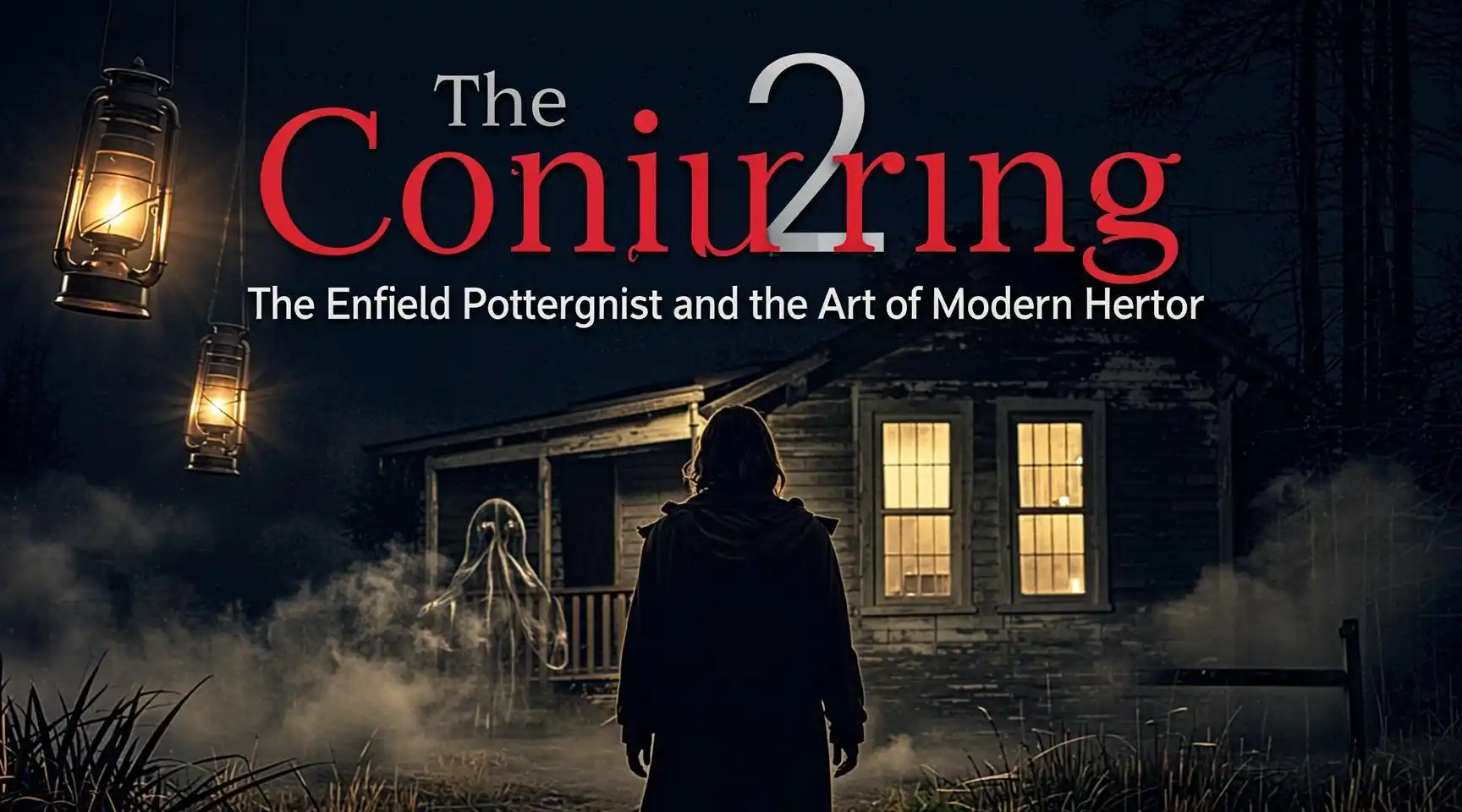
The Conjuring 2: The Enfield Poltergeist and the Art of Modern Horror
Introduction: Return to the Haunted
In 2013, director James Wan successfully revitalized the haunted house subgenre with The Conjuring, a film that relied less on jump scares and gore and more on atmosphere, practical effects, and the emotional anchor of real-life demonologists Ed and Lorraine Warren. It was a critical and commercial juggernaut, proving that there was still a massive appetite for R-rated horror grounded in character. Naturally, a sequel was inevitable. However, the curse of the horror sequel is a potent one; many follow-ups fail to capture the lightning in a bottle that made the original special. They often escalate the scale at the expense of the intimacy that made the terror palpable.
Released in 2016, The Conjuring 2 (subtitled The Enfield Poltergeist) defied these odds. James Wan returned to the director’s chair, bringing with him his signature visual style and a deep understanding of what makes an audience afraid. Moving the setting from the sun-drenched isolation of Rhode Island to the gray, claustrophobic terraced houses of North London, the film expanded the scope of the Warrens’ world while maintaining the franchise’s beating heart: the love between its central couple. This expansion explores not just the mechanics of the film, but the cultural tapestry it weaves, the true crime history it adapts, and the technical wizardry that cemented it as a modern horror masterpiece.
The True Story: The Enfield Poltergeist
To understand the weight of The Conjuring 2, one must understand the source material. The film is based on the “Enfield Poltergeist,” a series of strange occurrences that garnered significant media attention in the late 1970s. Between 1977 and 1979, the Hodgson family, living in a modest council house at 284 Green Street, Enfield, reported inexplicable phenomena.
The family consisted of single mother Peggy Hodgson and her four children: Margaret, Janet, Johnny, and Billy. The haunting ostensibly began when one of the children, Janet, complained that her bed was shaking. From there, the activity escalated. Furniture moved on its own, knocking on the walls echoed through the house, and objects were hurled across rooms. The most terrifying aspect—and the one the film leans into heavily—was the apparent possession of Janet, who would slip into a trance-like state and speak in a guttural, disembodied voice claiming to be “Bill Wilkins,” a man who had died in the house years prior.
The case attracted the attention of the press, paranormal investigators, and skeptics alike. It became a media circus. Among the investigators were Ed and Lorraine Warren, whose involvement forms the spine of the movie. While the real-life case is still debated today—with skeptics arguing that the children, particularly Janet, faked much of the activity—the cultural footprint of the Enfield Poltergeist is undeniable. It represents the archetype of the “suburban haunting,” the idea that safety and domesticity can be shattered by forces from the other side, and it is this pervasive sense of insecurity that Wan taps into for the film.
The Cinematic Landscape: James Wan’s Vision
James Wan is a master of visual language. He does not just point a camera at actors; he manipulates the environment to make the viewer feel trapped. In The Conjuring 2, Wan and cinematographer Don Burgess paint with a palette of damp grays, murky browns, and the flickering orange of firelight. The London setting is crucial here. Unlike the open, sprawling farmland of the first film, Enfield is claustrophobic. The houses are attached, the streets are narrow, and the fog hangs low. The weather is perpetually dreary, raining constantly, creating a sense of entrapment. The Hodgson family cannot just run away into the sunlight; there is no sunlight.
Wan’s camera work is fluid and voyeuristic. He utilizes long, uninterrupted takes that force the audience to scan the frame for danger. In one of the film’s most impressive technical feats, the camera enters the Enfield house through the keyhole of the front door, weaves through the narrow hallway, glides up the stairs, and finally settles on the terrified family in the living room. This technique establishes the house as a living organism, a character in its own right that is inhaling the family and digesting their fear.
Furthermore, Wan employs lighting to create depth and dread. He often lights scenes from the side or from behind, casting characters in silhouette, making them look vulnerable against the encroaching darkness. The use of flashlights is more than a practical necessity; it is a narrative device that limits the visible world, forcing the characters (and the audience) to confront the unknown one inch at a time.
The Narrative Arc: From Amityville to Enfield
The film’s structure is a thing of beauty. It does not jump immediately into the main conflict but builds a slow, suffocating dread. It begins with a prologue set in Amityville, New York, revisiting the famous 1976 haunting of the Lutz family. This sequence serves multiple purposes: it connects the sequel to the broader lore of the Warrens, establishes Lorraine Warren’s psychic vulnerability, and introduces the antagonist, the demonic nun Valak, through a terrifying vision during a séance.
The prologue is brutal and efficient. We see the Warrens investigating the Amityville house, but the focus is entirely on Lorraine’s experience. She witnesses the murders of the DeFeo family (the previous owners) in a chilling, reversed sequence. It is here that she sees the demonic entity—a nun with rotting skin and piercing yellow eyes—who hisses a cryptic message about Ed’s death. This plants the seed of doubt and fear in Lorraine that persists throughout the entire film, raising the emotional stakes. She is not just fighting a ghost; she is fighting the premonition of losing her husband.
Transitioning from the bright, bloody violence of Amityville to the gloom of London, the film introduces the Hodgsons. We see their poverty, their struggle, and their love for one another. This character development is vital. When the horror starts, we care about the people involved. Janet, played with remarkable range by Madison Wolfe, is the focal point. She is an adolescent dealing with the trauma of her parents’ separation, making her a perfect target for a predatory spirit.
The escalation of the haunting is handled with patience. It starts small—a knocking on the walls, a chess piece moving. But as the Warrens arrive—reluctantly, due to Lorraine’s fear—the intensity ramps up. The film balances the investigation aspect with the supernatural occurrences, creating a rhythm of tension and release. The middle act is a tug-of-war between skepticism and belief, embodied by the police, the skeptical investigators, and the Warrens.
The Antagonist: Valak and The Crooked Man
While the Enfield Poltergeist is the “case,” the film needs a singular villain to drive the conflict, and that villain is Valak. In the film’s lore, Valak is a powerful demonic entity taking the form of a nun to mock Lorraine’s faith (and to play on Wan’s own fear of nuns from his childhood). This character design is instantly iconic. The habit, the pale skin, the jagged teeth, and the unholy scream create a figure of pure malevolence.
Valak is not just a jump-scare machine; it is a psychological tormentor. It targets Lorraine specifically, exploiting her fear of Ed’s death. By giving the demon a personal connection to the protagonist, the film raises the stakes above a simple “exorcism by numbers” plot. Valak represents the impending doom that hangs over the Warrens’ marriage and mission.
Additionally, the film introduces another iconic creation: The Crooked Man. Based on a nursery rhyme character (“There was a crooked man, and he walked a crooked mile…”), this character appears as a terrifying top-hatted figure with a snapping jaw. While he serves as a manifestation of the spirit Bill Wilkins (or perhaps a familiar spirit under Valak’s control), he provides a different flavor of horror—one that is reminiscent of a twisted, Victorian nightmare. The juxtaposition of a childhood rhyme with a horrific monster is a classic horror trope executed here with terrifying precision. The design of the Crooked Man is entirely practical, a towering suit performer with animatronics, adding a weight and realism that CGI often lacks.
Technical Mastery: Sound and Practical Effects
The Conjuring 2 is a masterclass in the use of sound. Sound designers and editors know that what you hear is often scarier than what you see. The film utilizes a soundscape of creaking floorboards, distant growls, and the unsettling silence of an empty house. The use of “binaural audio” or 3D sound techniques creates an immersive experience. When the characters hear knocking behind the walls, the audience hears it as if it is right next to their ears.
A pivotal scene involving the “Hail Mary” sequence showcases this perfectly. As the boys in the house play with a homemade ouija board (a Zozo board), the soundtrack drops out, replaced by a low, rhythmic thumping that synchronizes with the visuals. The silence in the house is heavy, and when the knocking starts, it is aggressive and percussive.
The practical effects are the unsung heroes of the film. In an era where horror films are often oversaturated with CGI, James Wan insisted on using in-camera effects as much as possible. The levitation of the chairs, the slamming of doors, and the physical contortions of the actors (particularly Madison Wolfe as Janet) were largely done practically. This grounds the supernatural elements in reality. When Janet is thrown across the room or dragged up the wall by her hair, the physics of the movement feel real because, in many cases, they were real. The production team used rigs and wires, but the interaction between the actors and the environment is tactile.
The makeup effects for Valak and the possessed Janet are grotesque and detailed. The decaying visage of the nun is a triumph of prosthetic design, looking ancient and wrong. The decision to keep these elements practical gives the film a timeless quality; it doesn’t look like a video game cutscene, but a recorded event.
Character Dynamics: The Heart of the Franchise
The secret weapon of The Conjuring universe is the relationship between Ed and Lorraine Warren, portrayed by Patrick Wilson and Vera Farmiga. Their chemistry is the anchor that keeps the movie from drifting into pure exploitation. They are not just ghost hunters; they are a deeply devout, loving couple who approach their work with empathy and scientific curiosity.
In The Conjuring 2, their relationship is strained. Lorraine is traumatized by her vision in Amityville and fears for Ed’s life. She wants to stop. Ed, ever the protector and the believer, feels compelled to help the Hodgson family. This conflict adds a layer of emotional depth rarely seen in horror sequels. They are not just fighting a demon; they are fighting for their future together.
The scene where Ed plays the guitar and sings “Can’t Help Falling in Love” to the Hodgson children is a masterpiece of tone. It is a moment of pure warmth and humanity amidst the chaos. It disarms the audience, relaxing them just before the horror kicks back into high gear. It reminds us why the Warrens are good at what they do—it is not just their knowledge of the occult, but their ability to bring light into dark places.
On the other side of the Atlantic, the Hodgson family feels equally real. Frances O’Connor plays Peggy Hodgson, a mother worn down by life but fiercely protective of her children. She is a skeptic initially, attributing the noises to rats or the kids playing around, but she is forced to confront the impossible when she sees her daughter levitating. Her terror is palpable, but she never stops trying to be a mother.
The “Hail Mary” Scene: A Set Piece for the Ages
No discussion of The Conjuring 2 is complete without analyzing the “Hail Mary” scene, often cited as one of the scariest sequences in modern horror history. It involves the youngest child, Billy, and his older sister Janet in the bedroom.
It starts innocently enough, with the children trying to sleep. But the atmosphere shifts. The lighting changes. The camera lingers on the closet door. A police officer, stationed outside, looks through the door’s keyhole. What follows is a masterclass in pacing and anticipation. We see a silhouette of a figure—an old man—standing in the corner of the room. But he isn’t just standing; he is moving in a disjointed, unnatural way.
The scene escalates into a chaotic frenzy. The wardrobe doors burst open. The lights flicker. The figure rushes toward the door. The sound design reaches a fever pitch—a mix of screeching strings and guttural growls. It culminates in the iconic image of the old man pressing his face against the door, his mouth wide open in a scream that transcends the physical. It is terrifying not just because of the monster, but because of the violation of the safe space. A child’s bedroom should be the safest place on earth; Wan turns it into a trap.
This scene works because it utilizes the “less is more” principle initially, showing only glimpses, before unleashing full-blown chaos. It forces the audience to stare at the dark corners of the frame, searching for the threat, and when the threat arrives, it is overwhelming.
The Climax: Faith and Sacrifice
The third act of The Conjuring 2 takes place during a massive thunderstorm. The house is under siege. Janet is fully possessed, and the local skeptics have fled in terror. It is up to Ed and Lorraine to save her.
The climax is physically and emotionally demanding. Ed attempts to perform an exorcism, but without the sanction of the church, he is unprepared for the physical toll it takes. Lorraine, realizing that her vision of Ed dying was a warning, not a prophecy, steps in to help him. She confronts Valak directly, using her psychic connection to understand the demon’s name and nature.
The revelation that Valak can be defeated by invoking the Holy Name—and by the power of the Warrens’ love—brings the thematic arcs to a close. It is not a magic spell or a ritualistic dagger that saves the day; it is faith. Specifically, Lorraine’s faith in God and in her husband.
The final confrontation involves a struggle at the edge of the wardrobe (a nod to The Lion, the Witch and the Wardrobe, representing a portal to another world). Ed saves Janet from falling into the abyss, nearly dying in the process, just as Lorraine foresaw. However, by knowing the future, they were able to change it. It is a satisfying, emotional conclusion that resolves the character arcs while delivering the necessary horror spectacle.
Cultural Impact and Legacy
The Conjuring 2 was a massive success, grossing over $320 million worldwide against a $40 million budget. Critics praised its performances, direction, and tension. More importantly, it solidified the “Conjuring Universe” as a viable franchise.
The film introduced the world to Valak, the demonic nun. The character was so popular that it spawned a spinoff film, The Nun (2018), which itself became a box office hit. The Crooked Man also received discussions for a potential spinoff, though the Nun took precedence. This ability to create memorable side characters that can sustain their own franchises is a testament to the strength of Wan’s world-building.
Furthermore, the film reignited interest in the Enfield Poltergeist case. Documentaries and books saw a resurgence in popularity, with debate reigniting over whether Janet and Margaret Hodgson had faked the events. The film walks a fine line, portraying the skepticism through the characters of investigators Anita Gregory and Maurice Grosse, but ultimately siding with the supernatural interpretation for the sake of the narrative.
The film also influenced the visual language of horror. The use of the “nun” character has since appeared in various forms in other genre films, and the emphasis on practical effects and lighting inspired a new generation of filmmakers to move away from lazy CGI jump scares.
Thematic Analysis: The Fragility of Reality
Beneath the scares, The Conjuring 2 explores themes of trauma, family, and the fragility of reality. The Hodgson family is already broken by the absence of the father. The haunting is a manifestation of this trauma—the house is reflecting their internal chaos. The spirit of Bill Wilkins is an old man who died alone and angry, mirroring the anger and confusion Janet feels as an adolescent without a father figure.
Lorraine’s struggle is about the loss of certainty. Her psychic gifts usually give her clarity, but the vision of Ed’s death shatters that certainty. She is forced to walk into the darkness blind, relying solely on her love for her husband to guide her. This mirrors the audience’s experience—we are in the dark, terrified of what might happen next, holding onto the hope that the heroes will survive.
The film also touches on the power of belief. The skeptics in the film represent the rigid, materialist worldview that refuses to acknowledge the possibility of the supernatural. While their skepticism is presented as rational, the film ultimately suggests that there are things in this world that science cannot explain. The Warrens represent the bridge between the known and the unknown, the scientific and the spiritual.
Conclusion
The Conjuring 2 stands as a towering achievement in the horror genre. It proves that sequels can be equal to, or in some aspects surpass, their predecessors. James Wan’s direction is assured and inventive, the performances are grounded and emotional, and the technical aspects—from the sound design to the practical effects—are top-tier.
It expands the lore of the Warrens while delivering a self-contained, terrifying story of a family under siege. It respects the intelligence of the audience, using silence and atmosphere as effectively as loud noises and monsters. By weaving the true history of the Enfield Poltergeist with the fictionalized narrative of Valak, the film creates a rich tapestry of horror that lingers in the mind long after the credits roll.
The movie is not just a collection of scares; it is a story about the resilience of the human spirit in the face of overwhelming darkness. Whether viewed as a historical dramatization, a supernatural thriller, or a love story between a husband and wife fighting evil, The Conjuring 2 succeeds on every level. It remains a benchmark for quality horror filmmaking in the 21st century.
Keywords: Enfield Poltergeist, James Wan, Supernatural Horror
Hashtags: #TheConjuring2 #HorrorClassic #EdAndLorraineWarren
Disclaimer: This text is an expansion and analysis of the movie The Conjuring 2 (2016). The film is based on the alleged real-life case of the Enfield Poltergeist, though the filmmakers took creative liberties for dramatic effect. The descriptions of paranormal events, demonic entities, and exorcisms depicted in the film and discussed in this text are based on folklore, religious belief, and the movie’s narrative, and should not be interpreted as verified historical or scientific fact.
Have any thoughts?
Share your reaction or leave a quick response — we’d love to hear what you think!
-
 0
-
 0
-
 0
-
 0
-
 0
-
 0
